
Meiosis - Overview & Meiosis I
Meiosis is the reductional division that occurs in the diploid reproductive cells and forms haploid gametes/spores. Key rules:
- DNA replicates only ONCE (in the S phase before meiosis), but the nucleus divides TWICE - Meiosis I followed by Meiosis II - giving four haploid cells from one diploid cell.
- Meiosis I is reductional (chromosome number is halved); Meiosis II is equational (like mitosis).
Prophase I - the longest and most complex phase
Prophase I has five sub-stages (mnemonic: L-Z-P-D-D):
- Leptotene - chromosomes become gradually visible (condense).
- Zygotene - synapsis begins: homologous chromosomes pair to form bivalents (tetrads); the pairing is held by the synaptonemal complex.
- Pachytene - crossing over occurs - the exchange of segments between non-sister chromatids of homologous chromosomes, mediated by recombination nodules (enzyme = recombinase). Bivalents now clearly appear as tetrads (4 chromatids).
- Diplotene - the synaptonemal complex dissolves; homologues start to separate but remain joined at the sites of crossing over, seen as X-shaped chiasmata.
- Diakinesis - terminalisation of chiasmata; the nucleolus disappears, the nuclear envelope breaks down and the spindle assembles. This marks the end of prophase I.
Metaphase I, Anaphase I & Telophase I
- Metaphase I - the bivalents (pairs of homologous chromosomes) align at the equator; spindle fibres attach to the kinetochores.
- Anaphase I - the homologous chromosomes separate and move to opposite poles, but the sister chromatids remain joined at their centromeres (the centromere does NOT split here). This is the actual reduction step.
- Telophase I - two haploid nuclei form (each chromosome still has two chromatids); a short interkinesis (no DNA replication) may follow before Meiosis II.
Rank-splitters: synapsis = zygotene; crossing over = pachytene; chiasmata visible = diplotene; the centromere does NOT split in anaphase I (homologues separate, chromatids stay together).
Visual - Sub-stages of Prophase I
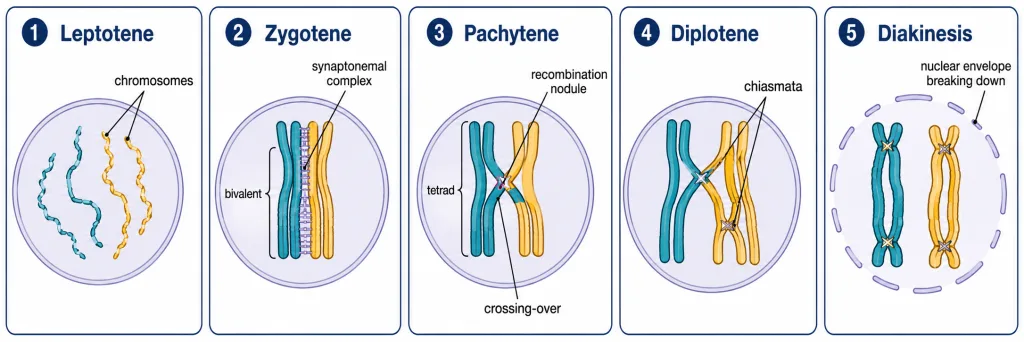
Leptotene (condensing), zygotene (synapsis, synaptonemal complex), pachytene (crossing over, recombination nodules), diplotene (chiasmata) and diakinesis (terminalisation, envelope breaks down).