
Mitosis (M Phase) - the Equational Division
Mitosis occurs in somatic (body) cells; the daughter cells receive the same number of chromosomes as the parent - hence it is called the equational division. The M phase has two events: karyokinesis (division of the nucleus) followed by cytokinesis (division of the cytoplasm). Karyokinesis has four stages:
1. Prophase
- Chromatin condenses into compact chromosomes (each with two sister chromatids joined at the centromere).
- The spindle apparatus begins to form; in animal cells the two centriole pairs move towards opposite poles.
- By the end, the nuclear envelope and the nucleolus disappear and the ER and Golgi break down.
2. Metaphase
- The chromosomes are the most condensed and line up at the equator (metaphase plate).
- Spindle fibres attach to the kinetochores of the centromeres.
3. Anaphase
- The centromeres split, so the two sister chromatids separate and move as daughter chromosomes towards opposite poles (centromere leading, arms trailing).
4. Telophase
- The chromosomes reach the poles and decondense; the nuclear envelope and nucleolus reappear; two daughter nuclei form.
Cytokinesis
- Animal cell - a cleavage furrow constricts the cell from the outside inward.
- Plant cell - a cell plate forms in the middle and grows from the centre outwards (because the rigid wall cannot furrow).
Significance of mitosis
- Produces genetically identical daughter cells; maintains the chromosome number.
- Responsible for growth, repair and cell replacement (e.g. skin, gut lining) and for the healing of wounds. In plants it keeps meristems dividing.
High-yield one-liners: chromosomes most condensed at metaphase; centromeres split at anaphase; nuclear envelope disappears in prophase and reappears in telophase; plant cytokinesis = cell plate (centre → outward); animal = cleavage furrow.
Visual - The Stages of Mitosis
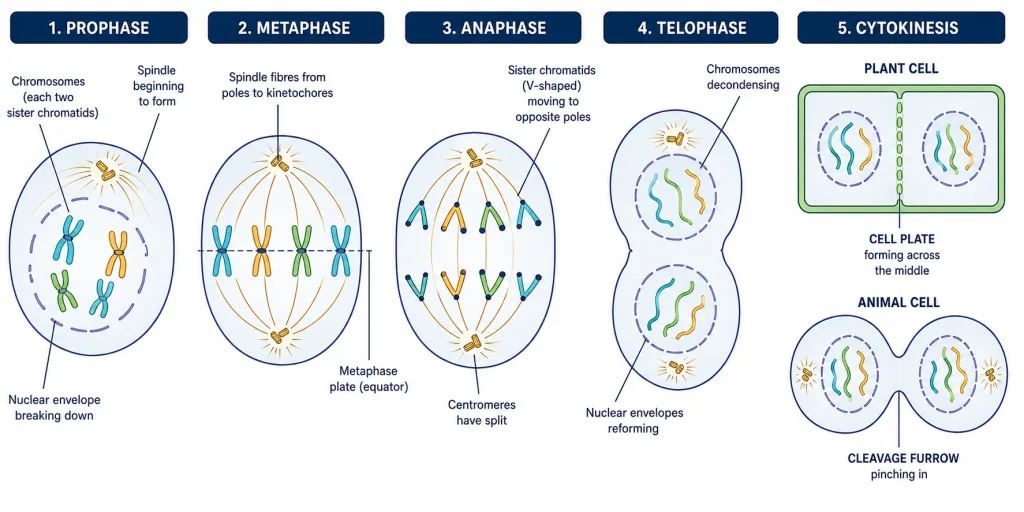
Prophase (condensing chromosomes, forming spindle), metaphase (chromosomes at the equator), anaphase (sister chromatids separate), telophase and cytokinesis (cell plate in plants, cleavage furrow in animals).