
The Cell Theory & Cell Overview
The cell is the basic structural and functional unit of all living organisms (Robert Hooke first saw dead cork cells and coined 'cell'; Leeuwenhoek first saw living cells).
Cell theory
- Schleiden (1838) - all plants are made of cells.
- Schwann (1839) - all animals are made of cells; proposed that the cell is the basic unit and that cells have a thin outer boundary (plasma membrane).
- Together Schleiden & Schwann proposed the cell theory: all living organisms are composed of cells and products of cells.
- Rudolf Virchow (1855) extended it: 'Omnis cellula-e-cellula' - all cells arise from pre-existing cells (cell division).
The cell theory as it stands: (i) all living things are made of cells, and (ii) all cells arise from pre-existing cells.
An overview of the cell
- Cells vary hugely in size, shape and volume. The smallest cells are Mycoplasma / PPLO (~0.3 µm); bacteria are 3-5 µm; the human RBC is ~7 µm; the largest isolated single cell is the egg of an ostrich; the longest cells are nerve cells.
- Shape varies with function - disc-like (RBC), polygonal, columnar, thread-like, or branched (nerve cell).
- Every cell has three features in common: a plasma membrane, a cytoplasm with ribosomes, and genetic material (DNA).
Two fundamental cell types
- Prokaryotic - bacteria, cyanobacteria (blue-green algae), mycoplasma and PPLO. No membrane-bound organelles and no true nucleus.
- Eukaryotic - protists, plants, fungi and animals. Have a true membrane-bound nucleus and membrane-bound organelles.
The Prokaryotic Cell
Found in bacteria, cyanobacteria, mycoplasma and PPLO. Generally smaller and multiply faster than eukaryotic cells. Key features:
- No membrane-bound organelles (no mitochondria, ER, Golgi, plastids, lysosomes, true nucleus).
- Genetic material is a single, circular DNA that is naked (not enclosed by a nuclear membrane) - the region it occupies is the nucleoid. Many bacteria also carry small extra circular DNA called plasmids (confer traits like antibiotic resistance).
- Ribosomes are 70S (a 50S + a 30S subunit); they occur on the membrane and in the cytoplasm and form polysomes on mRNA - the site of protein synthesis.
The cell envelope (three layers)
Most prokaryotes have a chemically complex cell envelope = glycocalyx → cell wall → plasma membrane acting as a single protective unit.
- Glycocalyx - the outermost coat; a loose slime layer or a tough capsule.
- Based on the response to Gram staining (Christian Gram), bacteria are Gram-positive (stain) or Gram-negative (do not retain the stain).
- Cell wall - gives shape and prevents bursting; made of peptidoglycan (murein).
- Plasma membrane - selectively permeable; mesosomes are its infoldings (help in respiration, secretion, cell-wall formation and DNA replication/distribution). In cyanobacteria, membranous extensions called chromatophores contain the photosynthetic pigments.
Appendages & inclusions
- Flagellum - for motility; made of three parts - filament, hook and basal body.
- Pili and fimbriae - small surface outgrowths; pili help in attachment/conjugation, fimbriae help the bacterium attach to surfaces.
- Inclusion bodies - reserve material stored in the cytoplasm freely, not bound by any membrane - e.g. phosphate granules, cyanophycean granules, glycogen granules and gas vacuoles (in blue-green/purple/green bacteria).
High-yield one-liners: prokaryote ribosome = 70S; nucleoid = naked DNA (no nuclear membrane); bacterial cell wall = peptidoglycan; mesosome = infolding of plasma membrane; inclusion bodies are NOT membrane-bound.
Visual - The Prokaryotic (Bacterial) Cell
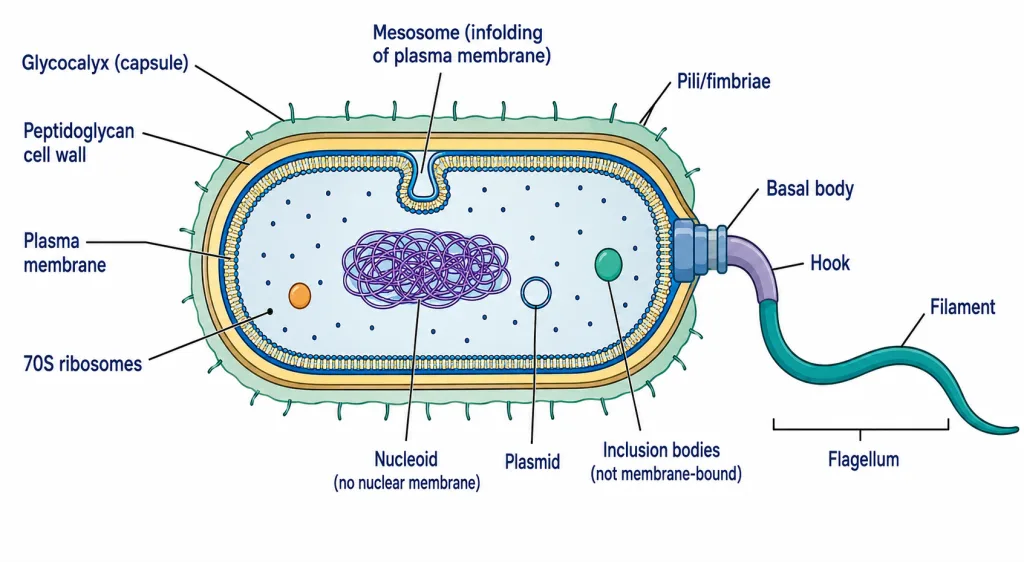
A bacterial cell - cell envelope (glycocalyx, peptidoglycan wall, plasma membrane), nucleoid with naked circular DNA, plasmid, mesosome, 70S ribosomes, inclusion bodies, flagellum (filament-hook-basal body) and pili.