
The Nucleus & Chromosomes
The nucleus (described by Robert Brown, 1831) is the control centre of the eukaryotic cell.
Structure of the nucleus
- Nuclear envelope - a double membrane with a perinuclear space; the outer membrane is often continuous with the RER. It bears nuclear pores through which RNA and proteins move between nucleus and cytoplasm.
- Nucleoplasm - contains the nucleolus and chromatin.
- Nucleolus - a non-membrane-bound region; the site of rRNA synthesis and ribosome assembly; not bounded by any membrane; larger in metabolically active cells.
- Chromatin - a network of DNA + histone proteins seen in the interphase nucleus. Loosely packed, transcriptionally active euchromatin, and densely packed, inactive heterochromatin.
Chromosome structure
- At division, chromatin condenses into chromosomes. Each chromosome has a primary constriction, the centromere, on which lie disc-shaped kinetochores (attach to spindle fibres). On either side is a chromatid.
- Some chromosomes have a secondary constriction and a terminal satellite (a SAT-chromosome).
- Types by centromere position:
- Metacentric - centromere in the middle → two equal arms (V-shaped at anaphase).
- Sub-metacentric - centromere slightly off-centre → one arm shorter (L-shaped).
- Acrocentric - centromere near one end → one very long and one very short arm (J-shaped).
- Telocentric - centromere at the very tip (i-shaped). (Human chromosomes are not telocentric.)
Visual - Chromosome Types by Centromere Position
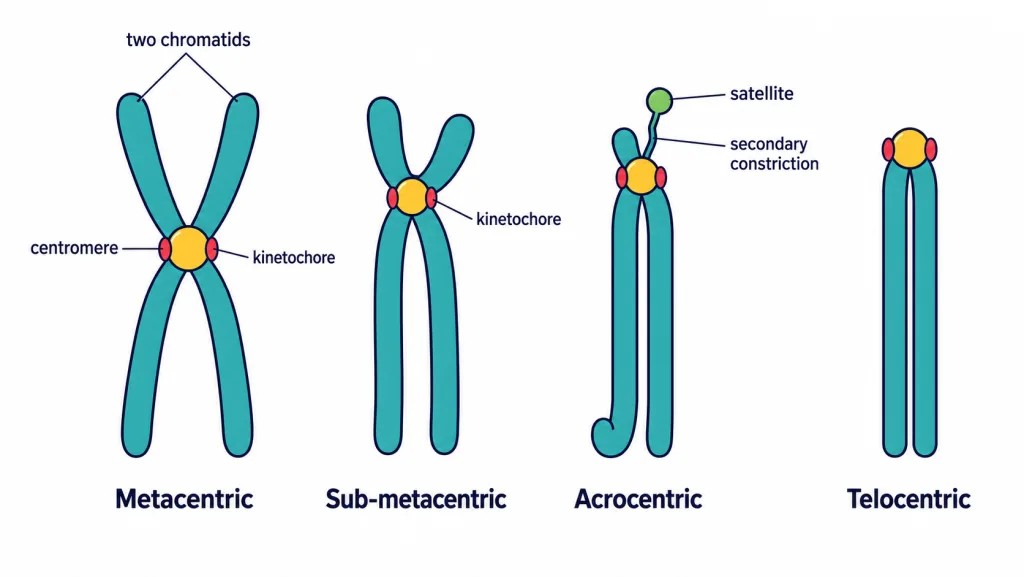
Metacentric (median centromere, equal arms), sub-metacentric (slightly off-centre), acrocentric (near one end) and telocentric (terminal centromere), with the centromere, kinetochore, chromatids and satellite labelled.
Microbodies & the Plant vs Animal Cell
Microbodies
- Microbodies are minute, membrane-bound vesicles containing enzymes, present in both plant and animal cells - e.g. peroxisomes (contain enzymes for the breakdown of fatty acids and photorespiration; produce/destroy H2O2) and glyoxysomes (in fat-storing plant tissues; site of the glyoxylate cycle).
Plant cell vs Animal cell
| Feature | Plant cell | Animal cell |
|---|---|---|
| Cell wall | present (cellulose) | absent |
| Plastids | present (chloroplasts etc.) | absent |
| Central vacuole | large (up to 90% of volume) | small or absent |
| Centrioles / centrosome | usually absent (present in lower plants) | present |
| Lysosomes | rare | usually present |
Visual - Plant Cell vs Animal Cell
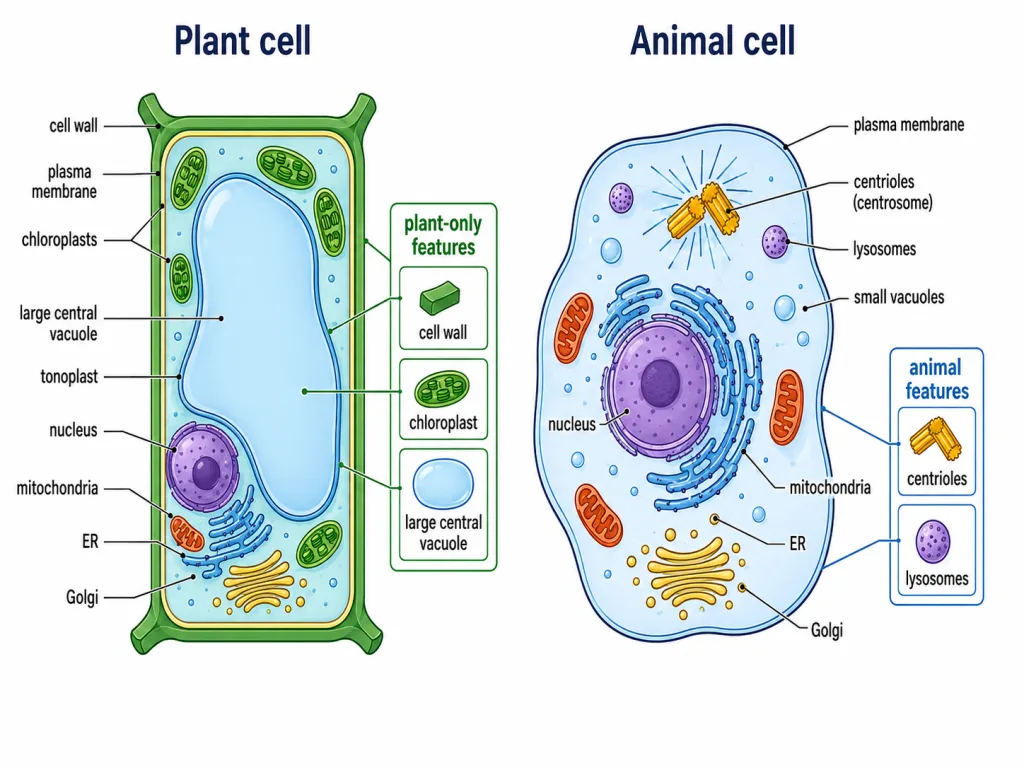
A plant cell (cell wall, chloroplasts, large central vacuole) beside an animal cell (no wall, centrioles, lysosomes, small vacuoles) with the organelles labelled.
Traps: the nucleolus is NOT membrane-bound; the nuclear envelope is a double membrane with pores; a metacentric chromosome has a median centromere; peroxisomes carry out photorespiration and handle H2O2; a plant cell is told apart from an animal cell by the cell wall, plastids and a large central vacuole, while centrioles are typically an animal-cell feature.