
The Cell Membrane & Cell Wall
Plasma (cell) membrane - the fluid-mosaic model
- Chemically it is mainly phospholipids arranged in a bilayer with the polar (hydrophilic) heads facing outward and the non-polar (hydrophobic) tails facing inward, plus proteins and some cholesterol.
- Proteins are integral (buried in / span the bilayer) or peripheral (on the surface).
- Singer and Nicolson (1972) proposed the fluid-mosaic model: the lipid bilayer is quasi-fluid, allowing lateral movement of proteins (measured as fluidity). Fluidity is important for functions like growth, cell division, secretion and endocytosis.
- Transport across the membrane:
- Passive - no energy needed; along the concentration gradient - simple diffusion (non-polar) and osmosis (water).
- Facilitated - polar molecules move through carrier proteins, still passive.
- Active transport - against the gradient, uses ATP energy (e.g. the Na+/K+ pump).
Visual - The Fluid-Mosaic Membrane
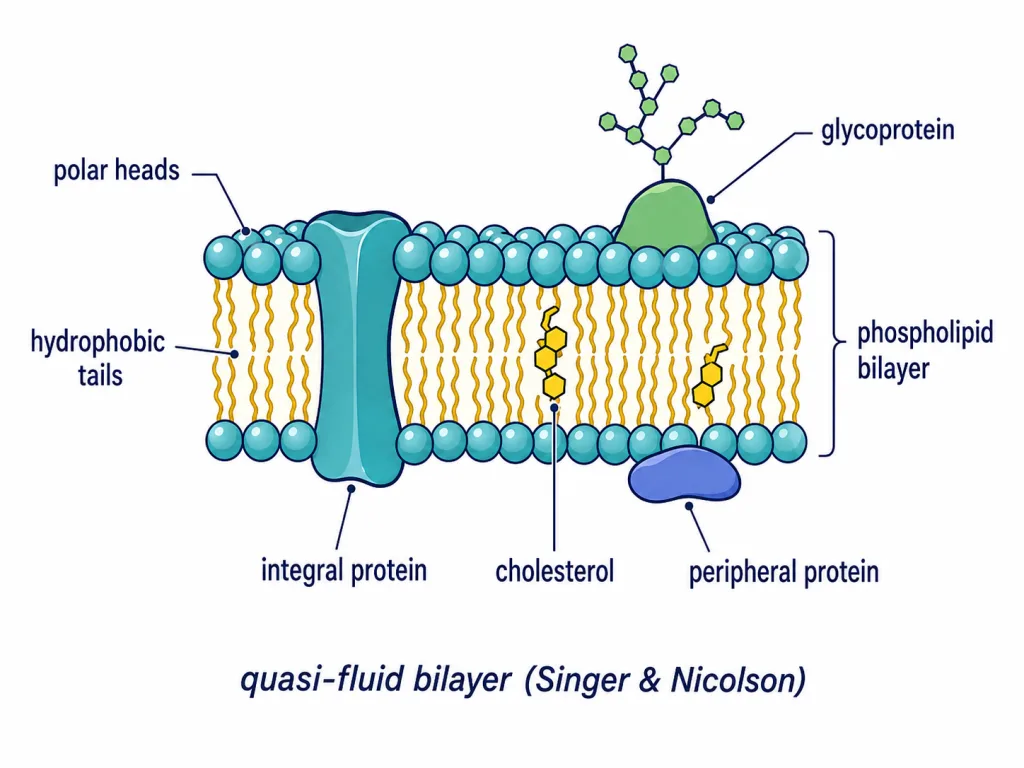
The plasma membrane as a phospholipid bilayer with polar heads outward and hydrophobic tails inward, integral and peripheral proteins and cholesterol embedded in the quasi-fluid bilayer.
Cell wall (plants, fungi)
- A non-living, rigid outer covering. In plants it is made of cellulose, hemicellulose, pectin, proteins and (in older/woody cells) lignin. In fungi it is chitin.
- Middle lamella - the outermost layer, made mainly of calcium pectate, that cements adjacent cells.
- Primary wall (thin, capable of growth) forms first; a secondary wall is laid down towards the inside in mature cells.
- Plasmodesmata - cytoplasmic bridges through the walls that connect the protoplasts of neighbouring cells.
- Functions: gives shape and mechanical support, protects against mechanical/osmotic damage, and allows cell-to-cell interaction.
The Endomembrane System
Some membrane-bound organelles whose functions are coordinated are together called the endomembrane system: the endoplasmic reticulum, Golgi apparatus, lysosomes and vacuoles (mitochondria, chloroplasts and peroxisomes are not included, as their functions are not coordinated with these).
Endoplasmic reticulum (ER)
- A network of membranous tubules continuous with the nuclear membrane.
- Rough ER (RER) - bears ribosomes on its surface; active in protein synthesis and secretion; abundant in cells making proteins.
- Smooth ER (SER) - no ribosomes; the site of lipid and steroid synthesis and, in the liver, glycogen metabolism and detoxification.
Golgi apparatus (dictyosome in plants)
- Stacks of flattened cisternae, with a convex cis (forming) face near the ER and a concave trans (maturing) face.
- Functions: packaging, modification (glycosylation) and secretion of materials; forms lysosomes; the site of the formation of glycoproteins and glycolipids. It is the principal cell organelle for secretion.
Lysosomes
- Membrane-bound vesicles formed by the Golgi, rich in hydrolytic (digestive) enzymes (lipases, proteases, carbohydrases) that work best in an acidic pH.
- Digest carbohydrates, proteins, lipids and nucleic acids; called the 'suicidal bags' of the cell.
Vacuoles
- A membrane-bound space filled with sap; its membrane is the tonoplast.
- In plant cells the central vacuole may occupy up to 90% of the cell volume; it maintains turgor pressure and stores water, ions and waste.
- In many protists, a contractile vacuole performs osmoregulation/excretion, and a food vacuole performs digestion.
Recap: RER → protein synthesis; SER → lipid synthesis; Golgi → packaging & secretion (cis near ER, trans away); lysosome → digestion (suicidal bags); vacuole → storage/turgor (bounded by tonoplast).