
Mitochondria & Plastids - the Semi-Autonomous Organelles
Both have a double membrane, their own circular DNA and 70S ribosomes, and divide on their own - so they are called semi-autonomous organelles (supporting the endosymbiotic origin).
Mitochondria - the 'powerhouse'
- Bounded by two membranes; the outer membrane is smooth, the inner membrane is folded into cristae that increase surface area and bear the F1 (oxysomes) particles (ATP synthase).
- The inner cavity holds the matrix, which contains enzymes, circular DNA and 70S ribosomes.
- Site of aerobic respiration - the citric acid (Krebs) cycle in the matrix and the electron transport chain / oxidative phosphorylation on the cristae → produces ATP; hence the 'powerhouse of the cell'.
Plastids (in plants only)
- Chloroplasts - green, contain chlorophyll; site of photosynthesis. Double membrane; the stroma holds enzymes, circular DNA and 70S ribosomes; stacked membranous thylakoids form grana, connected by stroma lamellae. Thylakoids hold the photosynthetic pigments.
- Chromoplasts - contain fat-soluble carotenoid pigments (yellow/orange/red - e.g. in petals and fruits).
- Leucoplasts - colourless, store food: amyloplasts (starch), elaioplasts (oils/fats) and aleuroplasts (proteins).
Visual - Mitochondrion & Chloroplast
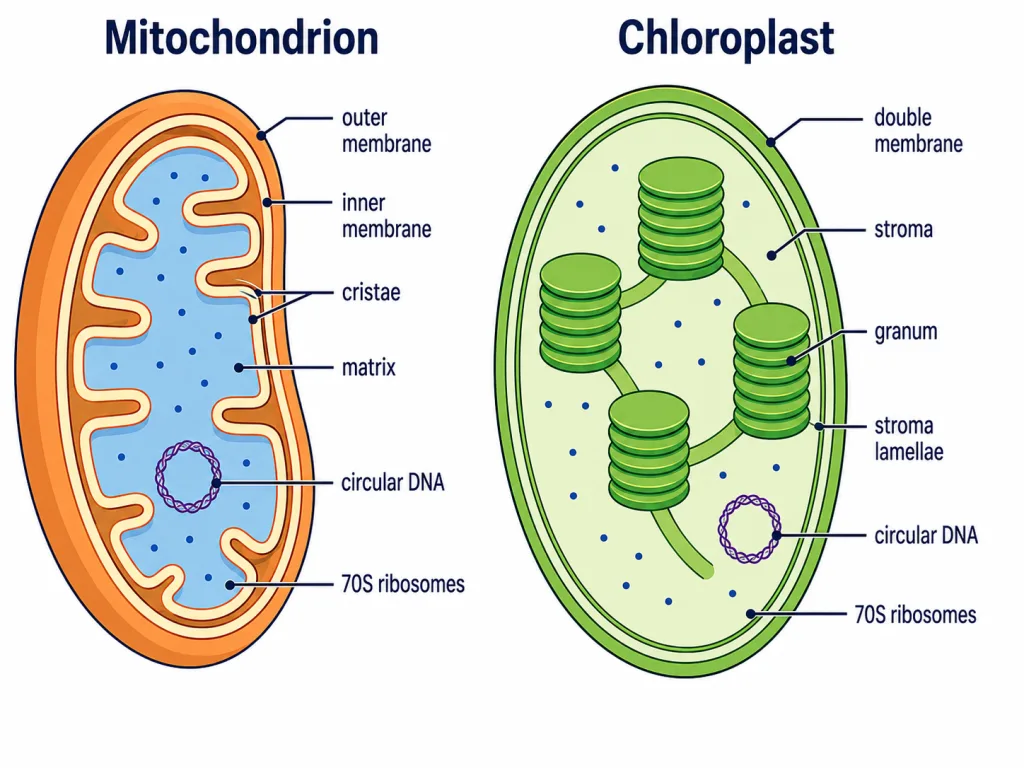
Mitochondrion (outer membrane, inner membrane folded into cristae, matrix with DNA + 70S ribosomes) and chloroplast (grana of thylakoids, stroma lamellae, stroma with DNA + 70S ribosomes).
Ribosomes, Cytoskeleton, Cilia & Flagella, Centrosome
Ribosomes
- Granular structures made of ribosomal RNA (rRNA) and proteins; they have no membrane; the site of protein synthesis.
- Eukaryotic ribosomes = 80S (a 60S + a 40S subunit).
- Prokaryotic ribosomes, and those inside mitochondria and chloroplasts, = 70S (50S + 30S).
- Several ribosomes attached to one mRNA form a polysome (polyribosome).
Cytoskeleton
- A network of proteinaceous filaments in the cytoplasm - microtubules, microfilaments (actin) and intermediate filaments.
- Functions: mechanical support, motility, and maintenance of cell shape.
Cilia & flagella
- Hair-like membrane-covered outgrowths of the cell; cilia are small and numerous (movement of fluids/the cell), flagella are longer and fewer (locomotion).
- Their core, the axoneme, has microtubules in a 9 + 2 array - nine peripheral doublets around a central pair.
- They arise from a basal body, which has a 9 + 0 array (nine peripheral triplets, no central microtubule).
- Note: eukaryotic flagella (microtubule 9+2, covered by membrane) differ structurally from the bacterial flagellum (a protein filament + hook + basal body).
Centrosome & centrioles
- The centrosome (in animal cells) contains two cylindrical centrioles at right angles, surrounded by pericentriolar material.
- A centriole has a cartwheel organisation of nine peripheral microtubule triplets with no central microtubule - i.e. a 9 + 0 pattern.
- Centrioles form the basal bodies of cilia/flagella and the spindle fibres during cell division.
Rank-splitters: 80S = eukaryotic cytoplasmic ribosome; 70S = prokaryote + mitochondrion + chloroplast; cilia/flagella axoneme = 9+2, basal body & centriole = 9+0; ribosomes and nucleolus have no membrane.