
Ecosystem - Structure and Components
An ecosystem is a functional unit of nature in which living organisms interact among themselves and with the surrounding physical environment. The word functional is doing real work in that sentence: an ecosystem is defined by what it does, not by where its edges are drawn.
Ecosystem varies greatly in size, from a small pond to a large forest or a sea. A grassland, a desert and an estuary are ecosystems too, and the entire biosphere is itself a global ecosystem, a composite of all the local ecosystems on Earth. Keep the scale order straight: a biome is a large regional unit that sits well below the biosphere, not above it.
Types. Ecosystems are broadly terrestrial or aquatic. Forest, grassland and desert are the standard terrestrial examples. Pond, lake, wetland, river and estuary are the standard aquatic ones. Alongside these natural ecosystems there are man-made ecosystems, of which the two NCERT names are the crop field and the aquarium. What makes an ecosystem man-made is that people create and maintain it, not the land or water it happens to occupy.
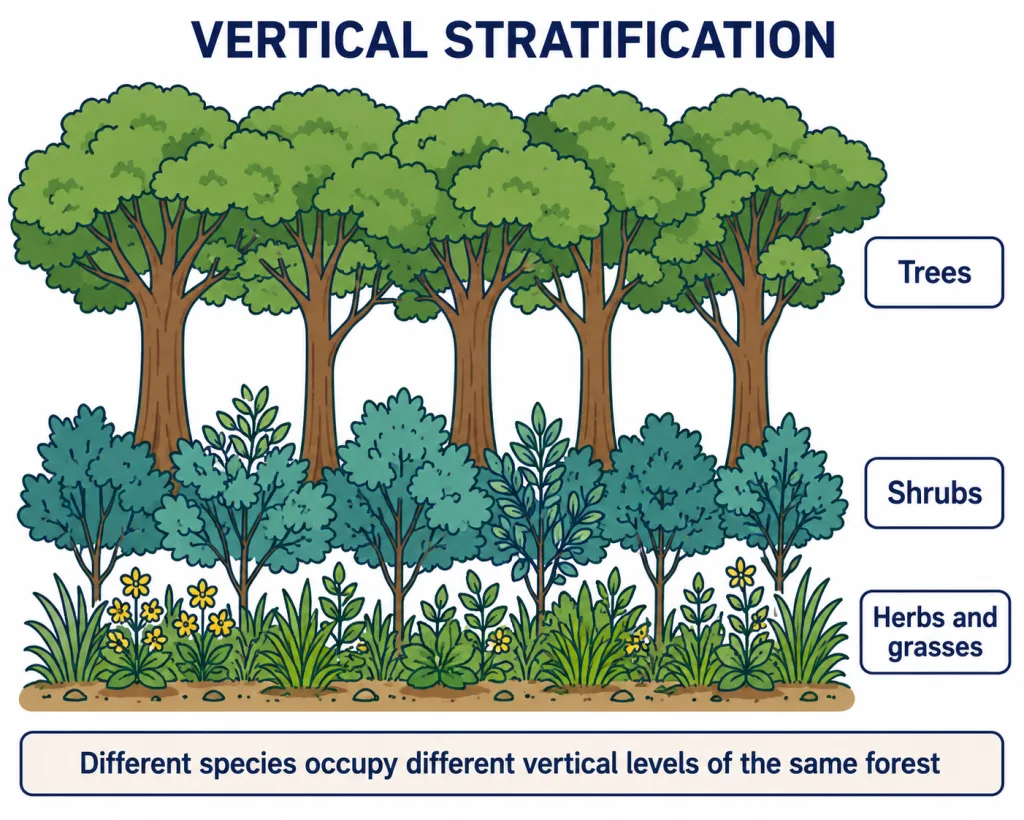
Physical structure. The interaction of biotic and abiotic components produces a physical structure that is characteristic of each type of ecosystem. Structure has two named halves. Identification and enumeration of the plant and animal species of an ecosystem gives its species composition; the vertical distribution of different species occupying different levels is stratification. Composition answers which species are present; stratification answers at what level each one sits. In a forest, trees occupy the top vertical stratum, shrubs the second and herbs and grasses the bottom layer.
The four functional aspects. The components of an ecosystem are seen to function as a unit when these four aspects are considered together: productivity, decomposition, energy flow and nutrient cycling. Every question about how an ecosystem works, rather than what it contains, is a question about one of these four - which is why stratification, a structural feature, is not among them.
The Pond as a Worked Example
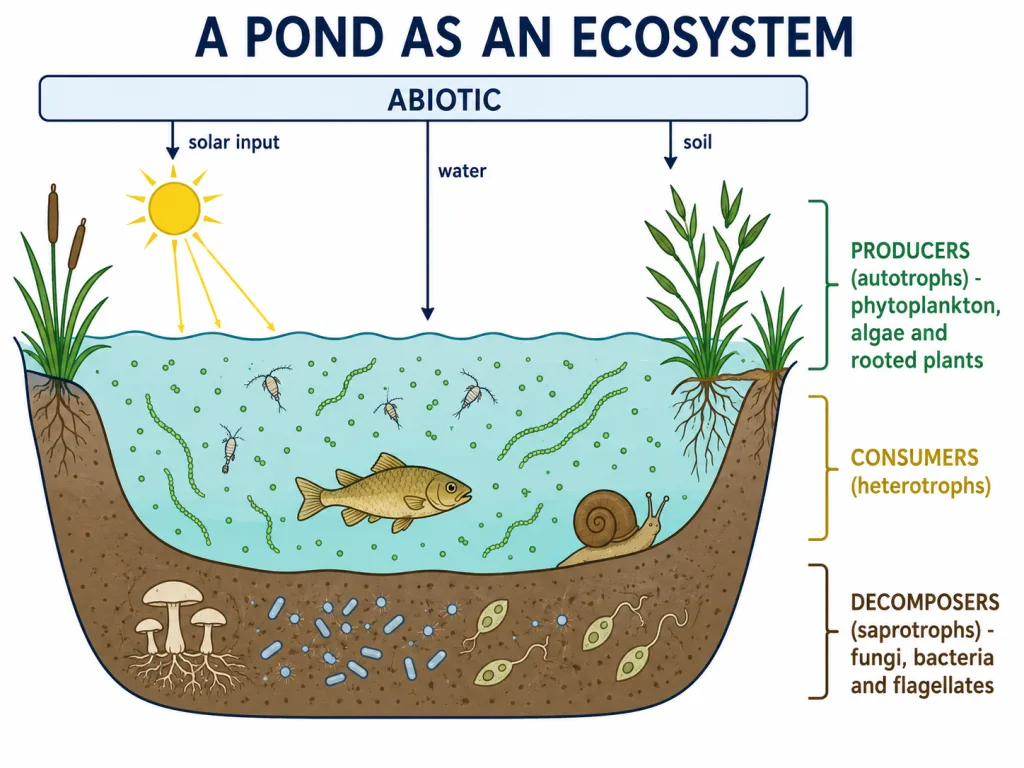
A shallow pond is the standard NCERT illustration because it is small enough to see whole and still shows every interaction a large ecosystem shows. It is a self-sustainable unit.
- Abiotic component. Water together with the soil deposit at the bottom, plus the solar input and the cycle of temperature, day length and other climatic conditions. These regulate the rate of function of the entire pond.
- Autotrophic component. Phytoplankton, some algae, and the floating, submerged and marginal plants found at the edges.
- Consumers. Zooplankton, which are free floating, together with free-swimming and bottom-dwelling forms.
- Decomposers. Fungi, bacteria and flagellates, especially abundant in the bottom of the pond, where dead matter settles.
Note what sorts an organism into its component: mode of nutrition, not where it lives or how it moves. Phytoplankton and zooplankton drift side by side in the same water and still belong to different components.
The pond performs all the functions of any large ecosystem, and there are three of them: conversion of inorganic into organic material with the help of the radiant energy of the sun by the autotrophs; consumption of the autotrophs by the heterotrophs; and decomposition and mineralisation of the dead matter to release it back for reuse by the autotrophs.
Standing Crop and Standing State
At any given moment each trophic level carries a certain mass of living material. This is the standing crop - the mass of living material at a particular trophic level at a particular time. It may be recorded in either of two ways: as the mass of living organisms (biomass), or as the number of organisms in unit area.
The biomass of a species can be expressed in terms of fresh weight or dry weight. Of the two, dry weight is the more accurate measure, because the water content of living tissue varies with the moment of sampling and carries no organic matter of its own.
A closely related term worth keeping separate is the standing state - the amount of inorganic nutrients such as carbon, nitrogen, phosphorus and calcium present in the soil at any given time. The contrast to hold on to: standing crop is biotic and belongs to a trophic level; standing state is abiotic and belongs to the soil. (Standing state sits in the nutrient-cycling section that the rationalised NCERT removed; it is retained here because previous-year papers have asked for it.)