
Productivity
Primary production is the amount of biomass or organic matter produced per unit area over a time period by plants during photosynthesis. It is expressed in terms of weight (g m^-2) or energy (kcal m^-2).
Productivity is the rate of biomass production. Because it is a rate, its unit must carry time: g m^-2 yr^-1 or (kcal m^-2) yr^-1. These units allow the productivity of different ecosystems to be compared with one another. Production and productivity are not interchangeable words, and the presence or absence of a time term in the unit is what separates them.
Primary productivity is divided into two quantities.
- Gross primary productivity (GPP) is the rate of production of organic matter during photosynthesis.
- A considerable amount of GPP is used up by plants in respiration. Writing that loss as R, the balance is GPP - R = NPP.
- Net primary productivity (NPP) is therefore what survives respiration, and it is the available biomass for the consumption of heterotrophs - herbivores and decomposers.
Secondary productivity is defined as the rate of formation of new organic matter by consumers.
Primary productivity depends on the plant species inhabiting a particular area. It also depends on environmental factors, the availability of nutrients, and the photosynthetic capacity of the plants. It therefore varies a great deal between different types of ecosystems.
The annual net primary productivity of the whole biosphere is approximately 170 billion tonnes (dry weight) of organic matter. Of this, the oceans contribute only about 55 billion tonnes, even though they cover roughly 70 per cent of the Earth's surface. The rest is produced on land.
Decomposition
Decomposition is the process by which decomposers break down complex organic matter into inorganic substances such as carbon dioxide, water and nutrients.
The raw material for decomposition is detritus: dead plant remains such as leaves, bark and flowers, together with the dead remains of animals, including faecal matter.
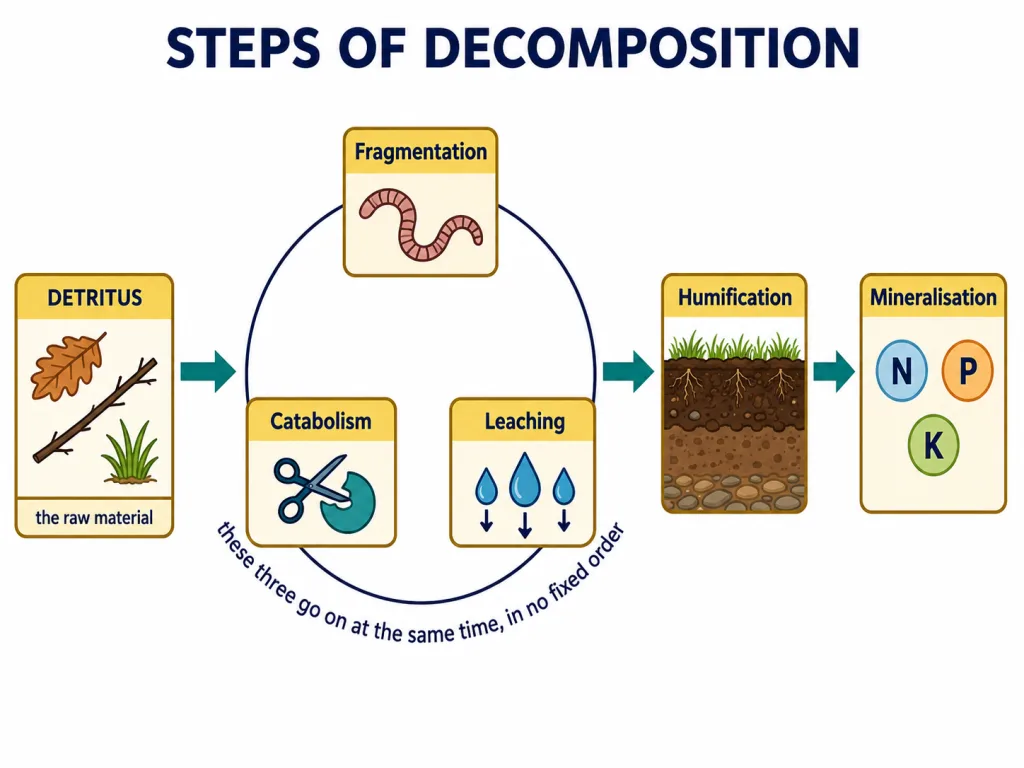
Decomposition proceeds through five named steps.
- Fragmentation. Detritivores, of which the earthworm is the standard example, break down detritus into smaller particles. This is a mechanical size reduction, and it multiplies the surface area available to enzymes.
- Leaching. Water-soluble inorganic nutrients go down into the soil horizon and get precipitated as unavailable salts.
- Catabolism. Bacterial and fungal enzymes degrade detritus into simpler inorganic substances.
- Humification. Detritus is converted into humus, a dark coloured amorphous substance of the upper soil. Microbial enzymes work on humus only with difficulty, so it decomposes at an extremely slow rate, and its colloidal nature lets it hold nutrients in store.
- Mineralisation. The humus is further degraded by some microbes, and the release of inorganic nutrients occurs.
These three are not a queue. Leaching, catabolism and fragmentation operate simultaneously on the same detritus, which is why the five steps are best treated as named processes rather than as a numbered sequence.
What Controls the Rate of Decomposition
Decomposition is largely an oxygen-requiring process. Its rate is controlled by two independent things: the chemical composition of the detritus and the climatic factors of the site.
On chemistry: detritus rich in lignin and chitin decomposes slowly, because these are structurally tough polymers that microbial enzymes attack with difficulty. Detritus rich in nitrogen and water-soluble substances such as sugars decomposes rapidly.
On climate: a warm and moist environment favours decomposition. Low temperature and anaerobiosis inhibit it, and the result of that inhibition is a build-up of organic material on the ground.