
Ecological Pyramids
An ecological pyramid is a graphic representation of the relationship between organisms at successive trophic levels. It is drawn as a stack of horizontal tiers: the base is always the producers (the first trophic level) and the apex is the top consumer in that chain. Each tier is one trophic level.
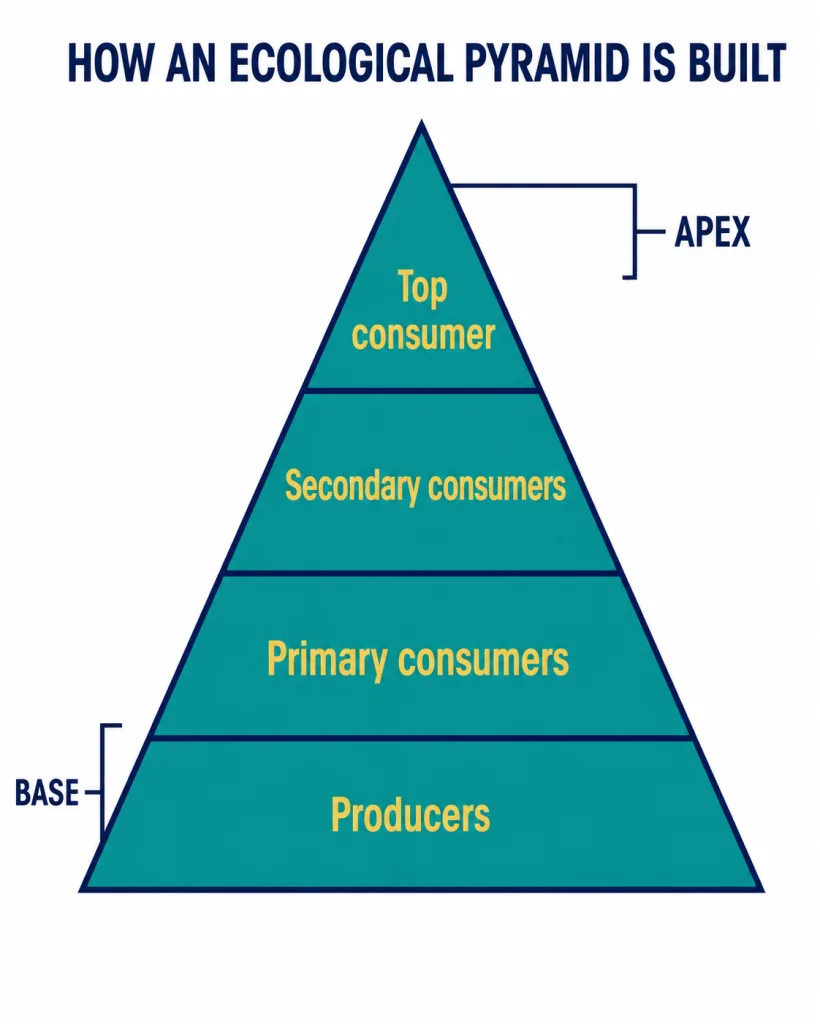
What is plotted. The tiers can be drawn to represent any one of three parameters, and the choice of parameter is what gives the pyramid its name:
Pyramid of number - the number of individuals at each trophic level. Pyramid of biomass - the total dry weight of living material at each trophic level. Pyramid of energy - the amount of energy flowing through each trophic level per unit area per unit time.
The counting rule. Any calculation of biomass, number or energy for a trophic level has to include all the organisms at that level. A pyramid therefore assigns each species to a single level, which is a deliberate simplification of what actually happens in a food web.
Upright and inverted forms. A pyramid is upright when each tier is smaller than the one below it, and inverted when a tier is larger than the tier below.
The pyramid of number is upright in a grassland: grasses are the most numerous, herbivores fewer, and the top carnivores fewest of all. It inverts in a single large tree, where the producer tier is one individual and the tier resting on it is far more numerous.
The pyramid of biomass is upright in most terrestrial ecosystems, where the standing crop of vegetation greatly exceeds the mass of the animals it feeds. It inverts in the sea, where the producer standing crop present at any instant is far smaller than the mass of animals it feeds, because those producers are replaced very rapidly.
The pyramid of energy is always upright. It can never be inverted under any circumstance.
Why energy behaves differently. Number and biomass are standing amounts - what is present at one moment. Whether such a pyramid can invert turns on how fast the level below is renewed. Energy in a pyramid of energy is a flow, an amount per unit area per unit time. Because energy is dissipated as heat at every transfer, less energy can pass through a level than passed through the level below it. A flow pyramid cannot invert.
Limitations. Ecological pyramids carry three stated limitations. First, they do not take into account the same species belonging to two or more trophic levels. Second, they assume a simple food chain, something that almost never exists in nature, and they do not accommodate a food web. Third, saprophytes are given no place in ecological pyramids, even though they play a vital role in the ecosystem.