
Energy Flow - The Input
Except for the deep-sea hydrothermal ecosystem, the sun is the only source of energy for all ecosystems on Earth.
Of the incident solar radiation, less than 50 per cent is photosynthetically active radiation (PAR) - the part of the spectrum that photosynthesis can actually use. Of that PAR, plants capture only 2 to 10 per cent, and this small amount of energy sustains the entire living world.
Watch the denominators. The first figure is a percentage of the total incident solar radiation; the second is a percentage of PAR alone, not of the total sunlight. Multiplied out, the energy finally captured comes to roughly 1 per cent of the total incident radiation, which is why the two figures must never be quoted against the same base.
Ecosystems are not exempt from the laws of thermodynamics. They obey both. The consequences of that fact run through everything that follows.
Producers and Consumers
Green plants are called producers. In a terrestrial ecosystem the major producers are herbaceous and woody plants; in an aquatic ecosystem they are phytoplankton, algae and higher plants.
All animals depend on plants, directly or indirectly, for their food. They are consumers, or heterotrophs. Those that feed on producers are primary consumers; those that feed on other consumers are secondary consumers, and so on upward.
Decomposers, also called saprotrophs, are heterotrophic organisms, mainly fungi and bacteria. They secrete digestive enzymes that break down dead and waste materials into simple inorganic materials, which they subsequently absorb. Note the mechanism: decomposers break the material down outside the body and then take up the products, while detritivores swallow particles first and reduce them to smaller pieces.
The Two Food Chains
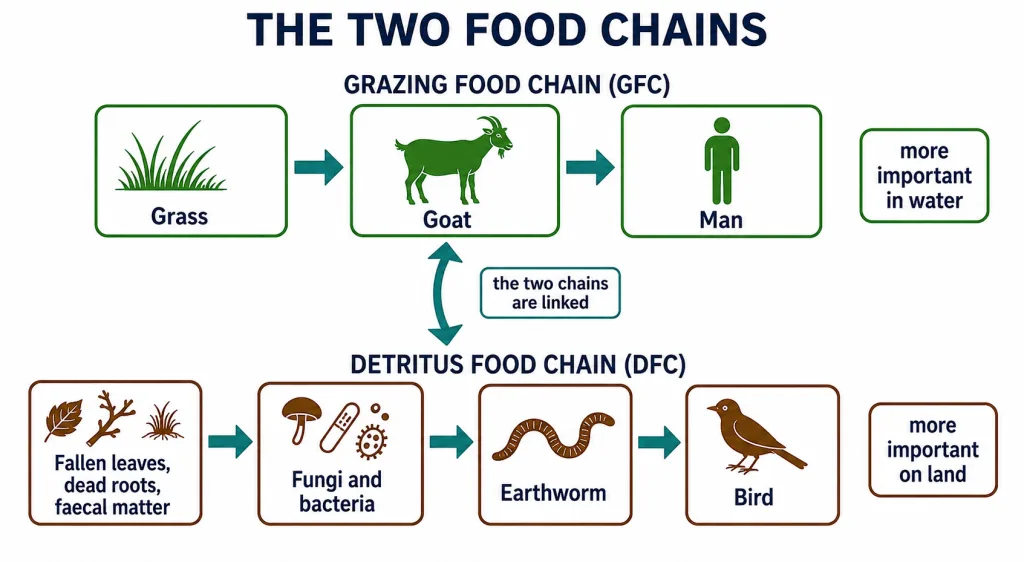
A grazing food chain (GFC) begins with the producers and runs producer to herbivore to carnivore.
A detritus food chain (DFC) does not start from a living producer at all. Its starting material is dead organic matter, and the organisms that carry it forward are the decomposers, not herbivores.
The share taken by each chain is not the same everywhere. In water, most of the energy fixed by the producers travels the grazing route. On land the balance tips the other way: the detritus route carries by far the larger share. Both chains run in both settings; what changes is their relative importance.
The two are not sealed off from one another. The DFC may be connected with the GFC at some levels, because some of the organisms of the DFC are prey to GFC animals, and because in a natural ecosystem some animals - cockroaches and crows, for instance - are omnivores. The result is a food web: the natural interconnection of food chains, which is what actually exists in nature rather than a single isolated chain.
Trophic Levels
Organisms occupy a place in a community according to their feeding relationship with other organisms, and that place is their trophic level.
- First trophic level - producers
- Second trophic level - herbivores, the primary consumers
- Third trophic level - carnivores, the secondary consumers
- Fourth trophic level - the secondary carnivores, or tertiary consumers
Each trophic level carries a certain standing crop, the mass of living material present there at that time.
The important point is that the amount of energy decreases at successive trophic levels. When an organism dies it becomes detritus and enters the decomposer route, so material is not lost from the ecosystem even where energy is.
The Ten Per Cent Law and Unidirectional Flow
Lindeman's ten per cent law states that only about 10 per cent of the energy at one trophic level is transferred to the next. The number of trophic levels in a grazing food chain is therefore restricted. It is usable energy that runs out after a few transfers, not mineral nutrients - those are released again by decomposers and used over and over.
Energy flow is unidirectional. Energy captured by autotrophs does not revert back to the solar input, and energy passed to herbivores does not come back to autotrophs. It moves progressively through the trophic levels and is no longer available to the previous level. The reason lies in the second law of thermodynamics: some energy is dissipated as heat at every transfer, and heat cannot be recovered as food. It is this same dissipation that both makes the flow one-way and limits the number of levels.