The Leaf
The leaf is a flattened, green, lateral outgrowth of the stem that arises at a node and bears an axillary bud. Its parts are the leaf base (may bear stipules; a swollen pulvinus in legumes), the petiole, and the lamina (blade with midrib, veins and veinlets).
Venation: reticulate (net-like - dicots) or parallel (monocots).
Simple vs compound: a simple leaf has an entire or incised lamina that is not cut down to the midrib; a compound leaf has the lamina divided into leaflets. Compound types: pinnately compound (leaflets on a common rachis - neem) and palmately compound (leaflets at the tip of the petiole - silk cotton).
Phyllotaxy (arrangement of leaves on the stem): alternate (china rose, mustard, sunflower), opposite (Calotropis, guava), whorled (Alstonia).
Leaf modifications: tendrils (pea), spines (cactus/Opuntia), fleshy storage leaves (onion, garlic), phyllode (Australian Acacia - flattened petiole), and pitchers/bladders in insectivorous plants (Nepenthes, Utricularia, Venus flytrap).
The Inflorescence
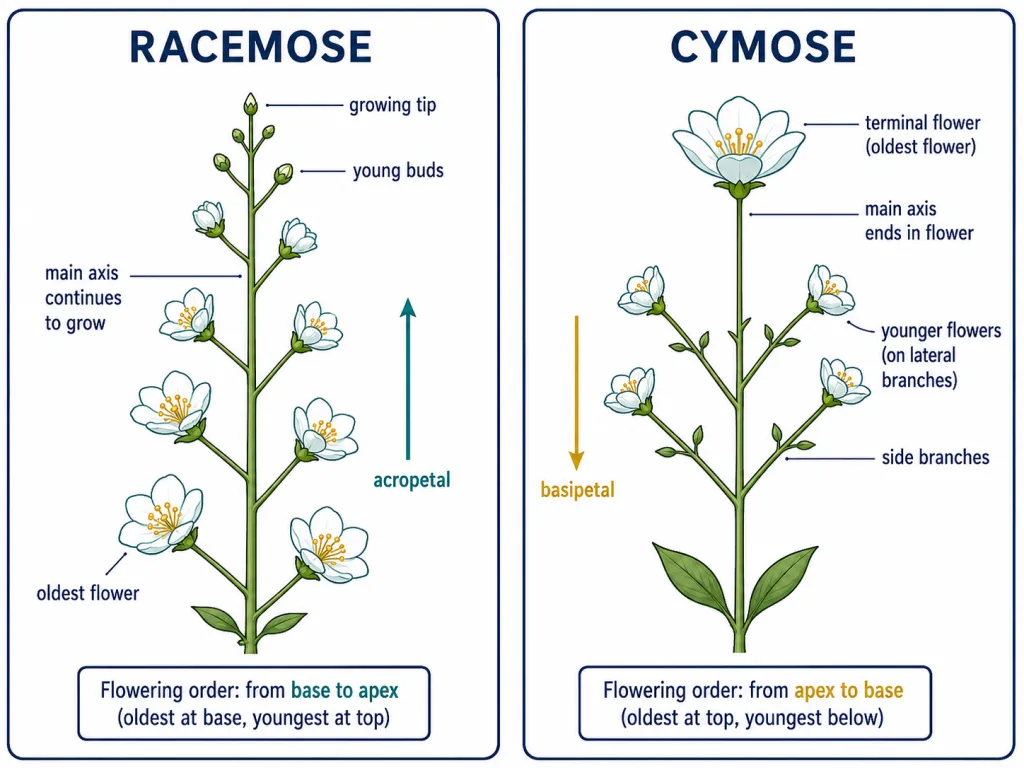
The inflorescence is the arrangement of flowers on the floral axis. There are two main types:
- Racemose - the main axis keeps growing (does not end in a flower); flowers are borne laterally in acropetal succession (older at the base, younger toward the tip). Example: mustard.
- Cymose - the main axis ends in a flower (limited growth); flowers are borne in basipetal order (older at the top/centre).