
The Flower - Symmetry and Position of the Ovary
A flower is a modified shoot - the reproductive unit of angiosperms - with four whorls: calyx, corolla, androecium and gynoecium.
Symmetry
- Actinomorphic (radial) - can be divided into equal halves in any plane: mustard, Datura, chilli.
- Zygomorphic (bilateral) - divides into equal halves in only one plane: pea, gulmohur, bean, Cassia.
- Asymmetric: Canna.
Position of the ovary on the thalamus
| Flower type | Ovary | Examples |
|---|---|---|
| Hypogynous | superior | mustard, china rose, brinjal |
| Perigynous | half-inferior | rose, peach, plum |
| Epigynous | inferior | guava, cucumber, ray florets of sunflower |
Calyx, Corolla, Aestivation, Androecium and Gynoecium
Calyx = sepals (green, protective); gamosepalous (united) or polysepalous (free). Corolla = petals (coloured, attract pollinators); gamopetalous or polypetalous.
Aestivation (arrangement of sepals/petals in the bud):
| Aestivation | Description | Example |
|---|---|---|
| Valvate | margins just touch, no overlap | Calotropis |
| Twisted | one margin overlaps the next | china rose, lady's finger, cotton |
| Imbricate | overlapping but not in a set direction | Cassia, gulmohur |
| Vexillary | 5 petals: 1 standard (vexillum), 2 wings, 2 keel | pea, bean |
Androecium = stamens (filament + two-lobed/dithecous anther).
- Adhesion: epipetalous (attached to petals - brinjal), epiphyllous (attached to perianth - lily).
- Cohesion: monadelphous (one bundle - china rose), diadelphous (two bundles - pea), polyadelphous (many bundles - Citrus), syngenesious (only anthers united - sunflower).
Gynoecium = carpels (stigma + style + ovary). Apocarpous (free carpels - lotus, rose) or syncarpous (fused - mustard). See the placentation diagram for how ovules are arranged.
Visual - Types of Placentation (ovary cross-sections)
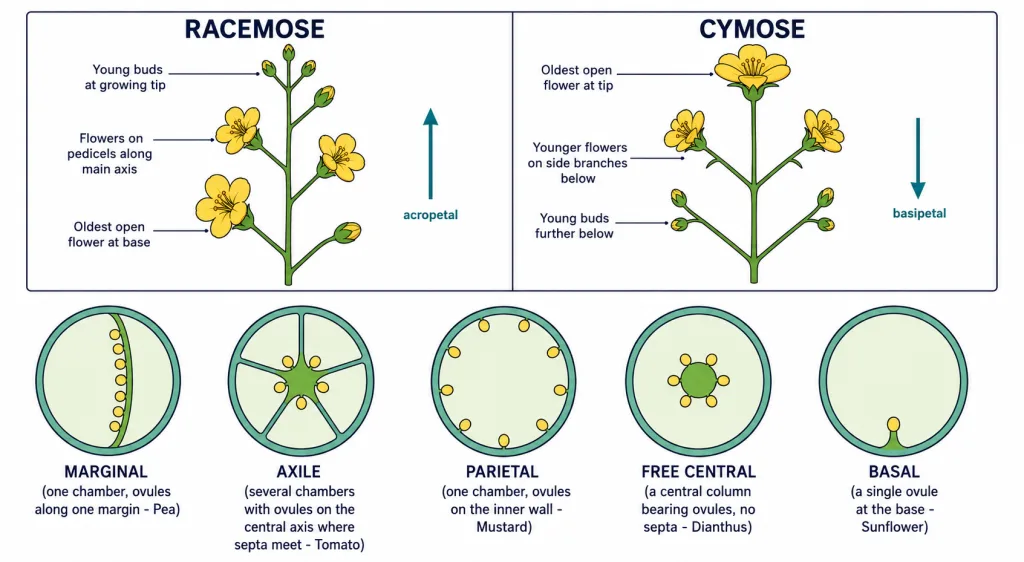
Red dots = ovules. Marginal (one chamber, ovules on one margin - pea); Axile (septate, ovules on the central axis - tomato, china rose, lemon); Parietal (one chamber, ovules on the wall - mustard); Free central (central column, no septa - Dianthus); Basal (a single ovule at the base - sunflower, marigold).
Visual - Types of Aestivation
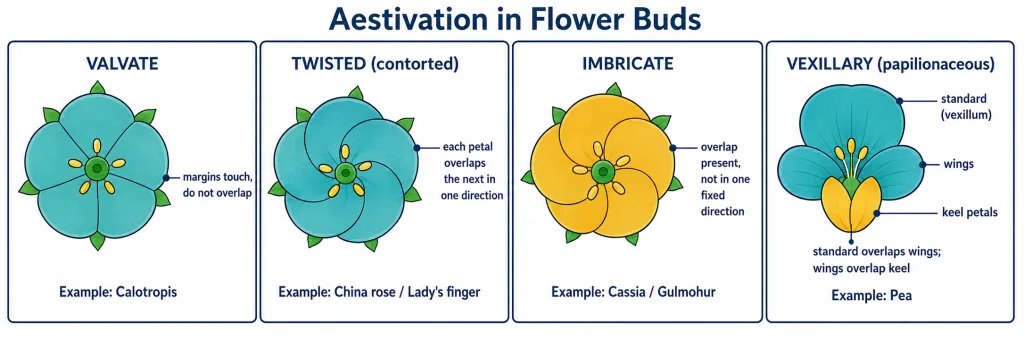
Four petal-arrangement patterns: valvate (petals just touch, e.g. Calotropis), twisted (one margin overlaps the next, e.g. china rose), imbricate (overlap but not in a set direction, e.g. Cassia/gulmohur) and vexillary/papilionaceous (standard over wings over keel, e.g. pea).