
The Fruit and the Seed
Fruit - a ripened ovary that develops after fertilisation. A true fruit forms from the ovary alone; a false fruit also has a contribution from the thalamus (apple). A parthenocarpic fruit forms without fertilisation (banana). The fruit wall (pericarp) has three layers - epicarp, mesocarp and endocarp (in a mango drupe the mesocarp is the edible juicy part).
Seed
- Dicot seed (e.g., bean/gram): seed coat (outer testa + inner tegmen), hilum, micropyle; embryo = two cotyledons + embryonal axis (radicle + plumule).
- Monocot seed (e.g., maize): seed coat fused with the fruit wall; a food-storing endosperm bounded by an aleurone layer; the embryo has one cotyledon (the scutellum), with a coleoptile over the plumule and a coleorhiza over the radicle.
Floral Formula and the Three Families
The floral formula summarises a flower using symbols: Br (bracteate), symmetry actinomorphic or zygomorphic, K = calyx, C = corolla, P = perianth, A = androecium, G = gynoecium; brackets like C(5) mean united parts, and a line below G = superior ovary, a line above G = inferior ovary.
The three families (memorise the floral characters)
| Character | Fabaceae (pea) | Solanaceae (potato) | Liliaceae (lily) |
|---|---|---|---|
| Symmetry | Zygomorphic | Actinomorphic | Actinomorphic, trimerous |
| Calyx / Perianth | 5, gamosepalous | 5, gamosepalous, persistent | Perianth 6 (3+3), tepals |
| Corolla | 5, papilionaceous (vexillary) | 5, gamopetalous | (perianth) |
| Androecium | 10, diadelphous (9+1) | 5, epipetalous | 6 |
| Gynoecium / placentation | monocarpellary, marginal | bicarpellary syncarpous, axile | tricarpellary syncarpous, axile |
| Ovary | superior | superior | superior |
| Fruit | legume (pod) | berry / capsule | capsule / berry |
| Examples | pea, gram, groundnut, soybean | potato, tomato, brinjal, Datura | tulip, Aloe, onion, garlic |
Economic uses: Fabaceae - pulses, edible oil, dye (indigo), fodder; Solanaceae - food, spice, medicine, ornamentals; Liliaceae - ornamentals (tulip), medicine (Aloe, colchicine), vegetables (onion, garlic).
Visual - Floral Diagrams of Three Families
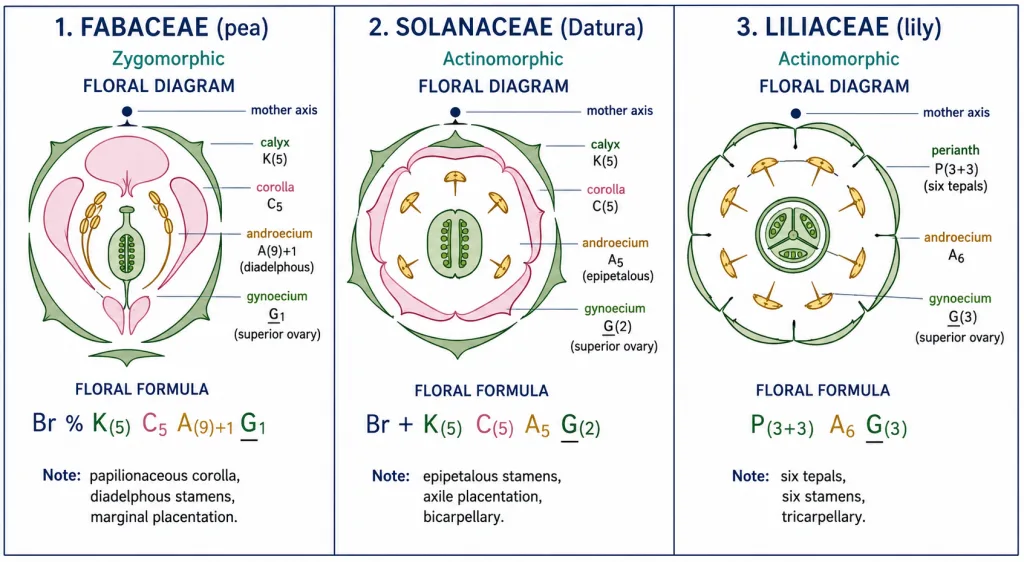
Floral diagram and floral formula side by side for Fabaceae (zygomorphic; K(5) C1+2+(2) A(9)+1 G1), Solanaceae (actinomorphic; K(5) C(5) A5 G(2)) and Liliaceae (P(3+3) A6 G(3)).
Visual - Position of the Ovary
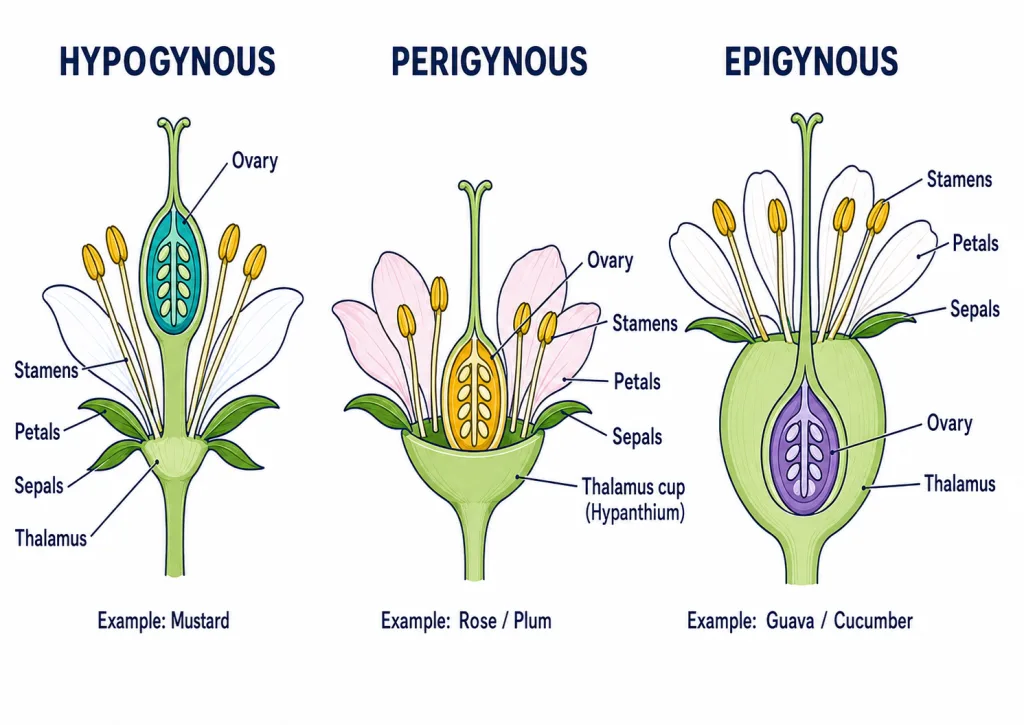
Longitudinal sections contrasting hypogynous (superior ovary, e.g. mustard), perigynous (half-inferior ovary, e.g. rose/plum) and epigynous (inferior ovary, e.g. guava/cucumber) flowers.
Visual - Structure of a Seed
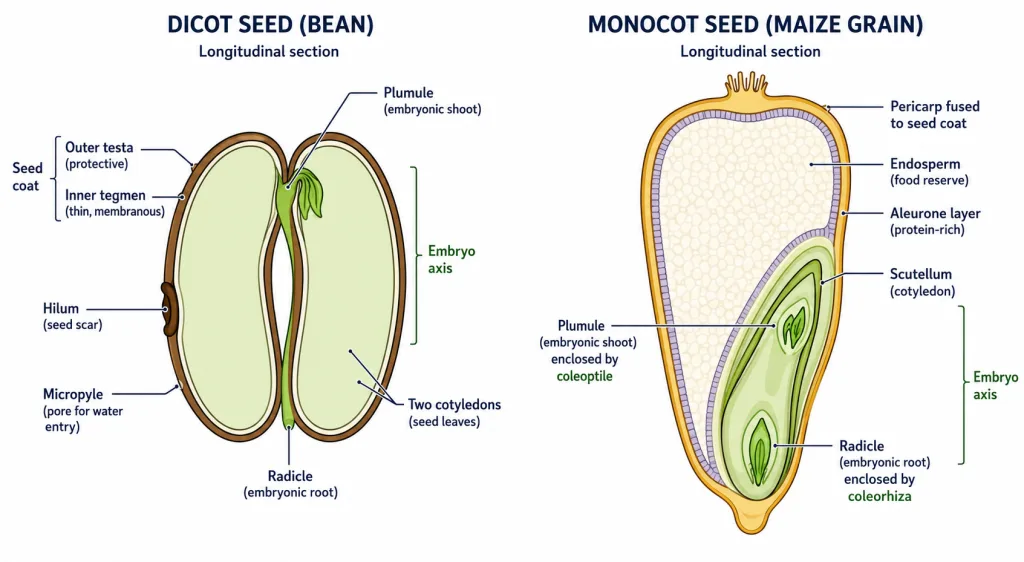
A dicot seed (bean) with testa, tegmen, hilum, micropyle, two cotyledons, plumule and radicle, beside a monocot seed (maize) showing pericarp fused to seed coat, endosperm, aleurone layer, scutellum, coleoptile and coleorhiza.