
Photosynthesis - the Early Experiments
Photosynthesis is the process by which green plants use light energy to make food (glucose) from CO2 and water, releasing O2. Overall: 6CO2 + 12H2O -> (light, chlorophyll) -> C6H12O6 + 6H2O + 6O2. (Note: the water on the right is newly formed; 12 water molecules are used and 6 released.)
Landmark experiments (learn who did what)
- Joseph Priestley (1770s) - the bell-jar experiments with a candle, a mouse and a mint plant; showed that plants restore ('purify') the air damaged by burning/breathing - i.e. plants release oxygen.
- Jan Ingenhousz - showed that light is essential and that only the green parts of a plant release O2 (bubbles from a submerged green plant in sunlight).
- Julius von Sachs (1854) - showed that the green parts make glucose which is usually stored as starch.
- T.W. Engelmann - using a prism and the alga Cladophora with aerobic bacteria, plotted the first action spectrum; photosynthesis (O2 release) was greatest in the blue and red regions of light.
- Cornelius van Niel - from work on purple/green (sulphur) bacteria, concluded that the O2 released comes from water (H2O), not from CO2. This was later confirmed by Ruben and Kamen using the heavy oxygen isotope O-18.
The site of photosynthesis
- Photosynthesis occurs in the chloroplast. It has two phases at two sites:
- Light reaction (photochemical phase) - on the thylakoid (grana) membranes.
- Dark reaction (biosynthetic phase / Calvin cycle) - in the stroma.
- The mesophyll cells of the leaf are the chief site; the thylakoids trap light and the stroma carries out sugar synthesis.
Photosynthetic Pigments & the Spectra
The pigments are located in the thylakoid membranes and are of two kinds:
- Chlorophylls - chlorophyll a (bright/blue-green) is the chief/primary pigment and the reaction-centre pigment; chlorophyll b (yellow-green) is an accessory pigment. Chlorophyll a is the most abundant pigment in plants.
- Carotenoids (accessory pigments) - carotenes (orange) and xanthophylls (yellow); they absorb light at wavelengths chlorophyll cannot and protect chlorophyll from photo-oxidation (photoprotection).
Accessory pigments (chlorophyll b, carotenoids) widen the range of wavelengths absorbed and hand the energy to chlorophyll a; they also protect chlorophyll a from UV/photo-damage.
Absorption spectrum vs Action spectrum
- Absorption spectrum - a graph of the light absorbed by a pigment at each wavelength; chlorophyll a absorbs most strongly in the blue (~430 nm) and red (~660 nm) regions.
- Action spectrum - a graph of the rate of photosynthesis at each wavelength; it also peaks in the blue and red, closely overlapping the absorption spectrum of chlorophyll a - this is the evidence that chlorophyll a is the chief pigment of photosynthesis. Maximum photosynthesis occurs in red and blue light; least in the green (which is reflected, so leaves look green).
Visual - Absorption & Action Spectra
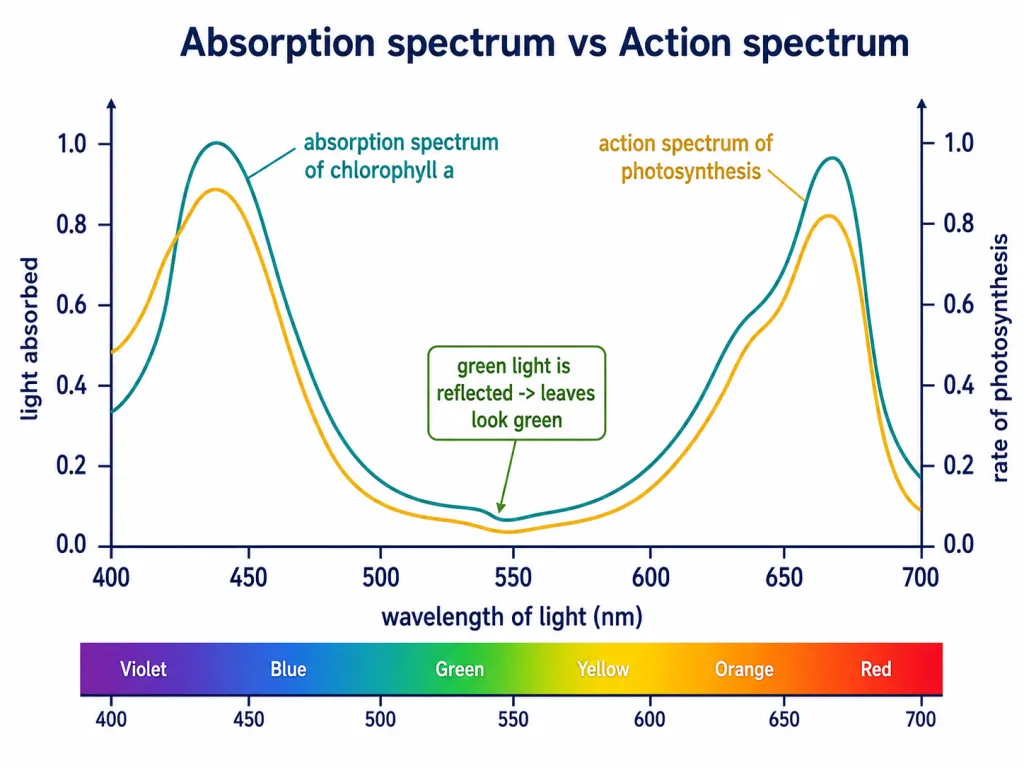
The absorption spectrum of chlorophyll a and the action spectrum of photosynthesis both peak in the blue (~430 nm) and red (~660 nm) and are lowest in the green - showing chlorophyll a is the main pigment.