
The Biosynthetic Phase - the Calvin (C3) Cycle
The dark reaction (biosynthetic phase) occurs in the stroma and uses the ATP and NADPH made in the light reaction to fix CO2 into sugar. It does not directly need light (but depends on the light reaction's products). In C3 plants the pathway is the Calvin cycle, whose first stable product is the 3-carbon 3-phosphoglyceric acid (3-PGA) - hence 'C3'.
The three stages of the Calvin cycle
- 1. Carboxylation - CO2 is added to the 5-carbon acceptor RuBP (ribulose-1,5-bisphosphate) by the enzyme RuBisCO (ribulose bisphosphate carboxylase-oxygenase), forming two molecules of 3-PGA (3-carbon). This is the crucial CO2-fixing step. RuBisCO is the most abundant enzyme/protein in the world.
- 2. Reduction - each 3-PGA is phosphorylated (by ATP) and reduced (by NADPH) to form G3P (glyceraldehyde-3-phosphate, a triose sugar). Per CO2 fixed, 2 ATP and 2 NADPH are used here.
- 3. Regeneration - the CO2 acceptor RuBP is regenerated from G3P, using 1 more ATP per CO2.
The stoichiometry (learn the numbers)
- To make one molecule of glucose, the cycle must turn 6 times (fix 6 CO2).
- Per CO2 fixed: 3 ATP + 2 NADPH.
- Per glucose (6 CO2): 18 ATP + 12 NADPH.
- Of 6 turns, 6 CO2 + 18 ATP + 12 NADPH yield 1 glucose; 6 RuBP are regenerated.
Rank-splitters: first stable product of C3 = 3-PGA (3-C); CO2 acceptor = RuBP (5-C); enzyme = RuBisCO; per glucose = 18 ATP + 12 NADPH; the cycle turns 6 times per glucose.
Visual - The Calvin Cycle
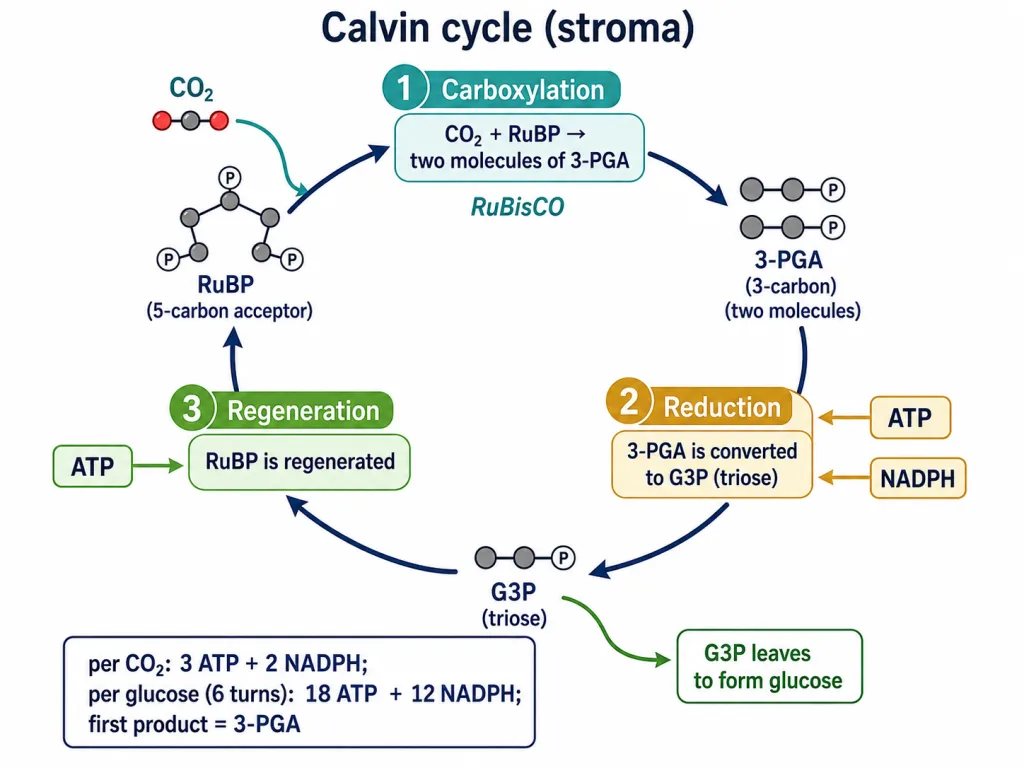
The Calvin cycle in the stroma: carboxylation (RuBP + CO2 -> 2 x 3-PGA by RuBisCO), reduction (3-PGA -> G3P using ATP + NADPH), and regeneration of RuBP (using ATP).