
The C4 Pathway & Kranz Anatomy
Some tropical plants (maize, sugarcane, sorghum, amaranthus) use the C4 (Hatch-Slack) pathway, which is more efficient in hot, dry, high-light conditions.
Kranz anatomy
- C4 leaves have a special anatomy - Kranz ('wreath') anatomy: the vascular bundles are surrounded by large bundle-sheath cells that have many chloroplasts, thick walls, no intercellular spaces, and are the site of the Calvin cycle.
The two-cell mechanism
- In the mesophyll cells, the primary CO2 acceptor is the 3-carbon PEP (phosphoenolpyruvate); the enzyme PEP carboxylase (PEPcase) fixes CO2 to give the first stable product - the 4-carbon oxaloacetic acid (OAA) - hence 'C4'. PEPcase has no affinity for O2 (unlike RuBisCO).
- OAA is converted to malate, which moves into the bundle-sheath cells and there releases CO2, which enters the Calvin cycle (with RuBisCO). The high CO2 concentration around RuBisCO prevents photorespiration.
Key contrasts: C4 first product = OAA (4-C) in mesophyll; C3 first product = 3-PGA (3-C). RuBisCO is present only in bundle-sheath cells of C4 plants; PEPcase is in the mesophyll. C4 plants show no photorespiration and are more efficient.
Visual - The C4 Pathway (Kranz Anatomy)
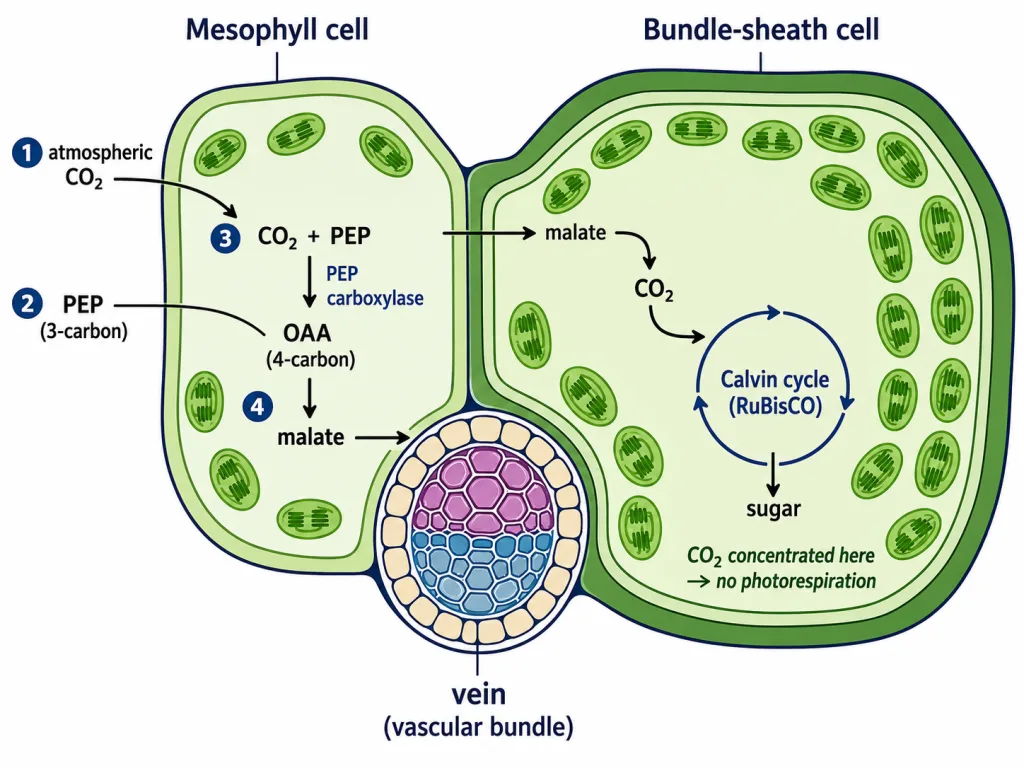
C4 pathway: in the mesophyll, PEP + CO2 -> OAA (by PEP carboxylase) -> malate; malate enters the bundle-sheath cell, releases CO2 for the Calvin cycle (RuBisCO), concentrating CO2 and avoiding photorespiration.
Photorespiration & Factors Affecting Photosynthesis
Photorespiration (the C2 cycle)
- RuBisCO has affinity for BOTH CO2 and O2 - it is a carboxylase AND an oxygenase. Which reaction occurs depends on the relative concentration of CO2 and O2.
- In C3 plants, when O2 is high and CO2 is low, RuBisCO binds O2 instead of CO2 - RuBP + O2 -> 1 molecule of 3-PGA + 1 molecule of phosphoglycolate (2-C). This is photorespiration.
- Photorespiration is a wasteful process: there is NO synthesis of sugar, NO ATP and NO NADPH; and CO2 is released.
- C4 plants do NOT show photorespiration because their bundle-sheath cells keep the CO2 concentration around RuBisCO high, so RuBisCO acts only as a carboxylase.
Factors affecting the rate of photosynthesis
- Blackman's Law of Limiting Factors (1905): when a process depends on several factors, its rate is limited by the factor that is nearest its minimum value (the limiting factor); changing that factor will directly change the rate.
- The main factors are light, CO2 concentration, temperature and water.
- Light - the rate rises with light intensity up to a point, then plateaus (light saturation, at ~10% of full sunlight).
- CO2 concentration - the major limiting factor in most conditions; C3 plants respond up to ~450 uL/L, C4 plants saturate at ~360 uL/L.
- Temperature - the dark reactions (enzyme-controlled) are more temperature-sensitive; C4 plants have a higher temperature optimum.
- Water - stress closes stomata, reducing CO2 uptake.
Traps: photorespiration gives no sugar/no ATP/no NADPH and releases CO2; it happens in C3 plants (RuBisCO's O2 binding) and is absent in C4 plants; the usual major limiting factor in nature is CO2.