
The Light Reaction (Photochemical Phase)
The light reaction occurs on the thylakoid membranes and produces the assimilatory power - ATP and NADPH - plus O2.
Photosystems
- The pigments are organised into two photosystems, PS I and PS II, each with a light-harvesting complex (LHC / antenna) of hundreds of pigment molecules that funnel energy to a central reaction-centre chlorophyll a.
- PS I reaction centre = P700 (absorbs at 700 nm); PS II reaction centre = P680 (absorbs at 680 nm).
Non-cyclic photophosphorylation & the Z-scheme
- In non-cyclic electron flow both photosystems work in series in the Z-scheme. The sequence is PS II first, then PS I (even though PS I was numbered first).
- At PS II, light splits water - photolysis: 2H2O -> 4H+ + O2 + 4e- - on the inner (lumen) side of the thylakoid; this is the source of the O2 released and of the electrons.
- Electrons flow PS II -> electron transport chain -> PS I -> finally reduce NADP+ to NADPH. ATP is made along the way.
- Products of non-cyclic: ATP + NADPH + O2 (both photosystems involved).
Cyclic photophosphorylation
- Only PS I is involved; the electron cycles back to PS I. It occurs in the stroma lamellae (which lack PS II and NADP reductase).
- Products: only ATP (no NADPH, and no O2, because water is not split).
The chemiosmotic hypothesis
- ATP synthesis is explained by a proton (H+) gradient across the thylakoid membrane. Protons accumulate inside the thylakoid lumen (from water splitting and electron transport), then flow out through the F0-F1 ATP synthase (CF0-CF1), driving the synthesis of ATP.
High-yield one-liners: O2 comes from the photolysis of water at PS II; non-cyclic gives ATP + NADPH + O2; cyclic gives only ATP (PS I only, stroma lamellae); protons accumulate in the thylakoid lumen.
Visual - The Z-scheme of the Light Reaction
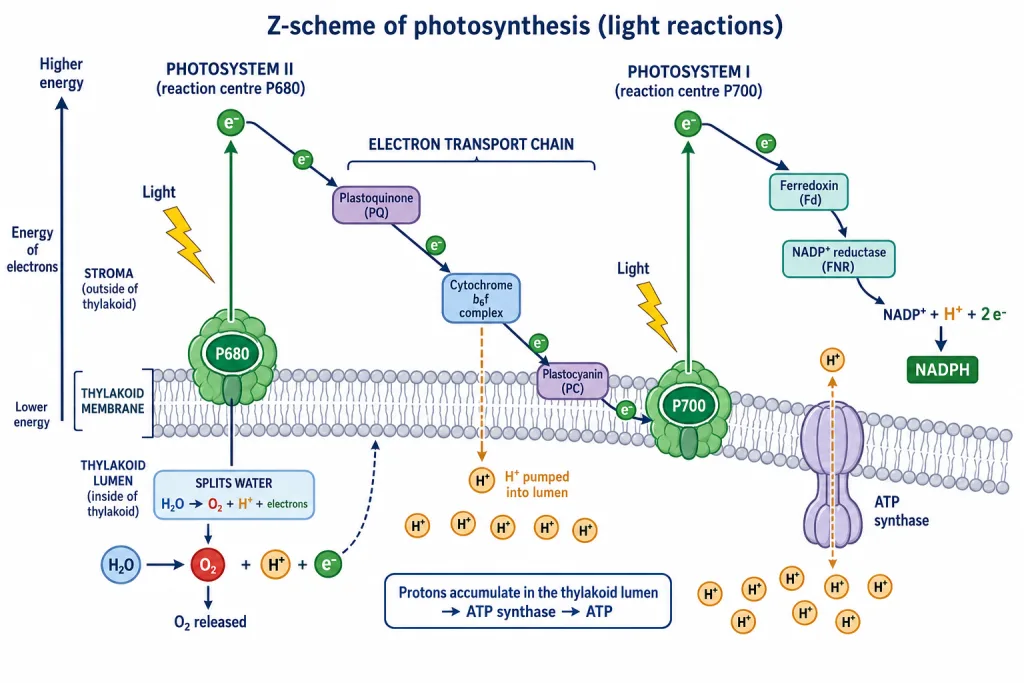
The Z-scheme: PS II (P680) splits water (releasing O2), electrons pass down an electron transport chain making ATP, then PS I (P700) raises them to reduce NADP+ to NADPH.