
The Flower - the Site of Sexual Reproduction
The flower is the reproductive structure of an angiosperm, where sexual reproduction takes place. The events of sexual reproduction occur in a fixed order:
- Pre-fertilisation events - the making of the male and female gametes: the development of the stamen (androecium) and pistil (gynoecium), gamete formation (gametogenesis), and pollination (transfer of pollen).
- Fertilisation - the fusion of the male and female gametes (double fertilisation in angiosperms).
- Post-fertilisation events - the development of the endosperm and embryo, and the maturation of the ovule into a seed and the ovary into a fruit.
The stamen is the male reproductive part and the pistil (carpel) is the female reproductive part. This section deals with the male side - the stamen, the pollen sac and the pollen grain.
The Stamen and the Anther
Each stamen has a long, slender stalk, the filament, and a terminal, usually bilobed anther. The proximal end of the filament is attached to the thalamus or the petal.
- A typical angiosperm anther is bilobed (two lobes), with each lobe having two theca - it is therefore dithecous. A longitudinal groove runs between the two lobes.
- The anther is a four-sided (tetragonal) structure consisting of four microsporangia located at the corners, two in each lobe. The microsporangia develop and become the pollen sacs, which extend longitudinally and are packed with pollen grains.
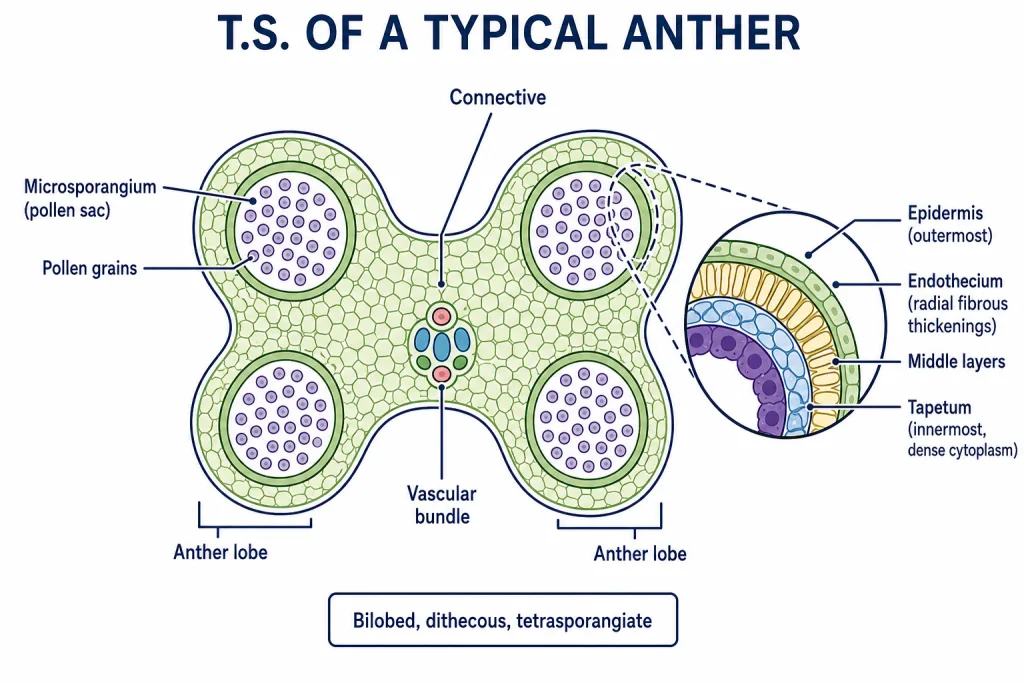
The wall of the microsporangium (four layers)
In a transverse section, a young microsporangium is surrounded, from outside in, by four wall layers:
- Epidermis - the outermost protective layer.
- Endothecium - lies below the epidermis; its cells develop fibrous thickenings that help in the dehiscence (splitting) of the anther to release pollen.
- Middle layers - one to three layers, thin-walled and usually short-lived.
- Tapetum - the innermost layer. Its cells have dense cytoplasm and generally more than one nucleus; the tapetum nourishes the developing pollen grains.
The outer three layers (epidermis, endothecium, middle layers) perform protection and dehiscence; the inner tapetum provides nutrition.
One-liners: flower = site of sexual reproduction; anther is bilobed, dithecous, tetrasporangiate (4 microsporangia); wall layers (out -> in) = epidermis, endothecium, middle layers, tapetum; endothecium -> dehiscence, tapetum -> nourishment.
Microsporogenesis - Making the Microspores
When the anther is young, a group of compactly arranged homogeneous cells called the sporogenous tissue occupies the centre of each microsporangium.
- As the anther matures, the cells of the sporogenous tissue enlarge and become the microspore mother cells (MMCs), also called pollen mother cells (PMCs). Each is diploid (2n).
- Each microspore mother cell undergoes meiosis to produce a cluster of four haploid (n) cells - a microspore tetrad. The formation of microspores from the pollen mother cell through meiosis is called microsporogenesis.
- As the anther matures and dehydrates, the microspores dissociate from one another and develop into pollen grains. Each microsporangium typically contains thousands of pollen grains, released when the anther dehisces.
Sequence: sporogenous tissue -> microspore (pollen) mother cell (2n) -> meiosis -> microspore tetrad (n) -> pollen grains.
The Pollen Grain - the Male Gametophyte
The pollen grain represents the male gametophyte. It is generally spherical, about 25-50 micrometres in diameter, and has a two-layered wall:
- The exine is the hard outer wall, made of sporopollenin - one of the most resistant organic materials known. It can withstand high temperatures and strong acids and alkalis, and no enzyme yet is known to degrade it, so pollen grains are extremely well preserved as fossils. The exine has apertures called germ pores where sporopollenin is absent.
- The intine is the inner wall - a thin, continuous layer of cellulose and pectin.
Cells of the pollen grain
When shed, the pollen grain may be at the 2-celled or 3-celled stage:
- In over 60% of angiosperms, pollen is shed at the 2-celled stage - a large vegetative cell (abundant food reserve, large irregularly shaped nucleus) and a small generative cell (spindle-shaped, dense cytoplasm) that floats in the vegetative cell's cytoplasm.
- In the remaining ~40%, the generative cell divides mitotically to form two male gametes before pollen is shed, so pollen is shed at the 3-celled stage.
One-liners: pollen grain = male gametophyte; wall = exine (sporopollenin, with germ pores) + intine (cellulose-pectin); sporopollenin = most resistant; shed at 2-celled (60%) or 3-celled (40%) stage; vegetative cell large + generative cell forms the two male gametes.
Pollen Viability, Allergy and Products
Pollen viability
The viability (period for which pollen remains capable of germinating) varies widely with the species and with humidity and temperature:
- In cereals such as rice and wheat (Poaceae/grasses), pollen loses viability within 30 minutes of release.
- In members of Rosaceae, Leguminosae (Fabaceae) and Solanaceae, pollen can retain viability for months.
- Pollen can be stored for years in liquid nitrogen (-196 degrees Celsius); such stored pollen is used in crop-breeding programmes and kept in pollen banks.
Pollen allergy
The pollen of some plants causes severe allergies and respiratory disorders (asthma, bronchitis) in sensitive people. A notorious example is Parthenium (carrot grass), an invasive weed that came into India with imported wheat.
Pollen products
Pollen grains are rich in nutrients. Pollen tablets and syrups are sold as food supplements; their consumption is claimed to increase performance, and pollen is used by athletes and race-horses.
One-liners: grasses (rice/wheat) -> 30 min viability; Rosaceae/Leguminosae/Solanaceae -> months; stored in liquid nitrogen (-196 C) in pollen banks; Parthenium causes pollen allergy.