
The Pistil - the Female Reproductive Part
The gynoecium is the female reproductive part of the flower and is made of one or more pistils (carpels). A pistil has three regions:
- Stigma - the terminal, often sticky landing platform that receives pollen.
- Style - the elongated slender part connecting the stigma to the ovary.
- Ovary - the swollen basal part; inside it is the ovarian cavity with a cushion-like placenta on which the ovules (megasporangia) are borne.
When a flower has more than one pistil, they may be:
- Apocarpous - the pistils are free (not fused), as in lotus and rose.
- Syncarpous - the pistils are fused, as in Papaver (poppy) and tomato.
Each ovary may have one to many ovules. After fertilisation the ovule becomes the seed and the ovary becomes the fruit.
The Ovule (Megasporangium)
The ovule is a small structure attached to the placenta by a stalk called the funicle. Its parts are:
- Funicle - the stalk of the ovule.
- Hilum - the junction where the body of the ovule is fused with the funicle.
- Integuments - one or two protective coats that enclose the ovule, leaving a small opening at the tip.
- Micropyle - that small opening, at the tip; through it the pollen tube usually enters.
- Nucellus - the mass of cells enclosed within the integuments, with abundant reserve food; the embryo sac lies embedded in it.
- Chalaza - the basal part of the ovule, opposite the micropylar end, representing the region where the integuments and nucellus join the funicle.
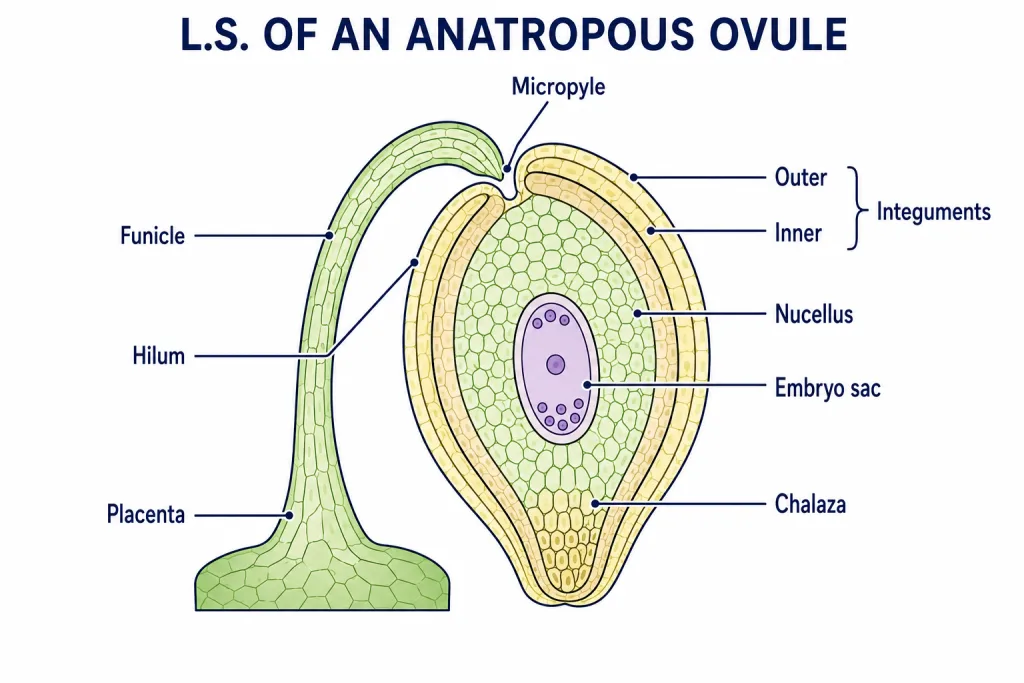
Most angiosperm ovules are anatropous - the body of the ovule is inverted so that the micropyle lies close to the hilum.
One-liners: pistil = stigma + style + ovary; ovules on the placenta; apocarpous = free (lotus, rose), syncarpous = fused (poppy, tomato); ovule parts = funicle, hilum, integuments, micropyle, nucellus, chalaza; micropyle = pollen-tube entry.
Megasporogenesis - Making the Megaspores
The formation of megaspores from the megaspore mother cell is called megasporogenesis.
- A single cell in the micropylar region of the nucellus enlarges, develops dense cytoplasm and becomes the megaspore mother cell (MMC), which is diploid (2n).
- The MMC undergoes meiosis, producing four haploid (n) megaspores, usually arranged in a linear tetrad.
- In most flowering plants only one megaspore (typically the chalazal one) remains functional; the other three degenerate. Because the embryo sac develops from a single functional megaspore, this is called monosporic development.
The Female Gametophyte (Embryo Sac)
The functional megaspore develops into the female gametophyte, or embryo sac, by successive divisions:
- The megaspore's nucleus divides mitotically to form two nuclei that move to opposite poles, giving a 2-nucleate embryo sac.
- Two further free-nuclear mitotic divisions produce the 4-nucleate and then the 8-nucleate stages. These are free-nuclear divisions - nuclear divisions not followed at once by cell-wall formation.
- Cell walls are then laid down, organising the typical Polygonum-type embryo sac, which is 8-nucleate but 7-celled.
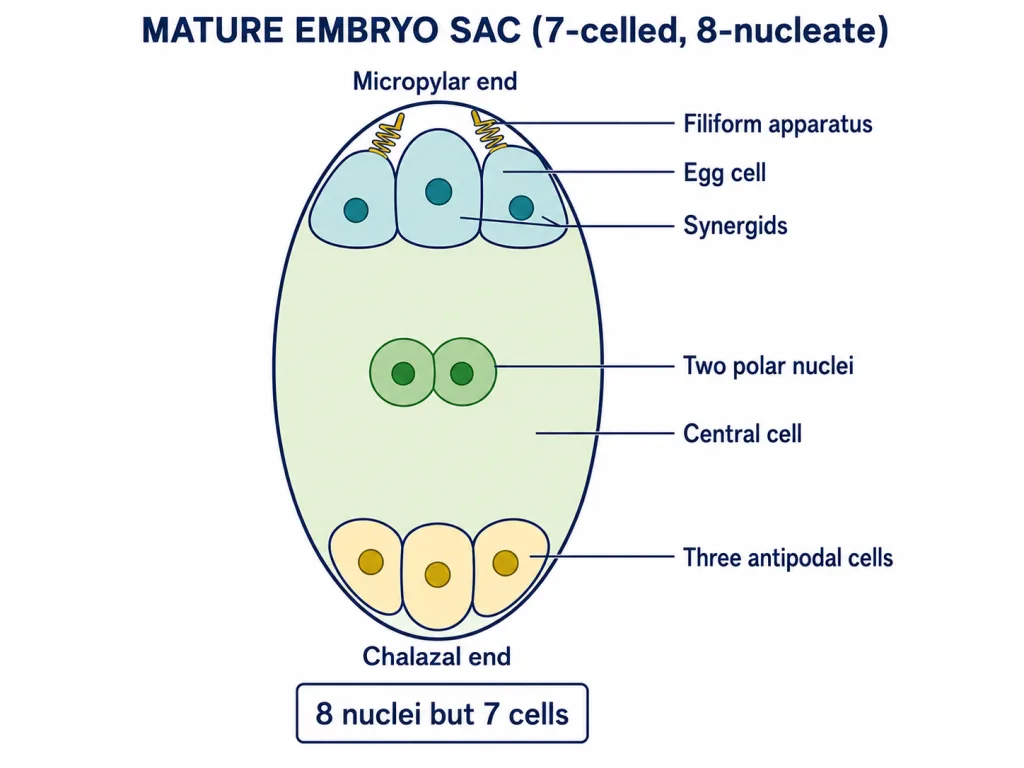
Organisation of the mature embryo sac
- Micropylar end - the egg apparatus: one egg cell flanked by two synergids. The synergids have special cellular thickenings at the micropylar tip called the filiform apparatus, which guides the pollen tube into the synergid.
- Chalazal end - three antipodal cells.
- Centre - one large central cell containing the two polar nuclei.
Count: 6 of the 8 nuclei are enclosed one each within a cell (egg + 2 synergids + 3 antipodals); the remaining two are the polar nuclei in the central cell. This gives 8 nuclei but only 7 cells.
One-liners: MMC (2n) -> meiosis -> 4 megaspores, only 1 functional (monosporic); embryo sac develops by 3 free-nuclear mitoses -> 8 nuclei, 7 cells; egg apparatus = 1 egg + 2 synergids (filiform apparatus); 3 antipodals; central cell with 2 polar nuclei.