
Double Fertilisation
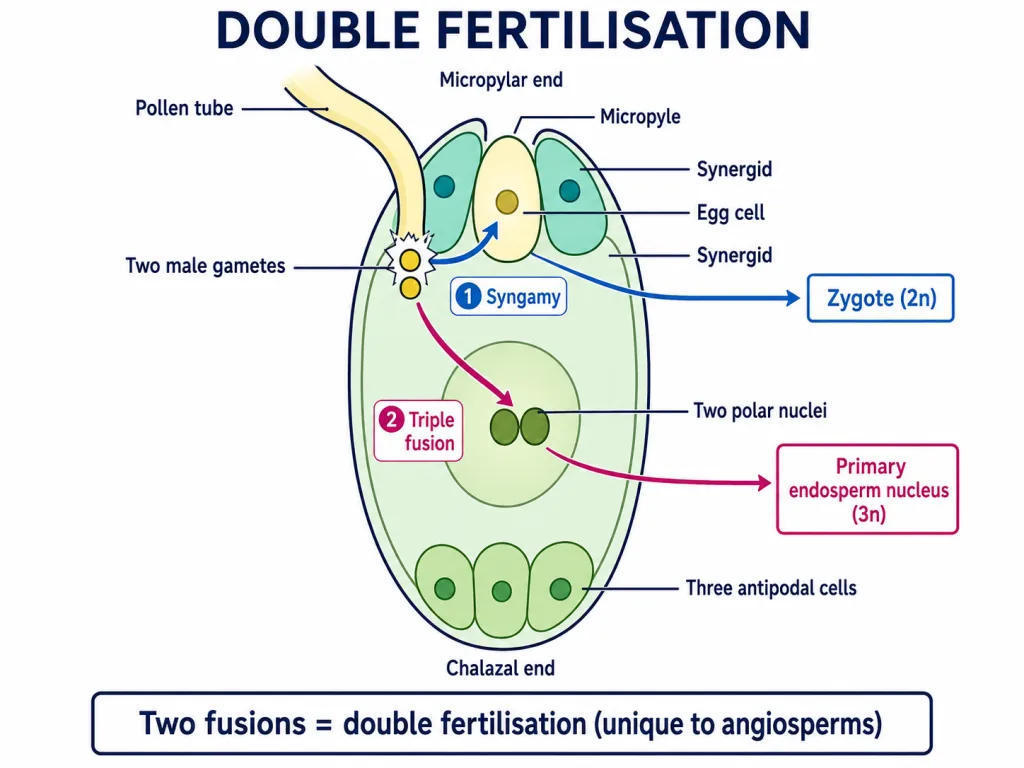
After the pollen tube grows through the style, it enters the ovule - usually through the micropyle (porogamy) - and then enters the embryo sac through a synergid, guided by its filiform apparatus. The tip of the pollen tube bursts and releases the two male gametes into the cytoplasm of the synergid.
Two fusions then take place:
- Syngamy - one male gamete fuses with the egg cell to form a diploid (2n) zygote.
- Triple fusion - the other male gamete fuses with the two polar nuclei in the central cell to form a triploid (3n) primary endosperm nucleus (PEN). Because three haploid nuclei fuse, it is called triple fusion.
Since two fusions - syngamy and triple fusion - occur in each embryo sac, the phenomenon is called double fertilisation. It is a distinctive event unique to flowering plants (angiosperms). The central cell after triple fusion becomes the primary endosperm cell (PEC) and develops into the endosperm.
Post-Fertilisation Events - an Overview
After double fertilisation, the parts of the flower develop as follows:
- Zygote -> embryo
- Primary endosperm nucleus -> endosperm
- Ovule -> seed
- Ovary -> fruit
One-liners: pollen tube enters through micropyle (porogamy) into a synergid; syngamy (male gamete + egg -> zygote, 2n); triple fusion (male gamete + 2 polar nuclei -> PEN, 3n); the two together = double fertilisation, unique to angiosperms.
Endosperm Development
The endosperm develops from the primary endosperm cell, and its development precedes that of the embryo, so that the developing embryo is supplied with nourishment.
- Free-nuclear endosperm - the most common type: the primary endosperm nucleus undergoes successive nuclear divisions without wall formation, producing many free nuclei; cell walls are laid down later. The water of tender coconut is free-nuclear endosperm (with the nuclei), and the surrounding white kernel is the cellular endosperm.
- The endosperm may be completely consumed by the developing embryo before the seed matures (non-endospermic / exalbuminous seeds, e.g. pea, groundnut, beans), or it may persist in the mature seed (endospermic / albuminous seeds, e.g. wheat, maize, castor, sunflower, coconut).
- Sometimes remnants of the nucellus persist in the seed; this residual nucellus is the perisperm, seen in black pepper and beet.
Embryo Development (Embryogeny)
The embryo develops at the micropylar end of the embryo sac, from the zygote. Most zygotes divide only after some endosperm is formed.
- The zygote gives a proembryo, then the globular and heart-shaped stages, and finally the mature embryo. Embryogeny is similar in dicots and monocots up to the globular stage.
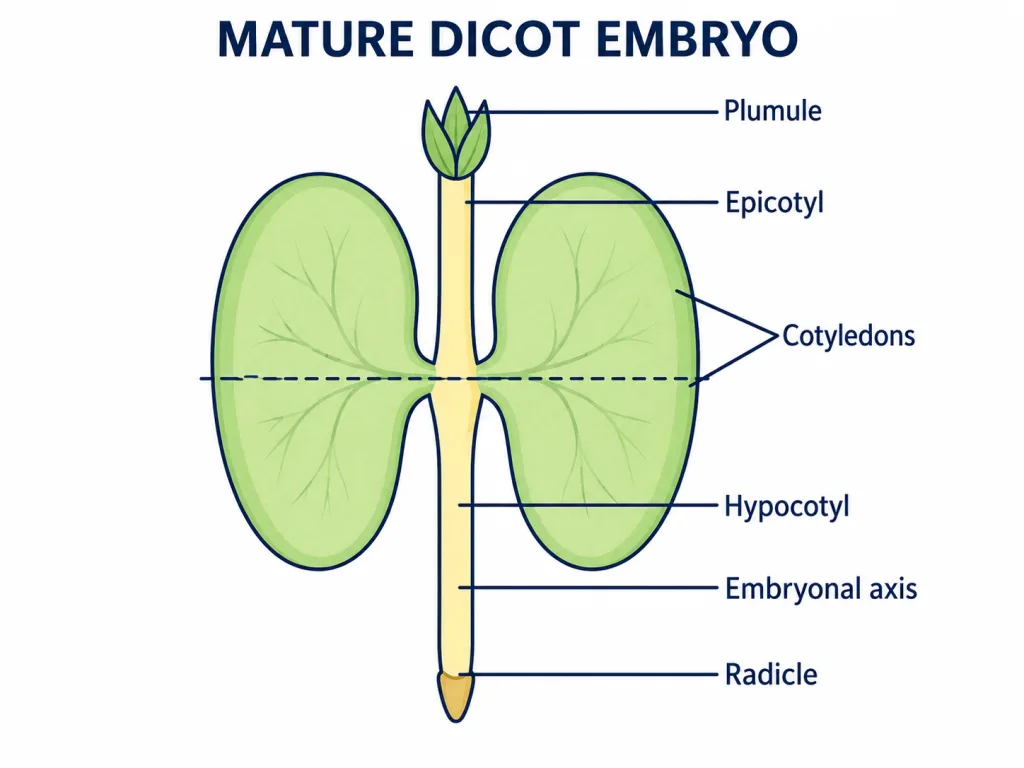
- A dicot embryo has an embryonal axis and two cotyledons. The part of the axis above the level of the cotyledons is the epicotyl, which ends in the plumule (shoot tip); the part below the cotyledons is the hypocotyl, which ends in the radicle (root tip), its tip covered by the root cap.
- A monocot embryo has a single cotyledon called the scutellum. Its embryonal axis has a radicle and root cap enclosed in a sheath, the coleorhiza, and the plumule enclosed in the coleoptile.
One-liners: endosperm develops before the embryo; coconut water = free-nuclear endosperm; exalbuminous (pea, groundnut) vs albuminous (wheat, maize, castor, coconut); perisperm = residual nucellus (black pepper, beet); dicot embryo = epicotyl+plumule / hypocotyl+radicle; monocot = scutellum, coleoptile, coleorhiza.
Seed and Fruit
Seed
The seed is the fertilised, mature ovule - the final product of sexual reproduction. It has a seed coat (developed from the integuments - outer testa, inner tegmen), one or two cotyledons, and an embryonal axis.
- Non-albuminous (exalbuminous) seeds have no residual endosperm (pea, groundnut); albuminous seeds retain endosperm (wheat, maize, castor, sunflower).
- As the seed matures its water content falls and it becomes dry and metabolically inactive (dormant), able to survive unfavourable conditions.
Fruit
The fruit is the mature ovary (developing after fertilisation). Its wall is the pericarp, which may be dry or fleshy.
- True fruit - develops from the ovary only, e.g. mango.
- False fruit - a fruit in which the thalamus or other floral parts also contribute to the fruit, e.g. apple (the fleshy edible part is the thalamus); other examples include strawberry and cashew.
- Parthenocarpic fruit - a fruit formed without fertilisation, and therefore seedless, e.g. banana. Parthenocarpy can be induced by the application of growth hormones.
Apomixis and Polyembryony
- Apomixis is the production of seeds without fertilisation - a form of asexual reproduction that mimics sexual reproduction. It occurs in some Asteraceae and grasses. Apomictic embryos may arise from a diploid egg cell (formed without meiosis) or from the nucellus cells surrounding the embryo sac.
- Importance: apomixis is valuable to the hybrid-seed industry. Hybrid seeds must be produced every year because, on being sown, the segregation of characters in the hybrid progeny loses the hybrid vigour. If hybrids are made to produce seeds apomictically, there is no segregation, so the farmer can keep using the same hybrid seed year after year.
- Polyembryony is the occurrence of more than one embryo in a single seed, as seen in many varieties of citrus and mango, where nucellar cells divide and develop into additional embryos.
One-liners: seed = matured ovule; seed coat from integuments (testa + tegmen); true fruit = ovary only (mango), false fruit = thalamus contributes (apple), parthenocarpy = seedless (banana); apomixis = seeds without fertilisation (helps fix hybrid vigour); polyembryony = many embryos per seed (citrus, mango).