
Enzyme Action and Activity Factors
Enzymes are biological catalysts. Almost all are proteins; catalytic RNA molecules are called ribozymes.
Active site and catalytic cycle
- The active site is a pocket or crevice in the folded enzyme. Substrate first binds to it, and binding can induce the enzyme to fit the substrate more tightly.
- Catalytic groups then favour bond breaking or bond formation, product is generated and released, and the enzyme is ready for another cycle: E + S -> ES -> E + P.
- The enzyme is regenerated at the end of the cycle, so a small amount can process many substrate molecules.
Activation energy and rate
- Reactants must reach a high-energy transition state. Enzymes provide an alternative route with lower activation energy.
- Catalysis changes the rate, not the reaction's free-energy change, equilibrium constant or final equilibrium composition.
- Carbonic anhydrase illustrates catalytic power: formation of carbonic acid rises from about 200 molecules per hour without enzyme to about 600,000 per second with enzyme.
Specificity
An active site selectively recognises a substrate or a type of bond. Specificity can be narrow or group/bond based; it should not be described as an absolute rejection of every related molecule.
Temperature, pH and substrate concentration
- Each enzyme has an optimum temperature and pH. Activity generally falls on either side of the optimum.
- Cooling usually reduces collision frequency reversibly. Sufficient heating disrupts the three-dimensional fold of a protein enzyme and can denature it; enzymes from thermophiles are adapted to much higher temperatures.
- With fixed enzyme concentration, velocity rises with substrate concentration and approaches a maximum when active sites are saturated.
Visual - Enzyme Action and Activation Energy
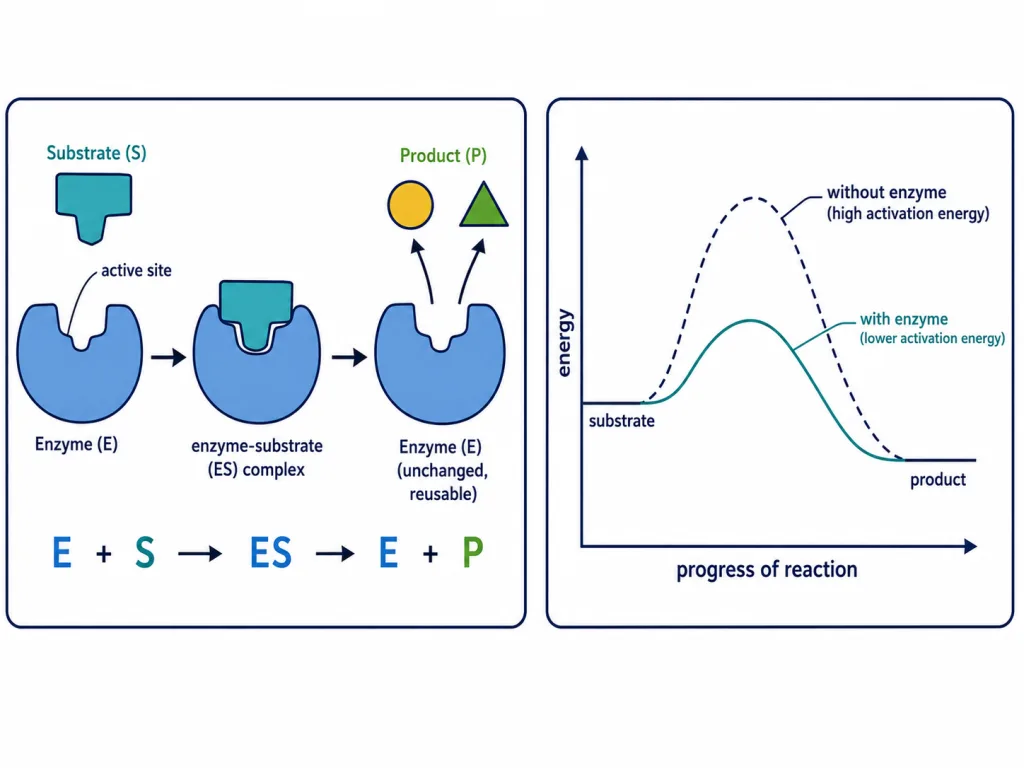
The binding sequence and energy profile show that an enzyme is regenerated and lowers the activation-energy barrier without changing the initial or final energy levels.
Cofactors, Enzyme Classes and Inhibition
Cofactors
- Apoenzyme: protein part alone. Holoenzyme: apoenzyme plus its required cofactor.
- Prosthetic groups: organic cofactors held tightly, for example haem in catalase and peroxidase.
- Coenzymes: organic cofactors that participate during catalysis; many contain vitamin-derived components, for example niacin in NAD and NADP.
- Metal ions: inorganic cofactors that form coordination interactions. Zinc is required by carboxypeptidase.
Six NCERT classes
- Oxidoreductases/dehydrogenases: oxidation-reduction between substrates.
- Transferases: transfer a group other than hydrogen from one substrate to another.
- Hydrolases: cleave ester, ether, peptide, glycosidic and related bonds by hydrolysis.
- Lyases: remove groups without hydrolysis, commonly leaving a double bond.
- Isomerases: interconvert optical, geometric or positional isomers.
- Ligases: link two compounds, forming bonds such as C-O, C-S, C-N or P-O, generally coupled to energy input.
Enzyme names commonly refer to the substrate or reaction and use the suffix -ase, although historical names such as pepsin and trypsin remain.
Competitive inhibition
A competitive inhibitor resembles the substrate and competes for the active site. Malonate resembles succinate and inhibits succinic dehydrogenase. Raising substrate concentration can reduce competitive inhibition because substrate and inhibitor compete for the same binding site.