
Chemical Composition of Living Tissue
Elemental composition
- No chemical element is unique to living matter. Living tissue and the earth's crust contain broadly the same elements but in very different relative proportions.
- Carbon, hydrogen and oxygen are relatively more abundant in living systems. Carbon is about 0.03% of the earth's crust but roughly 18.5% of the human body; silicon shows the opposite trend, forming over 27% of the crust but only a negligible fraction of the human body.
- A carbon compound isolated from living tissue is called a biomolecule. Living organisms also contain inorganic elements and compounds.
Wet weight, dry weight and ash
- Weigh fresh tissue to obtain its wet weight.
- Dry it: the lost mass is mainly water, while the remaining material gives the dry weight.
- Burn the dry tissue completely: organic carbon compounds are oxidised to gaseous products. The non-combustible residue is ash.
Ash reveals inorganic constituents such as calcium and magnesium and salts containing phosphate or sulphate. This experiment is different from acid extraction.
Acid-soluble and acid-insoluble fractions
Grind living tissue in trichloroacetic acid (Cl3CCOOH) and filter the slurry:
- Acid-soluble pool (filtrate): small molecules, mostly about 18-800 Da and conventionally below 1000 Da. Examples include amino acids, monosaccharides, nucleosides, nucleotides, nitrogen bases, fatty acids, glycerol and organic acids. It roughly represents the cytoplasmic composition.
- Acid-insoluble fraction (retentate): proteins, nucleic acids, polysaccharides and lipids. The first three are true biomacromolecules, generally around 10,000 Da or above.
- Lipid exception: individual lipid molecules generally do not exceed about 800 Da, but membrane lipids form water-insoluble vesicles after grinding and are therefore recovered with the acid-insoluble fraction. The separation reflects acid solubility, precipitation and cellular association, not a simple molecular-size sieve.
Average cellular composition by mass
- Water: 70-90%
- Proteins: 10-15%
- Nucleic acids: 5-7%
- Carbohydrates: about 3%
- Lipids: about 2%
- Ions: about 1%
Water is the most abundant chemical in living organisms. Proteins form the largest organic fraction in the average composition table.
Amino Acids - Building Blocks of Proteins
- Proteins are heteropolymers assembled from 20 standard amino acids.
- A general amino acid is a substituted methane: the alpha-carbon carries an amino group, a carboxyl group, a hydrogen and a variable R group. In glycine the R group is also hydrogen, so the four attachments are not four different groups.
- Named R groups: hydrogen in glycine, methyl in alanine and hydroxymethyl in serine.
Classification by side-chain character
- Acidic: an extra carboxyl group, for example glutamic acid.
- Basic: an extra amino/basic group, for example lysine.
- Neutral: for example valine.
- Aromatic: tyrosine, phenylalanine and tryptophan.
The alpha-amino and alpha-carboxyl groups are shared by the standard amino acids; differences arise from the R group.
pH, charge and the zwitterion
- Amino and carboxyl groups are ionisable, so charge changes with pH and, where relevant, with ionisable R groups.
- At sufficiently low pH an amino acid tends to have a net positive charge; at sufficiently high pH it tends to have a net negative charge.
- At its isoelectric pH, positive and negative charges balance. The molecule can be a zwitterion with charged groups but zero net charge.
Essential and non-essential amino acids
- Essential amino acids cannot be synthesised adequately by the human body and must be supplied through food. Examples include lysine, valine, methionine, leucine and phenylalanine.
- Non-essential amino acids can be synthesised by the body. Examples include glycine, alanine and glutamic acid.
- These are examples, not complete lists. "Essential" describes dietary need, not greater biological importance.
Visual - General Amino-Acid Structure
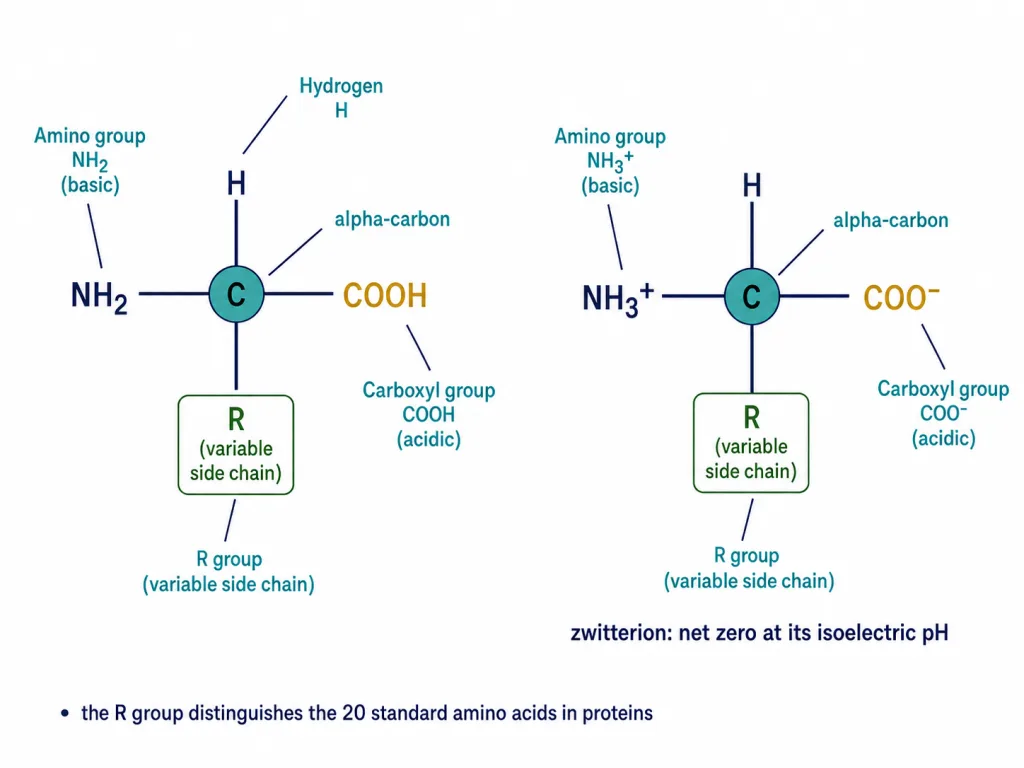
The alpha-carbon carries an amino group, carboxyl group, hydrogen and R group. Net charge depends on pH and the R group; it is zero at the isoelectric pH.