
Reading a Biomolecule From Its Components
Components -> product -> characteristic linkage
| Building component(s) | Product or assembly | Characteristic linkage |
|---|---|---|
| Amino acids | Polypeptide / protein | Peptide bond |
| Monosaccharides | Oligo- or polysaccharide | Glycosidic bond |
| Glycerol + fatty acids | Mono-, di- or triglyceride | Ester bond |
| Nucleotides | Nucleic-acid strand | Phosphodiester bond |
Triglycerides are not polymers and fatty acids/glycerol are not lipid "monomers" in the polymer sense. The table connects building components to their products and linkages.
Hydrolysis products help identify a class: amino acids indicate a polypeptide; sugar units indicate a carbohydrate; glycerol plus fatty acids indicate a glyceride; and base, sugar and phosphate indicate nucleic-acid components. In living cells, biosynthesis uses activated intermediates and coupled reactions, so these linkages should not all be imagined as forming by direct water loss between free monomers.
Acid extraction pools
| Fraction | Typical contents | Interpretation |
|---|---|---|
| Acid-soluble filtrate | amino acids, sugars, nucleosides, nucleotides, bases, fatty acids, glycerol | mostly small molecules, commonly below about 1000 Da |
| Acid-insoluble retentate | proteins, nucleic acids, polysaccharides and lipids | true macromolecules plus lipid-containing membrane vesicles |
Lipid molecular masses generally do not exceed about 800 Da, yet cellular lipids are recovered with membrane fragments in the acid-insoluble fraction. Fraction membership therefore reflects experimental solubility and association as well as molecular size.
Nitrogen checkpoints
Amino acids/proteins, nitrogenous bases/nucleotides and amino-sugar polysaccharides such as chitin contain nitrogen. Starch and cellulose are glucose polymers, and ordinary triglycerides are built from glycerol and fatty acids.
Amino Acids and Protein Organisation
- A general amino acid carries amino, carboxyl, hydrogen and R groups on the alpha-carbon.
- Its charge depends on pH and on ionisable side chains; at the isoelectric pH positive and negative charges balance.
| Level | Meaning |
|---|---|
| Primary | amino-acid sequence from N-terminal to C-terminal |
| Secondary | regular local folding such as alpha-helix or beta-sheet |
| Tertiary | overall three-dimensional fold of one polypeptide; enzyme active sites arise from this fold in enzyme proteins |
| Quaternary | arrangement of two or more folded subunits, as in haemoglobin |
Ordinary denaturation disrupts higher-order folding and activity while generally preserving the primary peptide-bond backbone.
Lipid checkpoints: saturated fatty acids lack C=C double bonds; unsaturated fatty acids contain one or more; phospholipids contain phosphorus and a phosphorylated organic group; cholesterol is a complex ring-containing lipid.
Nucleosides and Nucleotides
- Nucleoside = nitrogenous base + pentose sugar.
- Nucleotide = nucleoside + phosphate.
- Purines A and G have two fused rings; pyrimidines C, T and U have one.
- RNA characteristically contains ribose and uracil; DNA contains deoxyribose and thymine.
- Adjacent nucleotides are connected by 3-prime-5-prime phosphodiester bonds.
Enzymes and Metabolites - Cross-Cuts
| Cofactor type | Key feature | Example |
|---|---|---|
| Prosthetic group | organic and tightly bound | haem in catalase/peroxidase |
| Coenzyme | organic participant; often vitamin-derived | NAD or NADP contains niacin |
| Metal ion | inorganic coordination partner | zinc in carboxypeptidase |
Apoenzyme plus its required cofactor forms the active holoenzyme.
The six NCERT enzyme classes are oxidoreductases, transferases, hydrolases, lyases, isomerases and ligases. Enzyme specificity is selective rather than absolute: an enzyme may recognise one substrate, a related group of substrates or a particular bond. A competitive inhibitor resembles the substrate and competes for the active site; malonate inhibiting succinic dehydrogenase is the classic NCERT example.
Primary metabolites such as amino acids, sugars, nucleotides and lipids have identifiable roles in normal physiology. Secondary-metabolite examples include pigments, alkaloids, essential oils, toxins, drugs, rubber and gums.
Visual - Biomolecule Components, Products and Linkages
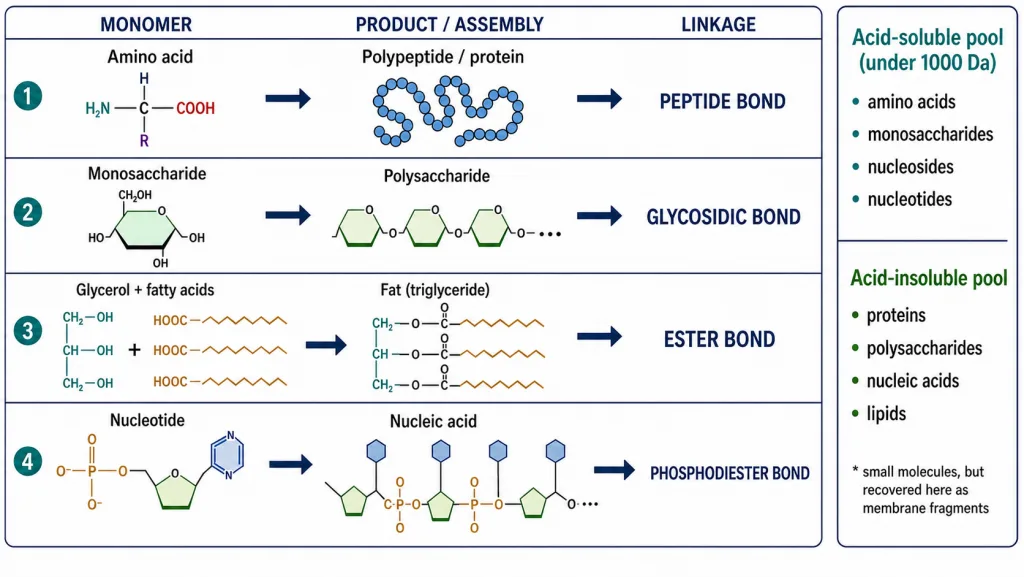
The corrected header says product or assembly, so triglyceride is no longer mislabelled as a polymer.