
Carbohydrates
Monosaccharides - the building units
- Monosaccharides are the simplest sugars and cannot be hydrolysed into anything smaller.
- Glucose, fructose and galactose each carry six carbon atoms; ribose and deoxyribose each carry five.
- Glucose occurs in alpha and beta forms. Starch and glycogen use alpha-linked glucose, while cellulose uses beta-linked glucose; the linkage pattern strongly influences the polymer's three-dimensional organisation and function.
Disaccharides
- Two monosaccharide units join through a glycosidic bond, formed with the loss of a water molecule. Boiling with dilute acid hydrolyses this bond and sets the two sugars free.
- Sucrose = glucose + fructose (cane sugar).
- Maltose = glucose + glucose (malt sugar).
- Lactose = glucose + galactose (milk sugar).
Polysaccharides
- Long chains of monosaccharide units, again linked by glycosidic bonds; a chain built from a single kind of unit is a homopolymer.
- A polysaccharide chain is not identical at its two ends. Drawn conventionally, the right end carries a free reducing group and is the reducing end; the left end has no such free group and is the non-reducing end.
- Starch - the storage polysaccharide of plants. It is a mixture of amylose, an unbranched helical chain, and amylopectin, a branched chain. The amylose helix holds iodine and gives the blue colour.
- Glycogen - the storage polysaccharide of animals, deposited chiefly in liver and skeletal muscle; a very highly branched chain, hence 'animal starch'.
- Cellulose - a structural homopolymer of beta-glucose, the main material of the plant cell wall; its straight chains pack into fibrils and it holds no complex helices.
- Inulin - a polymer of fructose.
- Chitin - a nitrogen-containing polysaccharide; every repeating unit carries nitrogen. It builds fungal cell walls and the exoskeleton of arthropods.
Lipids
A chemically diverse, water-insoluble group
- Lipids are a heterogeneous group of hydrophobic or amphipathic biomolecules, not one polymer family. Most individual lipid molecules are relatively small and generally do not exceed about 800 Da.
Fatty acids and glycerides
- A fatty acid has a carboxyl group attached to a hydrocarbon chain. Saturated fatty acids have no carbon-carbon double bond; unsaturated fatty acids have one or more.
- Palmitic acid has 16 carbon atoms and arachidonic acid has 20, counting the carboxyl carbon.
- Glycerol is trihydroxy propane. Esterification of one, two or three hydroxyl groups with fatty acids produces mono-, di- and triglycerides.
- Fats and oils are triglycerides distinguished mainly by melting behaviour. Greater unsaturation usually lowers melting point, so oils such as gingelly oil remain liquid at temperatures at which many saturated fats are solid.
Phospholipids and complex lipids
- NCERT describes phospholipids as lipids containing phosphorus and a phosphorylated organic compound; they are important components of cell membranes, and lecithin is an example.
- A common glycerophospholipid architecture contains glycerol, two fatty-acid chains and a phosphate-linked polar head group. This arrangement should not be treated as the structure of every phospholipid.
- Cholesterol illustrates a more complex ring-containing lipid. Lipids are grouped by their physical and biological behaviour, not by a single shared monomer or skeleton.
Nucleic Acids
Bases, nucleosides and nucleotides
- Purines, adenine and guanine, have two fused rings. Pyrimidines, cytosine, thymine and uracil, have one ring.
- A nucleoside is a nitrogenous base joined to a pentose sugar.
- A nucleotide is a nucleoside with phosphate. Named nucleosides include adenosine, guanosine, cytidine, uridine and thymidine; the corresponding nucleotide names include adenylic, guanylic, cytidylic, uridylic and thymidylic acid.
Building the polynucleotide
- The base attaches to sugar C1-prime through an N-glycosidic bond. Phosphate can esterify the sugar at the 5-prime position.
- Adjacent nucleotides in a strand are joined through 3-prime-5-prime phosphodiester bonds, producing a repeating sugar-phosphate backbone with bases projecting from the sugars.
- DNA contains deoxyribose and usually thymine; RNA contains ribose and usually uracil. Adenine, guanine and cytosine occur in both.
- DNA and RNA function as genetic material.
Bond map: sugars are linked by glycosidic bonds; glycerol and fatty acids by ester bonds; amino acids by peptide bonds; and adjacent nucleotides by phosphodiester bonds.
Visual - Nucleotide Connectivity
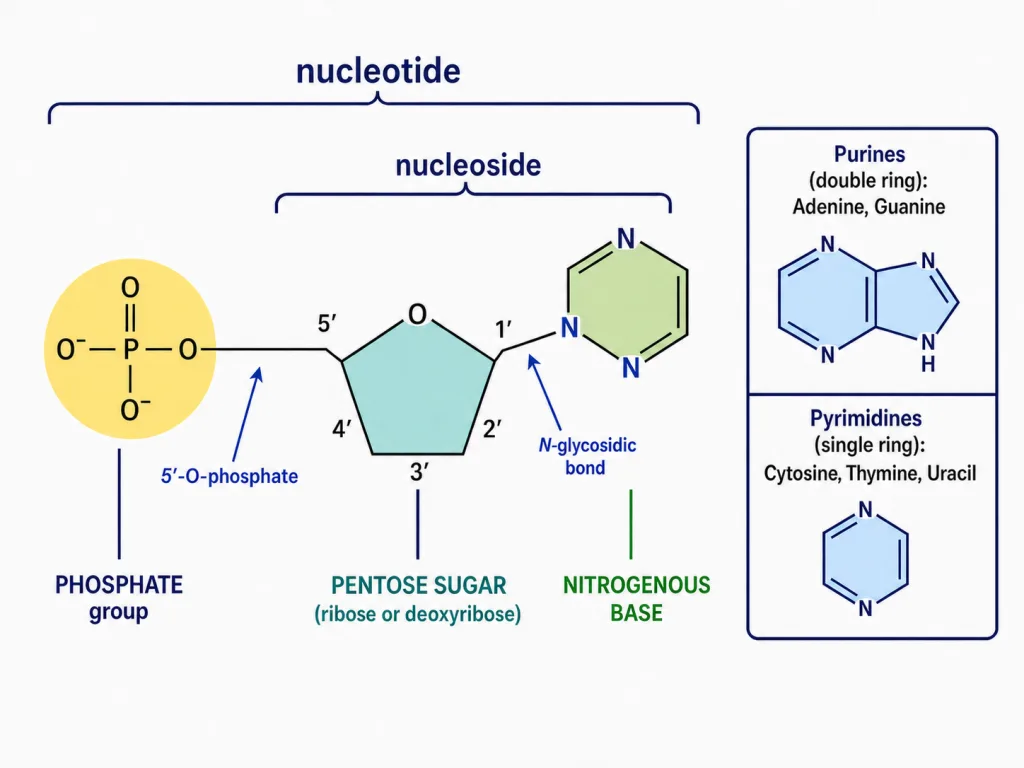
A nucleotide contains base, pentose sugar and phosphate. The base joins C1-prime through nitrogen, while phosphate is shown at the 5-prime oxygen.