
Hormonal regulation of kidney function
Kidney function is monitored by feedback involving the hypothalamus, the juxtaglomerular apparatus (JGA) and, to a smaller extent, the heart.
ADH and water balance
Changes in blood volume, body-fluid volume and ionic concentration activate osmoreceptors. Excessive fluid loss stimulates the hypothalamic response, and antidiuretic hormone (ADH), or vasopressin, enters the blood from the neurohypophysis. ADH increases water reabsorption from the latter parts of the renal tubule and therefore prevents diuresis. Once body-fluid volume rises, osmoreceptor activity and ADH release are suppressed. ADH also constricts blood vessels; the resulting rise in blood pressure can increase glomerular blood flow and GFR.
A deficiency or inadequate action of ADH causes diabetes insipidus, characterised by passage of large volumes of dilute urine. Do not confuse it with diabetes mellitus, in which glycosuria and ketonuria may be detected.
Renin-angiotensin-aldosterone mechanism
A fall in glomerular blood flow, glomerular blood pressure or GFR activates JG cells to release renin. Renin initiates conversion of angiotensinogen to angiotensin I, which is then converted to angiotensin II. Angiotensin II is a powerful vasoconstrictor: it raises glomerular blood pressure and GFR and stimulates the adrenal cortex to release aldosterone. Aldosterone increases reabsorption of sodium and water from distal parts of the tubule, further supporting blood pressure and GFR.
Atrial natriuretic factor
Increased blood flow to the atria can cause release of atrial natriuretic factor (ANF). ANF causes vasodilation, lowers blood pressure and acts as a check on the renin-angiotensin mechanism.
Micturition and normal urine
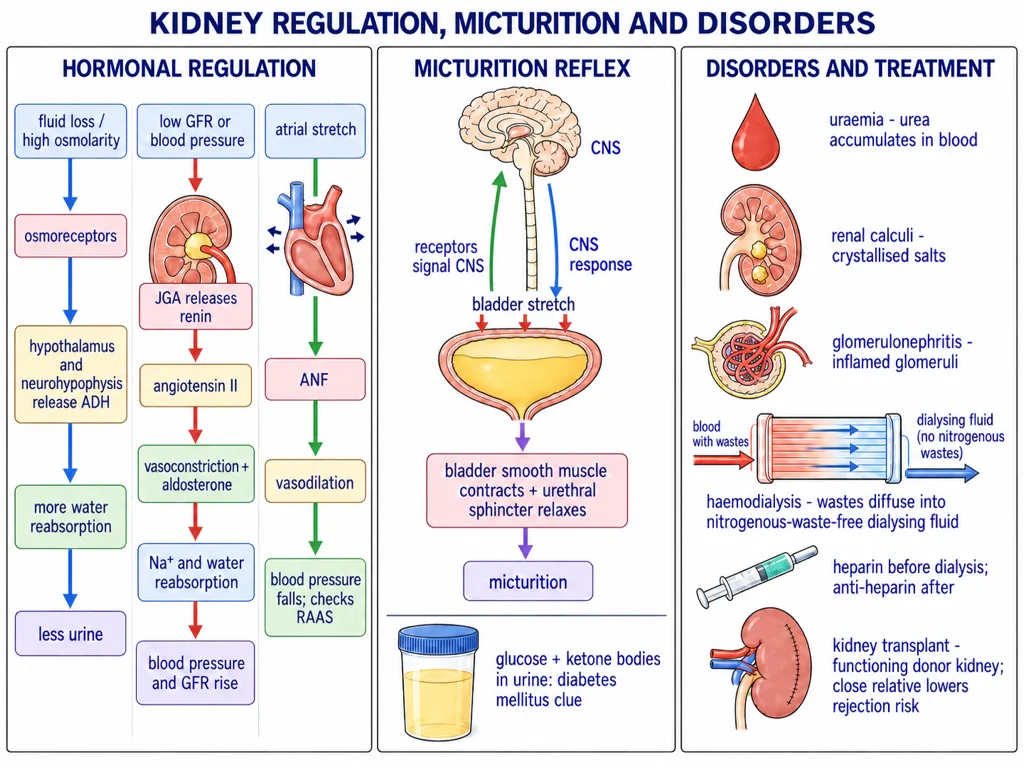
Urine formed by nephrons is carried to the urinary bladder, where it is stored until a voluntary signal is given by the central nervous system (CNS). Filling stretches the bladder wall. Stretch receptors signal the CNS, which sends motor messages that contract the bladder's smooth muscle while simultaneously relaxing the urethral sphincter. Urine then leaves through the urethra. This release is micturition, and its neural mechanism is the micturition reflex.
A healthy adult excretes about 1-1.5 litres of urine each day. Normal urine is a light-yellow, watery fluid, slightly acidic at about pH 6, with a characteristic odour. About 25-30 g of urea is excreted daily. These are approximate NCERT values; colour and volume can vary with hydration and other conditions.
Urine analysis and excretory disorders
Urine analysis can reveal metabolic disorders and malfunctioning of the kidney. Glycosuria means glucose in urine, while ketonuria means ketone bodies in urine; their presence is indicative of diabetes mellitus in the NCERT account.
Uraemia is the harmful accumulation of urea in blood when kidney function is impaired. It is a consequence and marker of inadequate renal clearance and may require haemodialysis.
Renal calculi are insoluble masses of crystallised salts, such as oxalates, formed within the kidney. Glomerulonephritis is inflammation of the glomeruli. Keep the defining structure straight: a calculus is a crystallised mass, whereas glomerulonephritis is inflammation of filtering capillary units.
Haemodialysis and transplantation
During haemodialysis, blood is withdrawn from a convenient artery and an anticoagulant such as heparin is added. The blood passes through a coiled cellophane tube in a dialysing unit. The surrounding dialysing fluid has a plasma-like composition but lacks nitrogenous wastes. Small solutes cross the semipermeable membrane according to concentration gradients, so nitrogenous wastes leave the blood; blood cells and large plasma proteins are retained. The cleared blood is returned through a vein after anti-heparin is added.
Haemodialysis substitutes for part of the kidney's excretory function, but it does not restore all endocrine and metabolic functions of healthy renal tissue. This distinction explains why patients with severe renal failure may still require management of anaemia and mineral imbalance.
NCERT identifies kidney transplantation as the ultimate corrective method for renal failure and notes that a functioning kidney is preferably obtained from a close relative to reduce the chance of immune rejection. For medical precision, transplantation is generally considered when kidney failure is irreversible or end-stage; it is not routine treatment for every potentially recoverable acute kidney injury.