
The Corticomedullary Osmotic Gradient
Mammalian kidneys can produce concentrated urine because the renal medulla maintains an increasing interstitial osmolarity. It rises from about 300 mOsmol L-1 in the cortex to about 1200 mOsmol L-1 in the inner medulla. This gradient is caused mainly by NaCl and urea.
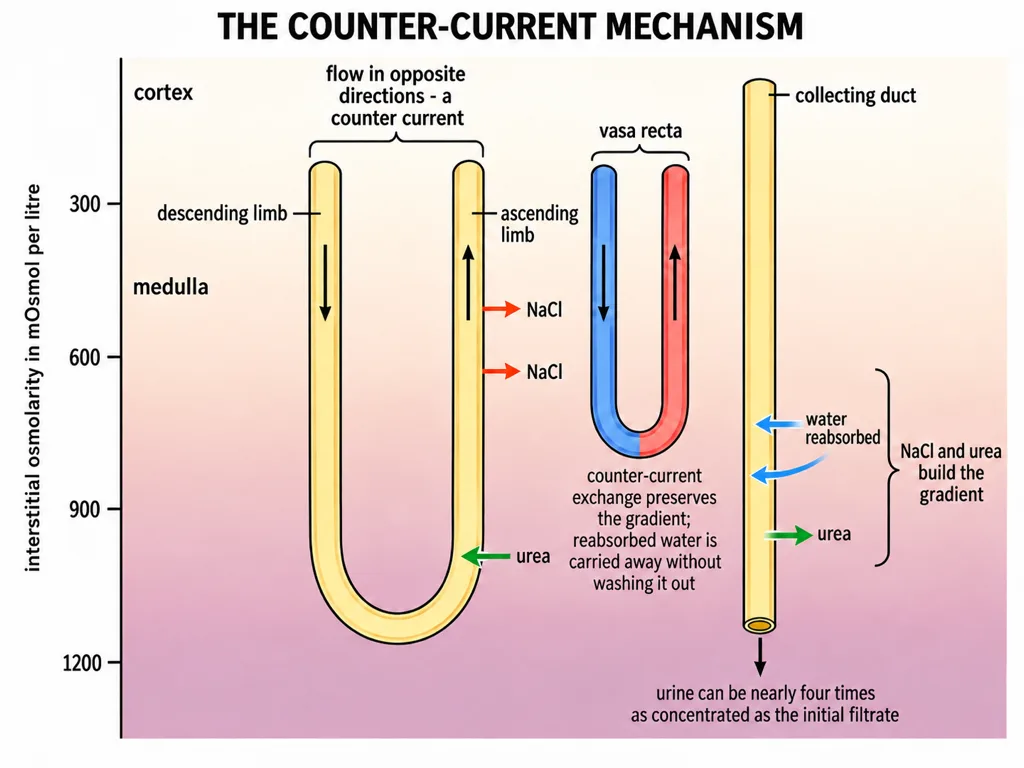
The gradient promotes the passage of water from the collecting tubule. Consequently, human kidneys can produce urine nearly four times as concentrated as the initial filtrate.
NCERT number trap: 300 → 1200 is the corticomedullary osmolarity gradient. The 180 L → 1-1.5 L comparison is a volume calculation and does not mean urine becomes 120 times as concentrated.
Henle's Loop: Opposite Flow and Opposite Permeability
Filtrate flows down the descending limb and up the ascending limb of Henle's loop. These opposite directions form a counter current.
- The descending limb is permeable to water and almost impermeable to electrolytes. Water leaves, so the filtrate becomes concentrated as it moves down.
- The ascending limb is impermeable to water but transports electrolytes actively or passively to the medullary fluid. The filtrate becomes diluted as it moves up.
The loop therefore helps establish and maintain high medullary interstitial osmolarity. It does not concentrate the final urine by simply removing both salt and water from the same limb.
Direction check: Descending limb → water out. Ascending limb → NaCl out, no water out.
Vasa Recta and NaCl Exchange
Blood also flows in opposite directions through the two limbs of the U-shaped vasa recta. The proximity of Henle's loop and vasa recta, together with counter-current flow in both structures, helps maintain the corticomedullary gradient.
NaCl transported from the ascending limb of Henle's loop is exchanged with the descending limb of the vasa recta. The ascending limb of the vasa recta returns NaCl to the medullary interstitium. This counter-current exchange limits loss of medullary solute in the blood leaving the medulla.
The vasa recta is a minute vessel of the peritubular capillary network arising from the efferent arteriole. It is absent or highly reduced in cortical nephrons, whose loops of Henle extend only a short distance into the medulla; it is well developed alongside the long loops of juxtamedullary nephrons.
Urea Recycling and Final Water Reabsorption
Small amounts of urea pass from the collecting tubule into the medullary interstitium. Urea also enters the thin segment of the ascending limb of Henle's loop and is later transported back to the interstitium through the collecting tubule. This recycling helps retain urea in the medulla and supports the osmotic gradient.
The collecting duct extends from the cortex to the inner medulla. As it passes through progressively more concentrated interstitial fluid, the gradient permits water to leave the tubular fluid, producing concentrated urine when water reabsorption is high.
One-pass NEET flow map
- Descending Henle limb loses water and concentrates the filtrate.
- Ascending Henle limb loses NaCl but not water and dilutes the filtrate.
- Vasa recta counter-current exchange helps retain medullary NaCl.
- Urea cycles between the collecting tubule, medullary interstitium and thin ascending limb.
- The maintained gradient facilitates water reabsorption from the collecting tubule.
The counter-current mechanism is the coordinated arrangement of Henle's loop and vasa recta that maintains the medullary concentration gradient; NaCl and urea are its principal osmotic contributors.