
Urine Formation and Glomerular Filtration
Three processes at different nephron sites
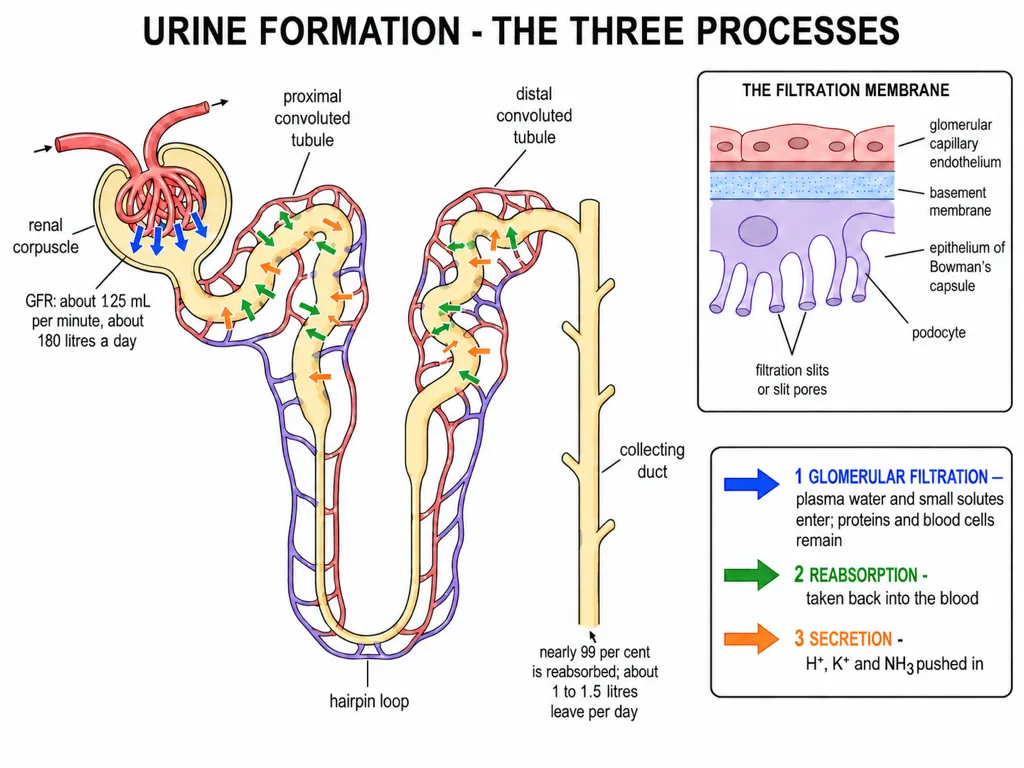
Urine formation involves glomerular filtration, reabsorption and secretion. Filtration occurs at the glomerulus; reabsorption and secretion occur along different parts of the renal tubule.
On average, the kidneys receive and filter about 1100-1200 mL of blood each minute, roughly one-fifth of the blood pumped by each ventricle per minute. Glomerular capillary blood pressure drives fluid from the glomerular capillaries into Bowman's capsule.
The three-layer filtration membrane
From capillary blood to the lumen of Bowman's capsule, filtrate crosses:
- the endothelium of the glomerular capillaries,
- the basement membrane, and
- the epithelium of Bowman's capsule.
The epithelial cells of Bowman's capsule are podocytes. Their interdigitating processes leave minute filtration slits or slit pores. Blood cells and plasma proteins are retained, while almost all other plasma constituents enter the capsular lumen. This fine, largely non-selective filtration is called ultrafiltration.
NCERT trap: The filtrate is not whole blood and is not merely water. It is a protein-poor, cell-free fluid containing water and small dissolved substances such as glucose, amino acids, ions and nitrogenous wastes.
GFR, JGA and the 180-Litre Calculation
Glomerular filtration rate
The volume of filtrate formed by the kidneys per minute is the glomerular filtration rate (GFR). In a healthy person it is approximately 125 mL per minute, equivalent to about 180 litres per day.
Only about 1-1.5 litres of urine are released daily. Comparing this output with 180 litres of filtrate shows that the renal tubules reabsorb nearly 99 per cent of the filtrate.
Autoregulation by the juxtaglomerular apparatus
The juxtaglomerular apparatus (JGA) is a sensitive region formed by cellular modifications in the distal convoluted tubule (DCT) and the afferent arteriole where they contact each other. A fall in GFR activates juxtaglomerular cells to release renin. Through the renal regulatory response, glomerular blood flow and GFR are restored towards normal.
Number chain: 1100-1200 mL blood filtered per minute → 125 mL filtrate per minute → 180 L filtrate per day → nearly 99% reabsorbed → 1-1.5 L urine per day.
Reabsorption, Secretion and the PCT
Direction and mechanism
Reabsorption moves selected substances from tubular fluid back to the blood. NCERT examples such as glucose, amino acids and Na+ are actively reabsorbed, whereas nitrogenous wastes are reabsorbed passively. Water is also reabsorbed passively in the initial nephron segments.
Tubular secretion moves selected substances from the blood or tubular cells into the filtrate. Across the renal tubule as a whole, secretion of H+, K+ and ammonia helps maintain ionic and acid-base balance.
Proximal convoluted tubule
The PCT is lined by simple cuboidal brush-border epithelium, providing a large surface area for reabsorption. It reabsorbs:
- nearly all essential nutrients;
- 70-80 per cent of filtered electrolytes and water; and
- bicarbonate (HCO3-), which contributes to acid-base balance.
The PCT selectively secretes H+ and ammonia into the filtrate. Do not assign the DCT's characteristic K+ secretion to the PCT when answering an NCERT-based segment question.
NEET contrast: General tubular secretion includes H+, K+ and ammonia, but NCERT's PCT description specifically names H+ and ammonia.
Segment-wise Functions Beyond the PCT
Henle's loop
The descending limb is permeable to water but almost impermeable to electrolytes, so its filtrate becomes concentrated as it descends. The ascending limb is impermeable to water but transports electrolytes actively or passively into the medullary interstitium; the filtrate becomes diluted as it ascends. Reabsorption is minimum in the ascending limb, yet its electrolyte transport is crucial for medullary osmolarity.
Distal convoluted tubule
The DCT performs conditional reabsorption of Na+ and water. It can also reabsorb HCO3- and selectively secrete H+, K+ and NH3, helping maintain blood pH and sodium-potassium balance.
Collecting duct
The collecting duct extends from the cortex into the inner medulla. It can reabsorb large amounts of water to produce concentrated urine, allows small amounts of urea to enter the medullary interstitium, and selectively secretes H+ and K+ to support pH and ionic balance.
| Segment | High-yield NCERT function |
|---|---|
| PCT | Bulk reabsorption; H+ and ammonia secretion; HCO3- reabsorption |
| Descending limb | Water leaves; filtrate concentrates |
| Ascending limb | Electrolytes leave; water does not; filtrate dilutes |
| DCT | Conditional Na+ and water reabsorption; H+, K+, NH3 secretion |
| Collecting duct | Water reabsorption, small urea passage, H+ and K+ secretion |