
Nitrogenous wastes and modes of excretion
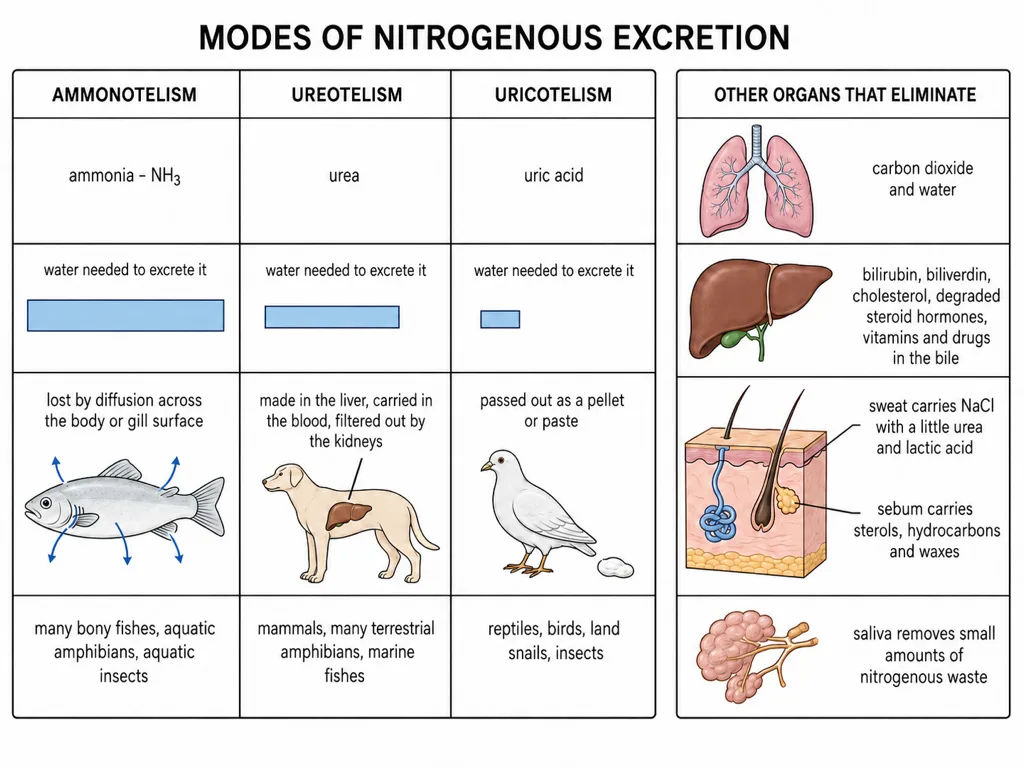
Animals accumulate nitrogenous wastes through metabolism. The major forms are ammonia, urea and uric acid. Besides these nitrogenous wastes, animals must also eliminate CO2, water and ions such as Na+, K+, Cl-, phosphate and sulphate. Ammonia is the most toxic and requires a large amount of water for elimination; uric acid is the least toxic and can be removed with minimum water loss.
- Ammonotelism: excretion mainly as ammonia. Many bony fishes, aquatic amphibians and aquatic insects are ammonotelic. Readily soluble ammonia is generally eliminated by diffusion across the body surface or gills as ammonium ions; kidneys play no significant role.
- Ureotelism: excretion mainly as urea. Mammals, many terrestrial amphibians and marine fishes are ureotelic. Metabolic ammonia is converted to urea in the liver, released into blood and filtered by the kidneys. In some of these animals, some urea is retained in the kidney matrix to maintain the desired osmolarity.
- Uricotelism: excretion mainly as uric acid. Reptiles, birds, land snails and insects eliminate it as a pellet or paste with minimum water loss.
[NEET Important] Learn the animal examples together with the waste form; questions often exchange one member between the three lists.
Lungs and liver in excretion
Kidneys are not the only human organs that eliminate metabolic products. The lungs remove large amounts of - approximately 200 mL per minute - and significant quantities of water.
The liver, the largest gland in the body, secretes bile containing bilirubin, biliverdin, cholesterol, degraded steroid hormones, vitamins and drugs. Most of these substances ultimately leave with digestive wastes.
Keep the routes distinct: lungs eliminate and water, whereas the liver transfers its listed substances into bile.
Skin and saliva in excretion
Sweat glands produce a watery fluid containing sodium chloride and small amounts of urea and lactic acid. Cooling the body surface is sweat's primary function, but sweating also removes small quantities of these wastes.
Sebaceous glands eliminate sterols, hydrocarbons and waxes through sebum. Sebum also forms a protective oily covering over the skin. Small amounts of nitrogenous wastes may also be eliminated through saliva.
[NEET Important] Do not interchange sweat and sebum: sweat is watery and contains , urea and lactic acid; sebum carries sterols, hydrocarbons and waxes.