
Muscle tissue and its fibres
Muscle tissue is made of elongated cells called muscle fibres, and it is the tissue responsible for movement of the body and of its parts. What allows a fibre to do this is a set of special contractile proteins, whose interactions actively shorten the fibre during contraction; relaxation removes active tension and allows the fibre to return toward its resting length.
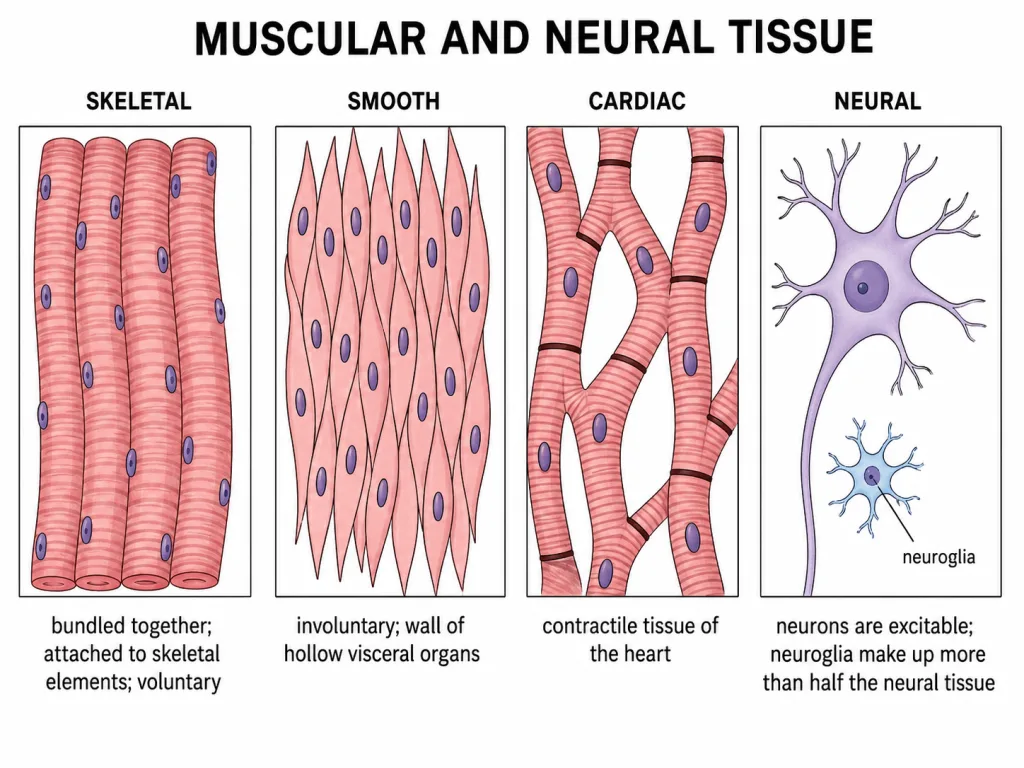
Three kinds of muscle exist:
- Skeletal muscle
- Smooth muscle
- Cardiac muscle
Skeletal, smooth and cardiac muscle
Skeletal muscle tissue is closely attached to the skeletal bones. In a typical muscle such as the biceps, striated (striped) muscle fibres are bundled together in a parallel fashion, and a sheath of tough connective tissue encloses several such bundles. That sheath is what turns a mass of separate fibres into a single organ that pulls on a bone as one.
Smooth muscle fibres taper at both ends, giving them a fusiform shape, and they carry no striations. Neighbouring fibres are held together by cell junctions, forming bundles and sheets rather than the discrete named muscles of the skeleton. Smooth muscle is found in the wall of the alimentary canal and in the walls of blood vessels, and its activity is involuntary - it is not under the direct control of the will.
Cardiac muscle is a contractile tissue present only in the heart. Its cells are stuck together in a branching fashion: they join at fusion points, where intercalated discs appear as communication junctions, so an electrical signal spreads through the whole sheet and the tissue contracts as a single unit. Intercalated discs are found nowhere else, which is why smooth muscle is characterised partly by their absence.
Neural tissue
Neural tissue exerts the greatest control over the body's responsiveness to changing conditions. Its excitable cells are the neurons. Alongside them sit the neuroglial cells, which protect and support the neurons and make up more than half the volume of neural tissue; despite their supporting role, neuroglia are not classed as a connective tissue.
When a neuron is suitably stimulated, an electrical disturbance is generated, and this disturbance travels swiftly along the neuron's plasma membrane. Its arrival at the endings of the neuron may either stimulate or inhibit the adjacent neurons and other cells - the same signal can therefore switch a target on or shut it down.
The frog's body and skin
The frog studied as the representative animal is Rana tigrina. Frogs live both on land and in fresh water.
Their skin is smooth and slippery because of the mucus covering it, and it is always kept moist. The body is divisible into a head and a trunk; a neck and a tail are absent. On the dorsal side the colouration is olive green with dark irregular spots, while the ventral side is uniformly pale yellow.
A frog never drinks water. It absorbs the water it needs through the skin, which is one reason that surface can never be allowed to dry.
Living at the environment's temperature
The frog can change the colour of its skin to blend with its surroundings and hide from enemies, a protective device described as camouflage or mimicry.
It is also a poikilotherm: its body temperature varies with the temperature of the environment rather than being held steady. Two periods of dormancy follow from this. Aestivation is summer sleep and hibernation is winter sleep, and the frog passes both of them inside deep burrows, sheltered from the extreme temperature outside.
Eyes, ears and limbs
The eyes are bulged and are covered by a nictitating membrane, which protects them while the frog is in water. A tympanum lies on either side of the eye and receives sound signals; external ears are absent altogether.
The fore limbs bear four digits and the hind limbs bear five. The hind limbs are larger and more muscular than the fore limbs and are used for swimming and leaping, and the digits of the hind feet are webbed to push against water.
Male and female differ in visible ways. Only the male carries vocal sacs and a copulatory pad, the latter sitting on the first digit of the fore limb. Webbing, eye structure and colouration are shared by both sexes and separate neither.
The frog's place in the field
Frogs are useful animals. They eat insects and so protect the crop, and they are an important link in maintaining ecological balance. In some countries the muscular legs of the frog are used as food.
Muscle Tissue — One-Table Comparison
| Feature | Skeletal muscle | Smooth muscle | Cardiac muscle |
|---|---|---|---|
| Fibre shape | Long, cylindrical and unbranched | Fusiform and unbranched | Short, cylindrical and branched |
| Striations | Present | Absent | Present |
| Control | Voluntary | Involuntary | Involuntary |
| Nuclei | Many, usually peripheral | One, central | Usually one, central |
| Main site | Attached to bones | Walls of hollow organs and blood vessels | Heart |
| Diagnostic feature | Parallel fibre bundles | Tapering cells in sheets | Intercalated discs coordinate contraction |
[NEET Important] “Striated” does not automatically mean voluntary: cardiac muscle is striated but involuntary. “Involuntary” does not automatically mean non-striated: cardiac muscle is the exception.
Neural-tissue checkpoint
Neurons are the excitable signalling cells. Neuroglia support and protect neurons and occupy more than half the volume of neural tissue, but they are not classified as connective tissue and are not specialised for muscular contraction.