
The closed circulation and the three-chambered heart
The frog has a closed circulatory system, its blood confined to vessels of varying diameters. The heart is a muscular structure lying in the upper part of the body cavity and covered by a membrane called the pericardium. It is built of three chambers - two atria and a single ventricle.
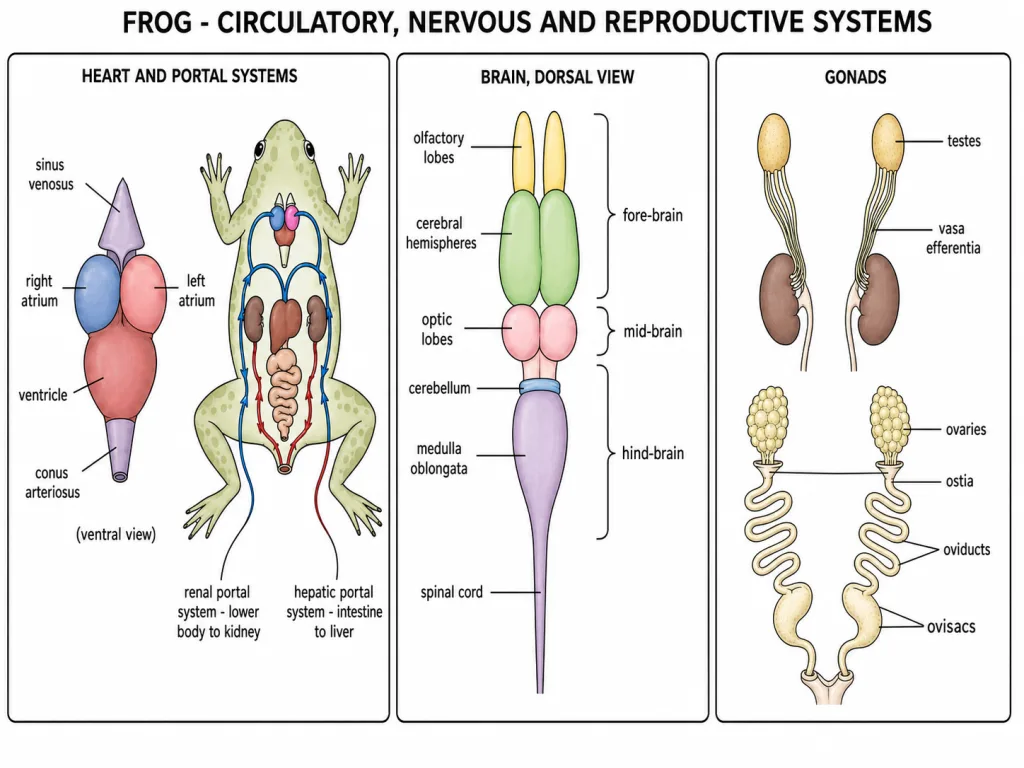
The ventricle opens into a sac-like conus arteriosus on the ventral side of the heart. Blood from the heart is carried to all parts of the body by the arteries, which make up the arterial system, while the veins collect blood from different parts and return it to the heart as the venous system. The vena cava brings deoxygenated blood from the body to the heart, and the sinus venosus delivers it into the right atrium.
Blood also travels along portal routes: the hepatic portal system between the intestine and the liver, the renal portal system between the lower part of the body and the kidney.
Blood and lymph
Frog blood is composed of plasma and cells: RBCs (erythrocytes), WBCs (leucocytes) and platelets. The RBCs are nucleated and contain the red pigment haemoglobin. Blood carries nutrients, gases and water to their respective sites.
Lymph is another body fluid, differing from blood in lacking RBCs and containing fewer plasma proteins. It contains leucocytes, especially lymphocytes, but platelets are not treated as a normal constituent of lymph.
How the nervous system is organised
The nervous system is divided into a central part (the brain and the spinal cord), a peripheral part (the cranial and spinal nerves) and an autonomic part (sympathetic and parasympathetic). Ten pairs of cranial nerves arise from the frog's brain, two pairs fewer than the twelve of a human.
The brain is enclosed in a bony brain box, or cranium, and falls into three regions. The fore-brain comprises the olfactory lobes, the paired cerebral hemispheres and an unpaired diencephalon. The mid-brain is characterised by a pair of optic lobes. The hind-brain consists of the cerebellum and the medulla oblongata. The medulla oblongata passes out through the foramen magnum and continues as the spinal cord, protected within the vertebral column.
Control and coordination involve the nervous system together with the endocrine system - pituitary, thyroid, parathyroid, thymus, pineal body, pancreatic islets, adrenal and gonads.
The sense organs
The frog possesses organs for touch, taste, smell, vision and hearing:
- Touch - sensory papillae
- Taste - taste buds
- Smell - nasal epithelium
- Vision - eyes
- Hearing - tympanum along with the internal ears
Among these, only the eyes and the internal ears are well-organised organs; the remainder are cellular aggregations around nerve endings. The eyes are a pair of spherical structures in the orbit; they are simple eyes, made of only one unit. The tympanum receives sound signals.
The male and female reproductive organs
The male has a pair of yellowish, ovoid testes adherent to the upper part of the kidneys by a double fold of peritoneum, the mesorchium. From the testes 10-12 vasa efferentia arise, enter the kidney of their own side, and open into Bidder's canal. Bidder's canal in turn communicates with the urinogenital duct, which emerges from the kidney and opens into the cloaca.
The female has a pair of ovaries near the kidneys, with no functional connection with the kidneys. Each oviduct begins anteriorly as a funnel-shaped ostium, runs posteriorly as a coiled tube and enlarges near its posterior end into an ovisac, also called the uterus. The two oviducts open separately into the cloaca; they do not merge into a common reproductive duct. The ureters also open into the cloaca separately, and no urinogenital duct exists in the female. A mature female sheds 2500-3000 ova at a time.
Fertilisation is external and occurs in water. Development proceeds through a larval stage, the tadpole, which undergoes metamorphosis to become the adult. Males are distinguished by vocal sacs and a copulatory pad on the first digit of the fore limb, both absent in females.
Where students go wrong
The optic lobes belong to the mid-brain, not the hind-brain; the hind-brain contains the cerebellum and the medulla oblongata only. The olfactory lobes are fore-brain structures, and the diencephalon is unpaired while the cerebral hemispheres are paired.
The conus arteriosus is ventral and leads out of the ventricle; the sinus venosus opens into the right atrium.
Frog RBCs keep their nucleus; mammalian ones do not. The frog has ten pairs of cranial nerves, the human twelve.
In the male, the vasa efferentia enter the kidney and reach Bidder's canal, ending in a urinogenital duct. In the female, the ovaries have no connection with the kidney, and the ureters and oviducts reach the cloaca by separate openings.
The hepatic portal system links the intestine with the liver; the renal portal system links the lower body with the kidney.
Frog Internal-System Route Maps
| System | High-yield route or relationship |
|---|---|
| Venous return | Venae cavae → sinus venosus → right atrium |
| Outflow | Ventricle → conus arteriosus → arterial system |
| Hepatic portal | Intestine → liver |
| Renal portal | Lower body → kidneys |
| Male reproductive | Testis → vasa efferentia → kidney/Bidder's canal → urinogenital duct → cloaca |
| Female reproductive | Ostium → oviduct → ovisac → separate opening into cloaca |
Brain-region checkpoint
- Forebrain: olfactory lobes, paired cerebral hemispheres and unpaired diencephalon.
- Midbrain: paired optic lobes.
- Hindbrain: a narrow transverse cerebellum and the medulla oblongata.
[NEET Important] The female oviducts do not merge. Each has its own posterior ovisac and opens separately into the cloaca. The corrected diagram shows the frog cerebellum as a narrow unpaired band rather than a large paired structure.