
A short canal for a carnivorous diet
The frog's alimentary canal is short. A carnivore swallows food that is already protein-rich and comparatively easy to break down, so the length of the intestine is reduced.
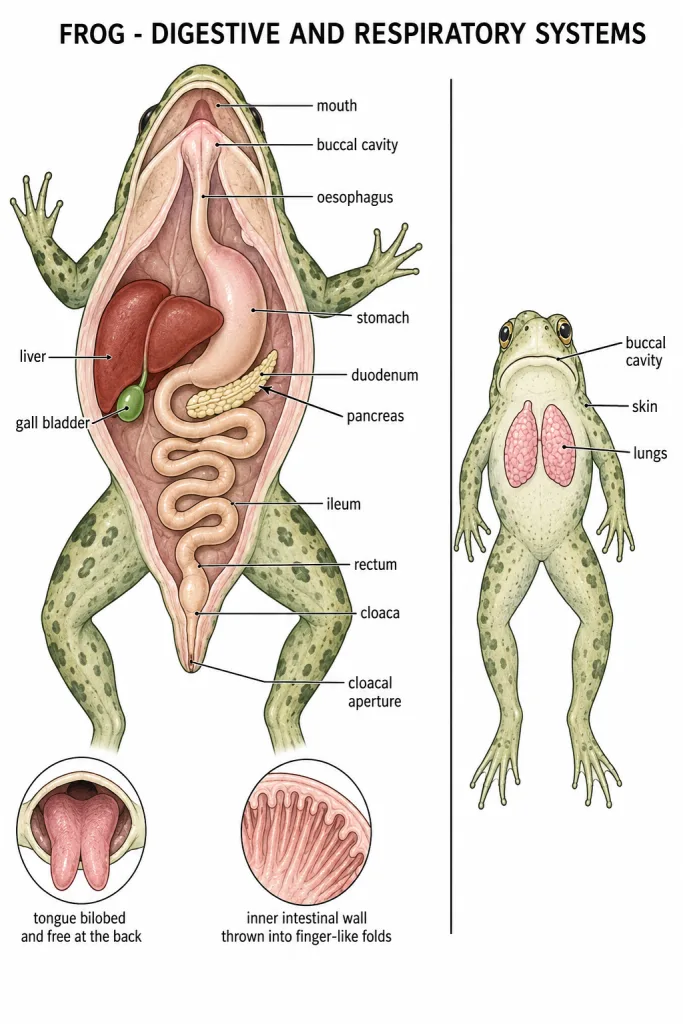
The canal begins at the mouth, which opens into the buccal cavity. This leads through the pharynx into a short oesophagus, and the oesophagus opens directly into the stomach. Beyond the stomach the canal continues as the intestine, whose first part is the duodenum and whose longer coiled portion is the ileum. The intestine leads into the rectum, and the rectum opens into the cloaca.
The cloaca is a common chamber. Faecal matter, urinary products and reproductive products all arrive in it, and all leave the body through one opening, the cloacal aperture.
Teeth and the tongue
Maxillary teeth are borne on the upper jaw, while vomerine teeth sit on the palate, the roof of the buccal cavity. Both kinds grip prey rather than chew it.
The tongue is bilobed - its free end is notched into two lobes. It is attached anteriorly, at the front of the floor of the buccal cavity, and lies free posteriorly, the reverse of the human arrangement. Because it is anchored only at the front, the tongue is protrusible: it flicks outward to capture prey and is drawn back with the catch adhering to it.
The digestive glands
The liver and the pancreas both pour secretions into the canal. The liver secretes bile, which is not released straight away but is stored in the gall bladder until it is needed. The pancreas is a digestive gland with a double output: it produces digestive enzymes and it also produces hormones.
From chyme to final digestion
Inside the stomach, digestion is carried out by HCl and gastric juices secreted from the stomach wall itself. Food leaving the stomach is only partly broken down at this stage and is called chyme; it passes on into the duodenum.
The duodenum is where the glandular secretions arrive. Bile from the gall bladder and pancreatic juice from the pancreas both reach it through a common bile duct. Their tasks are different. Bile emulsifies fat, breaking large fat globules into smaller droplets so enzymes can act efficiently. Pancreatic juice contains enzymes that digest carbohydrates, proteins and fats, including pancreatic lipase for fats. Bile is therefore a non-enzymatic preparatory secretion rather than a digestive enzyme.
Final digestion takes place in the intestine.
Absorption and the exit of waste
Digested food is absorbed through the inner wall of the intestine, which is thrown into numerous finger-like folds called villi, carrying still finer microvilli on their surface. These folds multiply the surface available for absorption, which matters in a canal that is short to begin with.
Whatever remains undigested moves on as solid waste into the rectum and passes out of the body through the cloaca.
Lungs, skin and buccal cavity
The lungs are a pair of elongated, pink, sac-like structures lying in the upper part of the trunk, the region called the thorax. Air is drawn in through the nostrils, enters the buccal cavity, and from there passes to the lungs. Exchange of gases in the lungs is pulmonary respiration.
The lungs are not the only respiratory surface. The frog's skin is thin and rich in blood vessels, so gases diffuse straight across it between the surrounding medium and the blood underneath. This is cutaneous respiration, and it works only because the skin is kept permanently moist.
Which surfaces are actually in use depends on where the animal is at the time. In water, respiration occurs through the skin alone. On land, three surfaces share the work: the skin, the lining of the buccal cavity, and the lungs. The skin also carries the entire burden during aestivation and hibernation, when the animal lies buried and inactive and neither the lungs nor the buccal cavity are ventilated.
That arrangement explains both why a submerged frog need not surface for air and why drying of the skin is fatal to it. The cutaneous route is not a supplement that can be dispensed with; in water it is the only route available.
Frog Respiratory Routes — Keep the Surfaces Separate
Route to the lungs
External nares → internal nares → buccopharyngeal cavity → glottis → laryngo-tracheal chamber → lungs
The buccopharyngeal region is a shared passage, not an exclusively digestive structure. Gas exchange across its moist vascular lining is buccopharyngeal respiration; gas exchange across the lungs is pulmonary respiration.
| Condition | Main respiratory surfaces |
|---|---|
| In water | Moist skin — cutaneous respiration |
| On land | Skin, buccopharyngeal lining and lungs |
| Aestivation and hibernation | Moist skin |
[NEET Important] The nictitating membrane protects the eye and is not a respiratory surface. The tympanum receives sound and is not an air inlet.