
A Vision of a World of Nations
In 1848, the French artist Frédéric Sorrieu prepared a series of four prints visualising his dream of a world made up of 'democratic and social Republics'. In the first print, the peoples of Europe and America — men and women of all ages and classes — march in a long train and offer homage to the Statue of Liberty, who bears the torch of Enlightenment in one hand and the Charter of the Rights of Man in the other. On the ground lie the shattered symbols of absolutist institutions.
In Sorrieu's utopian vision the peoples of the world are grouped as distinct nations, identified by their flags and costumes. Leading the procession are the United States and Switzerland, already nation-states; France, with the revolutionary tricolour, has just reached the statue, followed by the peoples of Germany bearing the black, red and gold flag — though Germany was not yet a united nation.
What is a Nation-State?
During the nineteenth century nationalism emerged as a force that brought sweeping changes to the political and mental world of Europe. Its end result was the nation-state replacing the multi-national dynastic empires.
A modern state is one in which a centralised power exercises sovereign control over a clearly defined territory. But a nation-state is one in which the majority of its citizens — not only its rulers — come to develop a sense of common identity and shared history. This commonness did not exist from time immemorial; it was forged through struggles and through the actions of leaders and common people.
In a lecture at the Sorbonne in 1882, the French philosopher Ernst Renan argued that a nation is not made merely by common language, race or religion, but is a large-scale solidarity — 'its existence is a daily plebiscite'.
The French Revolution and the Idea of the Nation
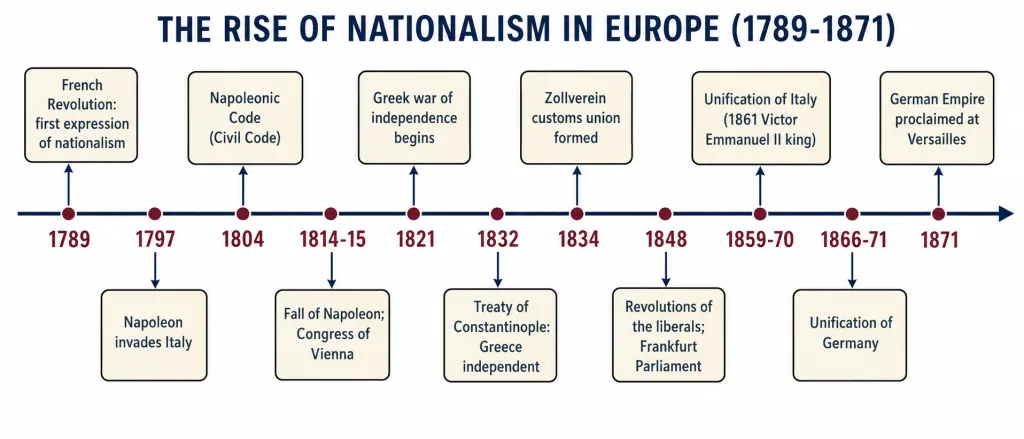
The first clear expression of nationalism came with the French Revolution in 1789. France was already a full-fledged territorial state under an absolute monarch, but the Revolution transferred sovereignty from the monarchy to a body of French citizens. It proclaimed that henceforth it was the people who would constitute the nation and shape its destiny.
The revolutionaries introduced measures to create a sense of collective identity:
- The ideas of la patrie (the fatherland) and le citoyen (the citizen), stressing a united community with equal rights under a constitution.
- A new tricolour flag replaced the royal standard.
- The Estates General was renamed the National Assembly.
- New hymns, oaths and martyrs in the name of the nation.
- A centralised administration with uniform laws, the abolition of internal customs duties, and a uniform system of weights and measures.
- French (as spoken in Paris) became the common language.
Carrying Nationalism Abroad
The revolutionaries declared that it was the mission and destiny of the French nation to liberate the peoples of Europe from despotism — to help other peoples become nations.
When news of the events in France reached other cities, students and members of the educated middle classes set up Jacobin clubs. Their activities prepared the way for the French armies that moved into Holland, Belgium, Switzerland and much of Italy in the 1790s. With the outbreak of the revolutionary wars, the French armies began to carry the idea of nationalism abroad.
Questions and Answers
Q1. Who was Frédéric Sorrieu and what did his 1848 prints depict? Ans. Frédéric Sorrieu was a French artist who, in 1848, prepared a series of four prints visualising a world made up of democratic and social Republics. The peoples of the world, grouped as distinct nations with their flags, offer homage to the Statue of Liberty, while the shattered symbols of absolutism lie on the ground.
Q2. When did the first clear expression of nationalism come? Ans. With the French Revolution of 1789, which transferred sovereignty from the monarchy to a body of French citizens.
Questions and Answers (continued)
Q3. What measures did the French revolutionaries introduce to create a sense of collective identity? Ans. They promoted the ideas of la patrie and le citoyen, adopted a tricolour flag, renamed the Estates General the National Assembly, composed hymns and commemorated martyrs, set up a centralised administration with uniform laws, weights and measures, abolished internal customs, and made French the common language.
Q4. According to Ernst Renan, what makes a nation? Ans. Renan argued that a nation is not made by common language, race or religion, but is a large-scale solidarity built on a shared past and a common will — 'its existence is a daily plebiscite'.