
Formal and Informal Sources of Credit
Loans can be grouped into formal sector loans and informal sector loans.
- Formal sources: loans from banks and cooperatives.
- Informal sources: moneylenders, traders, employers, relatives and friends.
In rural India (2019 data), the largest source is commercial banks (about 51 per cent), with cooperatives (about 10 per cent) and other formal agencies adding more, while moneylenders (about 23 per cent) remain the biggest informal source.
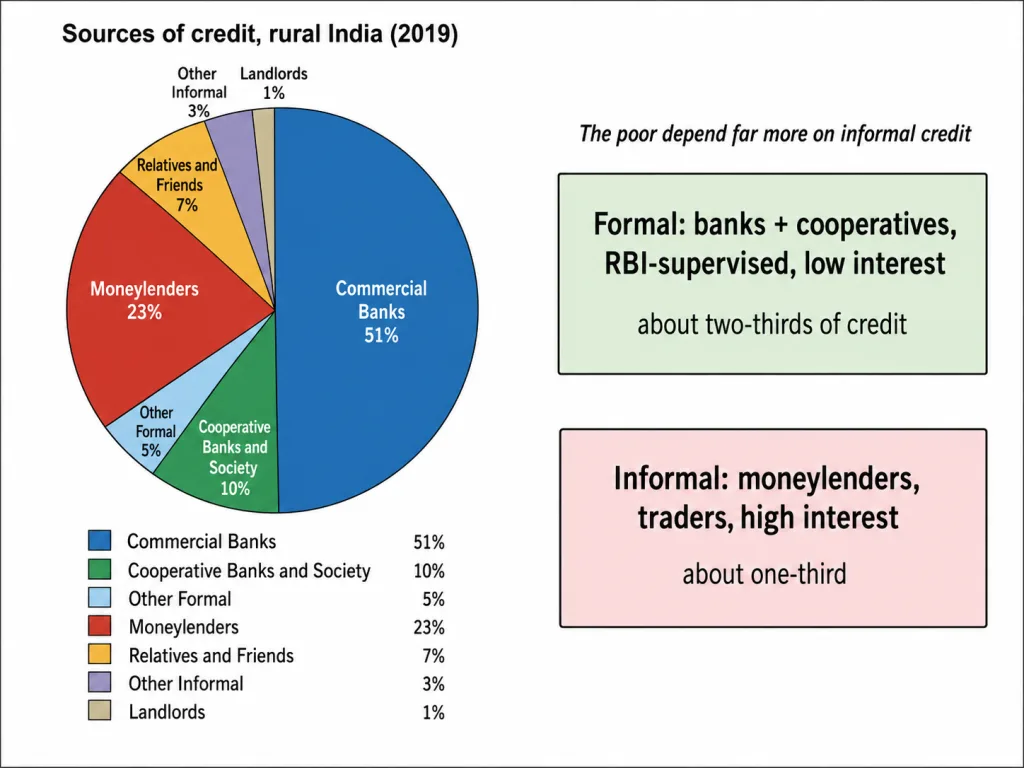
Why Supervision and Cheap Credit Matter
The Reserve Bank of India (RBI) supervises the formal sources. It checks that banks maintain their cash balance, and that they lend not just to profitable businesses but also to small cultivators, small industries and small borrowers. Banks must periodically report how much they lend, to whom, and at what interest rate.
There is no organisation to supervise informal lenders — they can charge whatever interest they like and use unfair means to recover money. Informal loans usually carry a much higher interest rate, so a larger part of the borrower's earnings goes to repay the loan, leaving less income and sometimes leading to a debt-trap. Therefore cheap and affordable credit is crucial for development, and banks and cooperatives need to lend more.
Who Gets Formal Credit?
Formal credit is not shared equally. In urban areas, 54 per cent of loans taken by poor households come from informal sources, while for rich households only 17 per cent are informal (83 per cent formal). A similar pattern holds in rural areas: the rich get cheap formal credit, while the poor pay heavily for informal loans.
This suggests two things: first, formal-sector credit must expand so that dependence on costly informal credit falls; and second, formal credit must be distributed more equally, so that the poor also benefit from cheaper loans. Both steps are important for development.
Questions and Answers
Q1. What are the differences between formal and informal sources of credit?
Answer: Formal sources are banks and cooperatives, supervised by the RBI, which ensures they charge reasonable interest and lend to small borrowers too. Informal sources — moneylenders, traders, employers, relatives — are not supervised by any organisation, charge much higher interest, and may use unfair means to recover loans. Thus formal credit is cheaper and regulated, while informal credit is costly and unregulated.
Q2. How does the RBI supervise the functioning of formal sources of credit?
Answer: The RBI supervises formal lenders by (i) monitoring that banks maintain the required cash balance; (ii) ensuring banks lend not only to profitable businesses but also to small cultivators, small industries and small borrowers; and (iii) requiring banks to periodically report how much they are lending, to whom and at what interest rate. This keeps the formal credit system fair and safe.
Q3. Why should cheap credit at reasonable rates be available to all, especially the poor?
Answer: Because cheap credit helps people start enterprises, grow crops and raise their incomes, which is crucial for development. At present the rich get cheap formal loans while the poor depend on costly informal loans, so a large part of the poor's earnings goes to repay debt, sometimes causing a debt-trap. Expanding formal credit and distributing it more equally would let the poor also borrow cheaply and improve their lives.