
Modern Forms of Money — Currency
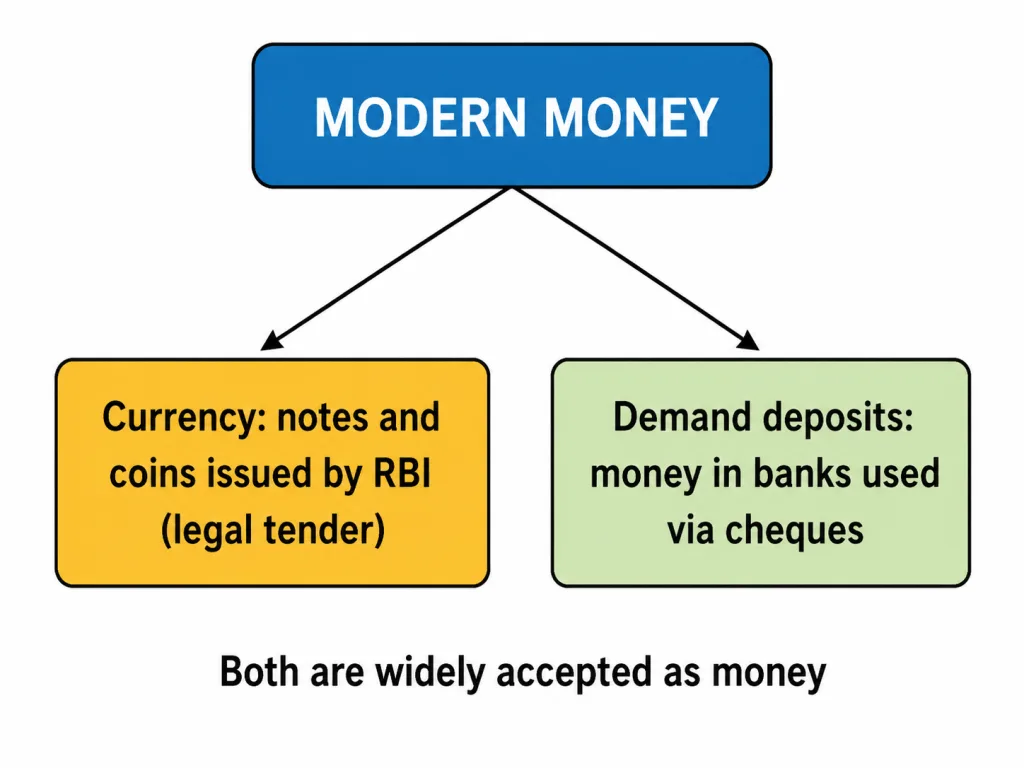
Before coins, many objects were used as money — early Indians used grains and cattle, then metallic coins of gold, silver and copper. Modern currency — paper notes and coins — is not made of precious metal and has no use of its own.
Then why is currency accepted? Because it is authorised by the government. In India, the Reserve Bank of India (RBI) issues currency notes on behalf of the central government. By law, no one else may issue currency, and no individual can refuse a payment made in rupees — so the rupee is widely accepted as a medium of exchange (it is legal tender).
Deposits with Banks
People also hold money as deposits with banks. People need only some cash for day-to-day use, so they deposit their extra money in bank accounts. Banks accept the deposits and pay interest on them, keeping people's money safe while it earns income. People can withdraw the money on demand, so these are called demand deposits.
Cheques and Demand Deposits as Money
Demand deposits offer another facility that gives them the essential feature of money — the ability to make payments. A cheque is a paper instructing the bank to pay a specific amount from the payer's account to the person named on the cheque.
For example, shoe manufacturer M. Salim writes a cheque to his leather supplier; the supplier deposits it in his account, and the money is transferred from one account to another without any cash. Because payments can be settled directly against demand deposits using cheques, demand deposits are accepted widely as money — so, along with currency, they constitute money in the modern economy. These modern forms are closely linked to the banking system.
Questions and Answers
Q1. Why is modern currency accepted as a medium of exchange even though it has no value of its own?
Answer: Modern currency (paper notes and coins) is accepted because it is authorised by the government. In India the Reserve Bank of India issues currency on behalf of the central government, no one else may issue it, and by law no person can refuse a payment made in rupees. This legal backing makes the rupee legal tender, so everyone accepts it as a medium of exchange even though the paper itself has no intrinsic value.
Q2. What are demand deposits? Why are they considered money?
Answer: Demand deposits are deposits in bank accounts that can be withdrawn on demand. They are considered money because they share the essential feature of money — they can be used to make payments. Using a cheque, a person can instruct the bank to transfer money from their account to another account, settling a payment without cash. Since demand deposits are widely accepted as a means of payment, they constitute money along with currency.
Q3. What is a cheque, and how does a cheque payment work?
Answer: A cheque is a paper instructing the bank to pay a specific amount from the payer's account to the person named on it. When M. Salim pays his leather supplier by cheque, he instructs his bank to pay that amount; the supplier deposits the cheque in his own account, and the money is transferred from Salim's account to the supplier's account in a couple of days — completing the transaction without any cash.