
Money as a Medium of Exchange
The use of money spans a very large part of our everyday life. In many transactions, goods and services are bought and sold using money; in some, there is no transfer of money now but a promise to pay later.
Why are transactions made in money? Because a person holding money can easily exchange it for any commodity or service they want. So everyone prefers to receive payment in money and then spend that money on the things they need.
Double Coincidence of Wants
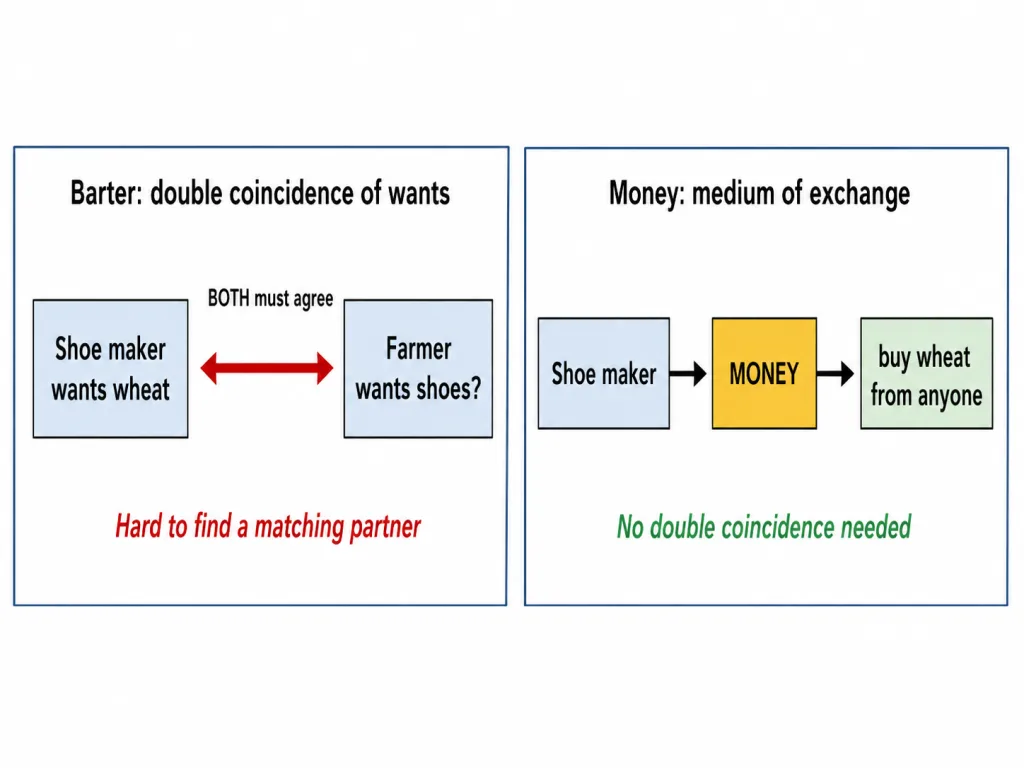
Consider a shoe manufacturer who wants to sell shoes and buy wheat. With money, he simply sells shoes for money, then uses the money to buy wheat — he only has to find a buyer for his shoes.
Without money, in a barter system (goods exchanged directly for goods), he would have to find a wheat-growing farmer who also wants to buy shoes — both parties must want exactly what the other offers. This is called the double coincidence of wants, which is an essential feature of barter.
In an economy that uses money, money provides the intermediate step and removes the need for double coincidence of wants. Because money acts as an intermediate in exchange, it is called a medium of exchange.
Questions and Answers
Q1. How does the use of money make it easier to exchange things?
Answer: Money makes exchange easier because a person holding money can exchange it for any good or service. A seller first sells his goods for money and then uses the money to buy whatever he needs, so he does not have to find someone who both wants his goods and has what he wants. Money thus acts as a convenient medium of exchange and greatly simplifies buying and selling.
Q2. What is meant by 'double coincidence of wants'? How does money solve this problem?
Answer: Double coincidence of wants is a situation in a barter system where both parties must want exactly what the other has to offer — e.g., a shoe-maker wanting wheat must find a wheat-farmer who also wants shoes. Money solves this problem by acting as an intermediate step: the shoe-maker sells shoes for money and uses that money to buy wheat from anyone, so the two wants no longer have to coincide.
Q3. Why is money called a medium of exchange?
Answer: Money is called a medium of exchange because it acts as an intermediate in the process of exchange. Instead of exchanging one good directly for another, people exchange their goods for money and then exchange the money for the goods they want. Money therefore stands in the middle of every transaction, making exchange smooth and removing the need for double coincidence of wants.