
Variety of Credit Arrangements — The Sonpur Example
Terms of credit differ greatly across lenders and borrowers. The village of Sonpur shows this clearly through three people.
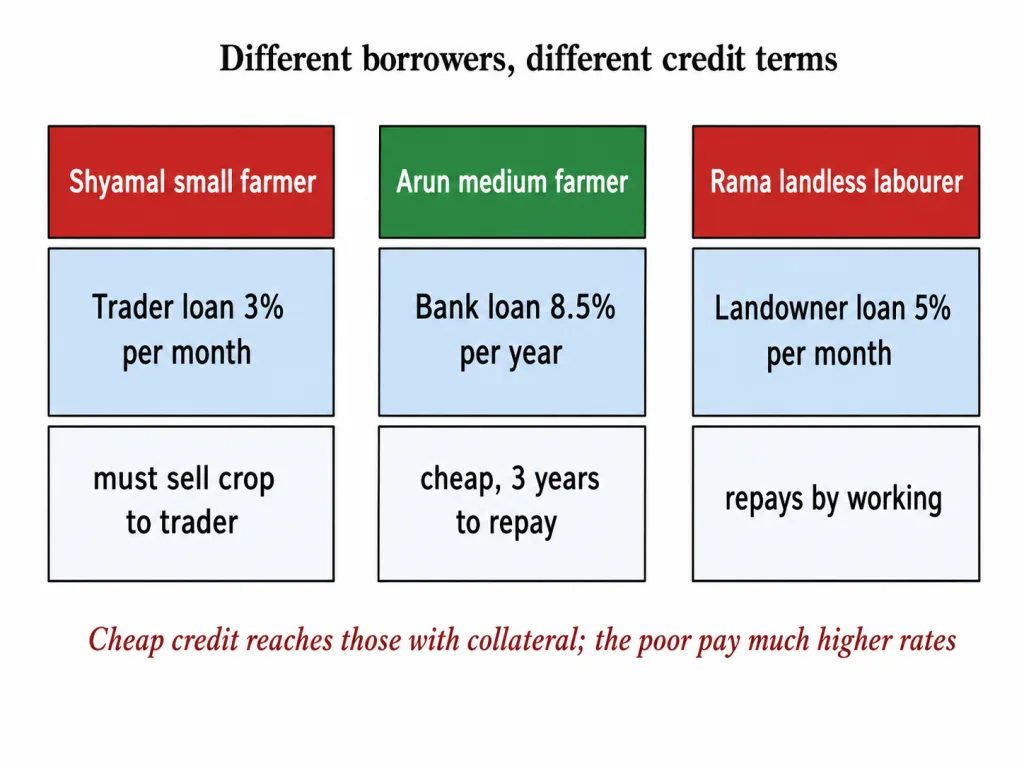
Shyamal, a small farmer with 1.5 acres, needs a loan every season. Earlier he borrowed from the village moneylender at 5 per cent per month (60 per cent per year); now he borrows from an agricultural trader at 3 per cent per month. The trader supplies inputs on credit but makes Shyamal promise to sell the crop to him — and, since crop prices are low just after harvest, the trader profits by buying cheap and selling later.
Arun, Rama, and Cooperatives
Arun, a medium farmer with 7 acres, is one of the few in Sonpur to get a bank loan for cultivation, at 8.5 per cent per year, repayable within three years. He plans to repay after harvest and store the rest in a cold storage, then take a fresh loan against the cold-storage receipt — a facility banks offer to their crop-loan customers.
Rama, a landless agricultural labourer, has no bank access and depends on her landowner-employer, who charges 5 per cent per month; she repays by working for him and is often forced to take a new loan before the old one is repaid.
Cooperatives are another major source of cheap rural credit. Members pool their resources; the Krishak Cooperative (2,300 farmer members) accepts deposits, uses them as collateral to obtain a large bank loan, and lends to members for cultivation, trade, fishery, housing and more.
Questions and Answers
Q1. Why will Arun have a higher income from cultivation compared to Shyamal?
Answer: Arun gets a bank loan at only 8.5 per cent per year, with three years to repay and the facility of a fresh loan against a cold-storage receipt — so he pays low interest and can sell his crop when prices are high. Shyamal borrows from a trader at 3 per cent per month (about 36 per cent per year) and must sell his crop to the trader at a low post-harvest price. Because Shyamal pays far more interest and gets a lower price, Arun earns a higher income.
Q2. Can everyone in Sonpur get credit at a cheap rate? Who can?
Answer: No. Only those who can offer collateral and proper documentation — mainly medium and large farmers like Arun — can get cheap bank loans. Small farmers like Shyamal and landless labourers like Rama cannot access banks and must borrow from moneylenders, traders or landowners at very high interest. So cheap credit is available mostly to the better-off, not to everyone.
Q3. What are cooperatives, and how do they provide cheap credit?
Answer: Cooperatives are societies whose members pool their resources for mutual benefit (e.g., farmers', weavers' or workers' cooperatives). A cooperative like the Krishak Cooperative accepts deposits from members, uses these as collateral to obtain a large loan from a bank, and lends the funds to members at a reasonable rate for cultivation, trade, fishery, housing and other needs. As loans are repaid, the money is lent again, providing a steady source of cheap rural credit.