
Two Different Credit Situations
Credit (loan) refers to an agreement in which the lender supplies the borrower with money, goods or services in return for a promise of future payment. Credit can help a borrower or leave them worse off — it depends on the situation.
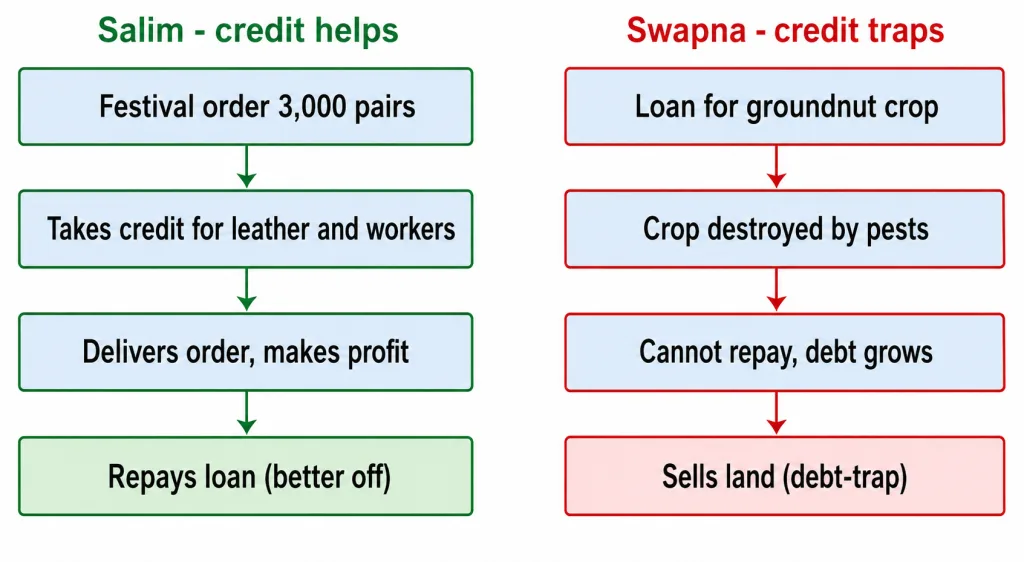
Salim — Credit Helps (a positive role)
It is festival season, and shoe manufacturer Salim gets an order for 3,000 pairs of shoes. To complete production he hires workers and buys raw materials, obtaining credit from two sources: he buys leather on credit (promising to pay later), and takes a cash advance from a trader for 1,000 pairs. At the end of the month he delivers the order, makes a good profit, and repays the loan.
Here Salim uses credit to meet the working capital needs of production. The credit helps him complete production on time and increase his earnings — so credit plays a positive role.
Swapna — Credit Traps (a negative role)
Swapna, a small farmer, takes a loan from a moneylender to grow groundnut on her three acres. Midway, the crop is destroyed by pests, and even costly pesticides do not help. She cannot repay the loan, and the debt grows. The next year she takes a fresh loan; the harvest is normal but earnings are not enough to clear the old loan. Caught in debt, she has to sell a part of her land to repay it.
This is a debt-trap — credit pushes the borrower into a situation from which recovery is very painful. So whether credit is useful depends on the risks in the situation and whether there is support in case of loss.
Questions and Answers
Q1. What is credit? How did credit help Salim?
Answer: Credit is an agreement in which the lender supplies the borrower with money, goods or services in return for a promise of future payment. Credit helped Salim meet his working capital needs during the festival season — he bought leather on credit and took a cash advance, completed a large order on time, made a good profit and repaid the loan. Here credit played a positive role, increasing his earnings.
Q2. What is a debt-trap? How did Swapna fall into one?
Answer: A debt-trap is a situation in which credit pushes the borrower into deeper debt from which recovery is very painful. Swapna borrowed to grow groundnut, but her crop failed due to pests, so she could not repay. Her debt grew, and even a normal harvest the next year did not clear the old loan. She finally had to sell part of her land to repay - leaving her worse off than before.
Q3. On what does it depend whether credit is useful or harmful to a borrower?
Answer: It depends on the risks in the situation and whether there is some support in case of loss. When production goes as planned (as with Salim), credit raises earnings and helps. But when there is high risk (like crop failure for Swapna) and no support to fall back on, credit can push the borrower into a debt-trap, making them worse off.