
Self-Help Groups for the Poor
Poor households often cannot get bank loans because banks require proper documents and collateral, and the absence of collateral is a major reason the poor are shut out. Informal lenders like moneylenders know borrowers personally and lend without collateral — but they charge very high interest, keep no records, and often harass borrowers.
To solve this, the rural poor — especially women — are organised into Self-Help Groups (SHGs).
How SHGs Work
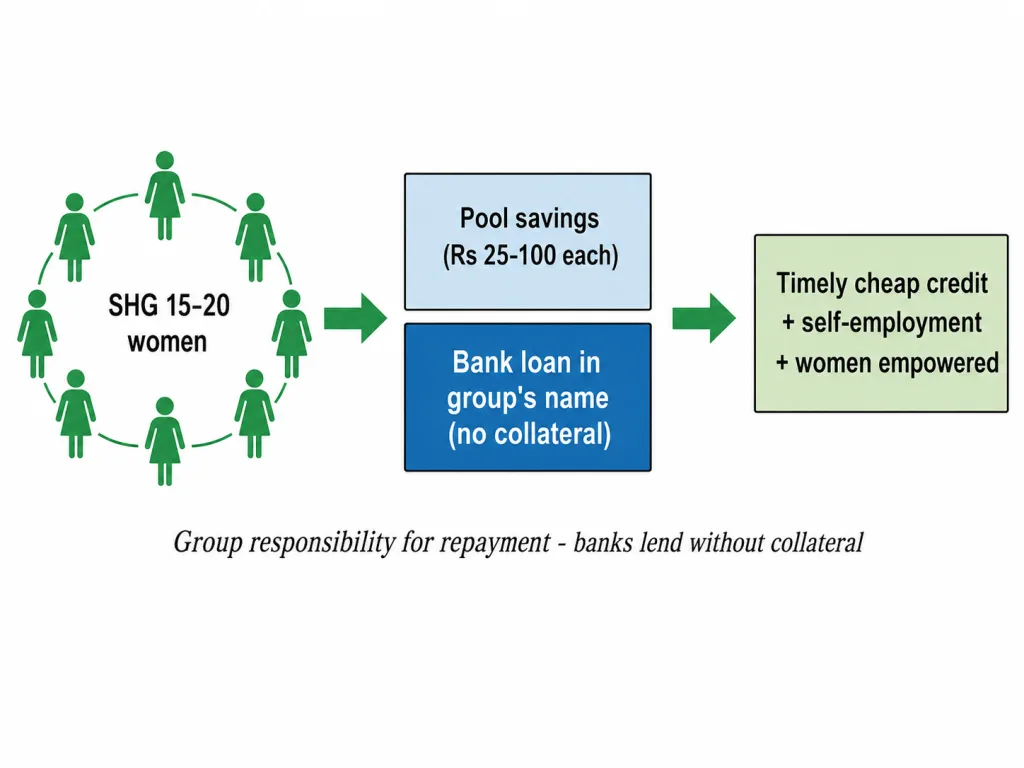
A typical SHG has 15–20 members from one neighbourhood who meet and save regularly, saving from Rs 25 to Rs 100 or more per member. Members can take small loans from the group at an interest lower than the moneylender's. After a year or two of regular saving, the group becomes eligible for a bank loan.
The loan is sanctioned in the name of the group to create self-employment for members. Crucially, it is the group that decides on loans (purpose, amount, interest, repayment) and the group that is responsible for repayment — any non-repayment by a member is followed up seriously by the others. Because of this, banks are willing to lend to poor women in SHGs even without collateral.
Why SHGs Matter
SHGs help borrowers overcome the lack of collateral, giving them timely loans at reasonable interest for purposes like releasing mortgaged land, buying seeds and raw materials, or acquiring assets like sewing machines and cattle. They are the building blocks of organisation of the rural poor: they help women become financially self-reliant, and their regular meetings provide a platform to discuss social issues like health, nutrition and domestic violence.
The Grameen Bank of Bangladesh is a famous success story: started in the 1970s, by 2018 it had over 9 million members in about 81,600 villages, almost all poor women — showing that the poor are reliable borrowers. Its founder, Professor Muhammad Yunus, won the 2006 Nobel Peace Prize.
Questions and Answers
Q1. What is the basic idea behind Self-Help Groups (SHGs) for the poor?
Answer: The basic idea of an SHG is to organise the rural poor — especially women — into a small group (usually 15–20 members) that pools its members' savings. Members can take small loans from the group at reasonable interest, and after regular saving the group becomes eligible for a bank loan in the group's name. This helps the poor get timely, affordable credit without collateral, which they could not get from banks individually.
Q2. How do SHGs help the poor overcome the problem of lack of collateral?
Answer: In an SHG, the loan is given to the whole group, and it is the group that is responsible for repayment. Any member who fails to repay is followed up by the other members, so the risk to the bank is reduced. Because of this group responsibility, banks are willing to lend to poor women even without collateral - solving the main problem that keeps the poor out of the formal credit system.
Q3. Apart from credit, how do SHGs benefit their members?
Answer: Besides providing timely, cheap credit, SHGs help women become financially self-reliant and are the building blocks of organisation of the rural poor. Their regular meetings give members a platform to discuss and act on social issues such as health, nutrition and domestic violence. Thus SHGs bring both economic and social empowerment to poor women.