
The Structure of a Deck of 52 Cards
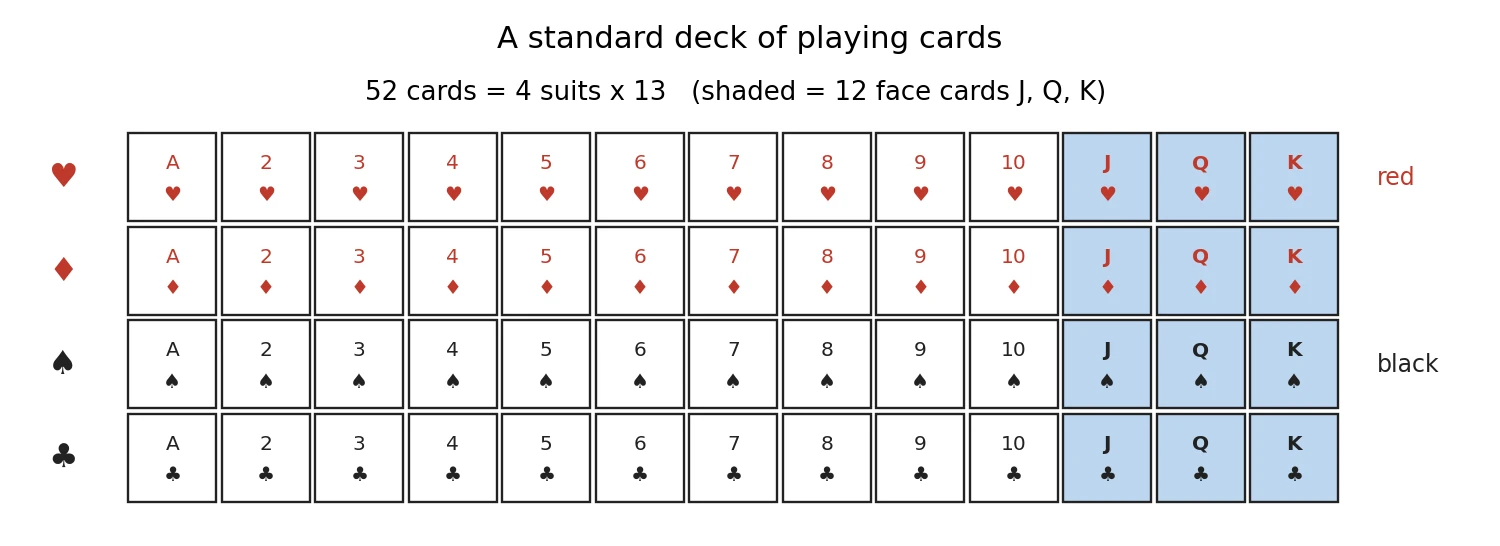
A standard deck has 52 cards in four suits:
- Red suits: hearts and diamonds — 13 cards each (26 red in all).
- Black suits: spades and clubs — 13 cards each (26 black in all).
Each suit has 13 cards: Ace, 2, 3, …, 10, Jack, Queen, King.
Key Point: 52 cards 4 suits 13. Two colours (26 red, 26 black). Learn this layout cold — every card question is counting within it.
Face Cards, Aces and Number Cards
- Face cards are the Jack, Queen and King — per suit, so face cards in all.
- Aces: one per suit, so aces.
- Number cards (2 to 10): per suit, so in all.
- Court/picture cards in board questions usually means the 12 face cards (some questions include aces — read carefully).
Key Point: 12 face cards (J, Q, K), 4 aces, 4 of each rank, 13 of each suit.
Standard Card Probabilities
For a single card drawn from a well-shuffled deck (total 52):
- ,
- ,
- ,
- ,
- ,
- ,
- .
Key Point: Denominator is 52; the numerator is how many of that kind exist.
Using the Complement with Cards
"Not" questions are quick with the complement:
- ,
- .
If some cards are removed first (e.g. "all kings are removed"), reduce both the count and the total (here to 48) before computing.
Key Point: If cards are removed, the total 52 changes — update the denominator.
Solved Examples
Example 1: A face card
One card is drawn from a well-shuffled deck of 52. Find the probability that it is a face card.
Solution:
- Face cards ; total .
- .
Final Answer: .
Takeaway: 12 face cards (J, Q, K of four suits).
Example 2: A red king
Find the probability of drawing a red king.
Solution:
- Red kings: king of hearts and king of diamonds .
- .
Final Answer: .
Takeaway: Two red kings out of 52.
Example 3: Not a king
Find the probability that the card drawn is not a king.
Solution:
- .
- .
Final Answer: .
Takeaway: Complement is quicker than counting all 48 non-kings.
Example 4: Kings removed first
All four kings are removed from a deck; a card is then drawn from the remaining 48. Find the probability that it is a queen.
Solution:
- Remaining cards ; queens still .
- .
Final Answer: .
Takeaway: When cards are removed, use the new total (48).