
Probability Never Leaves the Range 0 to 1
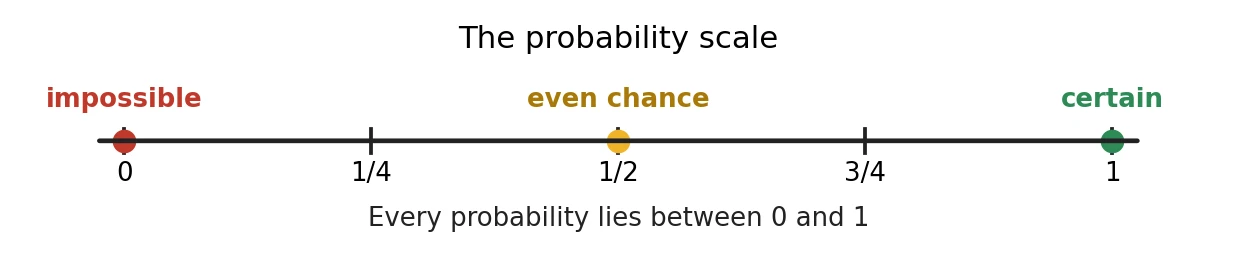
Because the number of favourable outcomes can be at least 0 and at most the total, every probability satisfies
- means cannot happen.
- means is certain.
- A value in between measures partial likelihood ( is an even chance).
Key Point: A probability can never be negative and never exceed 1. If your answer is or , you have miscounted.
Sure Events and Impossible Events
- A sure (certain) event always happens — every outcome is favourable — so . Example: "getting a number from 1 to 6" when throwing a die.
- An impossible event never happens — no outcome is favourable — so . Example: "getting 8" on an ordinary die.
[Board Important] "Certain / sure" ; "impossible / cannot happen" .
Complementary Events
For any event , the event " does not happen" is its complement, written (or "not "). Between them they cover every outcome, so their probabilities add to 1:
This is one of the most useful shortcuts in the chapter: if the event you want is awkward to count, count its complement instead and subtract from 1.
Key Point: . "At least one", "not", "none" problems are often easiest via the complement.
Using the Complement
Watch for wording that begs for the complement:
- "the probability that it is not a king" ,
- "the probability of getting at least one head" .
Counting the complement is often far quicker than listing every favourable case.
Key Point: When "not / at least / none" appears, ask: is easier to find? Then use .
Solved Examples
Example 1: Complement on a die
A die is thrown. Find the probability of not getting a 6.
Solution:
- .
- .
Final Answer: .
Takeaway: .
Example 2: Impossible and sure events
A die is thrown. Find the probability of (i) getting 8, (ii) getting a number less than 7.
Solution:
- (i) No face shows 8 impossible .
- (ii) Every face (–) is less than 7 sure .
Final Answer: (i) ; (ii) .
Takeaway: Impossible , certain .
Example 3: Find the complement's probability
The probability that it will rain tomorrow is . What is the probability that it will not rain?
Solution:
- .
Final Answer: .
Takeaway: Complementary probabilities add to 1.
Example 4: Is this a valid probability?
Can the probability of an event be ? What about ?
Solution:
- Probabilities must satisfy .
- Both and lie outside , so neither can be a probability.
Final Answer: No — a probability cannot exceed 1 or be negative.
Takeaway: Always check that your answer is between 0 and 1.