
Drawing Balls or Marbles from a Bag
If a bag holds coloured balls, each ball is equally likely to be drawn. The probability of a colour is
For a bag with red and blue balls (total ): , and ; these add to 1.
Key Point: Total all the balls, not just one colour. The colour counts are the numerators.
Spinners
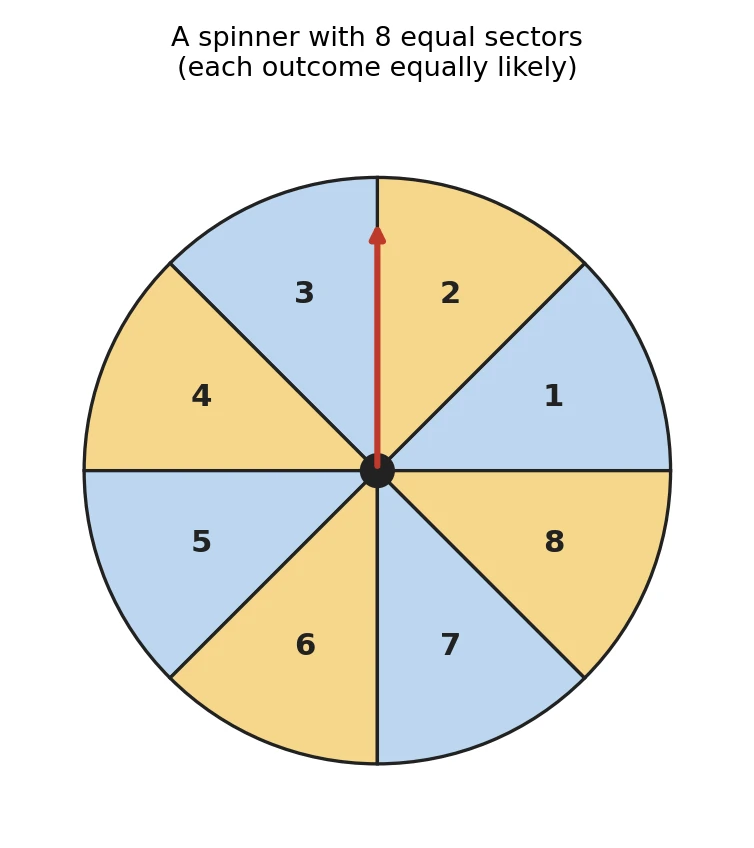
A spinner divided into equal sectors is like a die with as many faces as sectors. If a spinner has equal sectors, each is equally likely, and
If the sectors are not equal, the outcomes are not equally likely and this simple formula does not apply directly.
Key Point: Equal sectors equally likely. Count favourable sectors over total sectors.
Choosing a Number
When a number is picked at random from to , each is equally likely. Then, for example:
- , , , are each (how many such numbers) .
Count the favourable numbers carefully — for instance, the perfect squares from 1 to 100 are (ten of them), so .
Key Point: List or count the favourable numbers in the given range, then divide by how many numbers there are.
Defective Items and Real-Life Counts
Everyday problems ("a lot of bulbs, some defective", "tickets in a box") are the same idea: For 12 bulbs of which 3 are defective, and .
Key Point: Identify the total and the favourable count from the wording — the formula never changes.
Solved Examples
Example 1: Coloured balls
A bag contains 5 red and 3 blue balls. One ball is drawn at random. Find and .
Solution:
- Total .
- , .
Final Answer: and (they add to 1).
Takeaway: Colour count over total count.
Example 2: Not a particular colour
A bag has 4 red, 5 green and 6 blue balls. Find the probability that a drawn ball is not green.
Solution:
- Total ; green .
- .
Final Answer: .
Takeaway: Complement, or count the non-green directly.
Example 3: Choosing a number
A number is chosen at random from 1 to 20. Find the probability that it is a multiple of 3.
Solution:
- Multiples of 3 from 1 to 20: — six of them.
- .
Final Answer: .
Takeaway: Count the favourable numbers in the range.
Example 4: Defective bulbs
A carton has 20 bulbs, 4 of them defective. One bulb is drawn. Find the probability it is (i) defective, (ii) good.
Solution:
- (i) .
- (ii) (or ).
Final Answer: (i) ; (ii) .
Takeaway: Good defective all, so their probabilities add to 1.