One and Two Coins
One coin has sample space {H,T} — two equally likely outcomes.
Two coins (or one coin tossed twice) has four equally likely outcomes:
{HH, HT, TH, TT}.
From this list you can read off:
- P(two heads)=41 (only HH),
- P(exactly one head)=42=21 (HT,TH),
- P(at least one head)=43 (all but TT),
- P(no head)=41 (only TT).
Key Point: Write the whole sample space first; then counting favourable cases is easy.
One Die
One die has sample space {1,2,3,4,5,6}. Common events:
- P(even)=P(odd)=21,
- P(prime)=63=21 (primes 2,3,5),
- P(multiple of 3)=62=31 (3,6),
- P(number>4)=62=31 (5,6).
Key Point: For a single die the total is always 6 — only the favourable count changes.
Two Dice — 36 Outcomes
When two dice are thrown, each of the 36 ordered pairs (a,b) with a,b∈{1,…,6} is equally likely — total =6×6=36.
The sum of the two dice ranges from 2 to 12, but the sums are not equally likely. Counting the pairs:
| Sum |
2 |
3 |
4 |
5 |
6 |
7 |
8 |
9 |
10 |
11 |
12 |
| Ways |
1 |
2 |
3 |
4 |
5 |
6 |
5 |
4 |
3 |
2 |
1 |
So P(sum=7)=366=61 (the most likely sum), P(sum=2)=361, and so on.
[Board Important] A doublet is a pair with equal numbers {(1,1),…,(6,6)} — 6 of them, so P(doublet)=366=61.
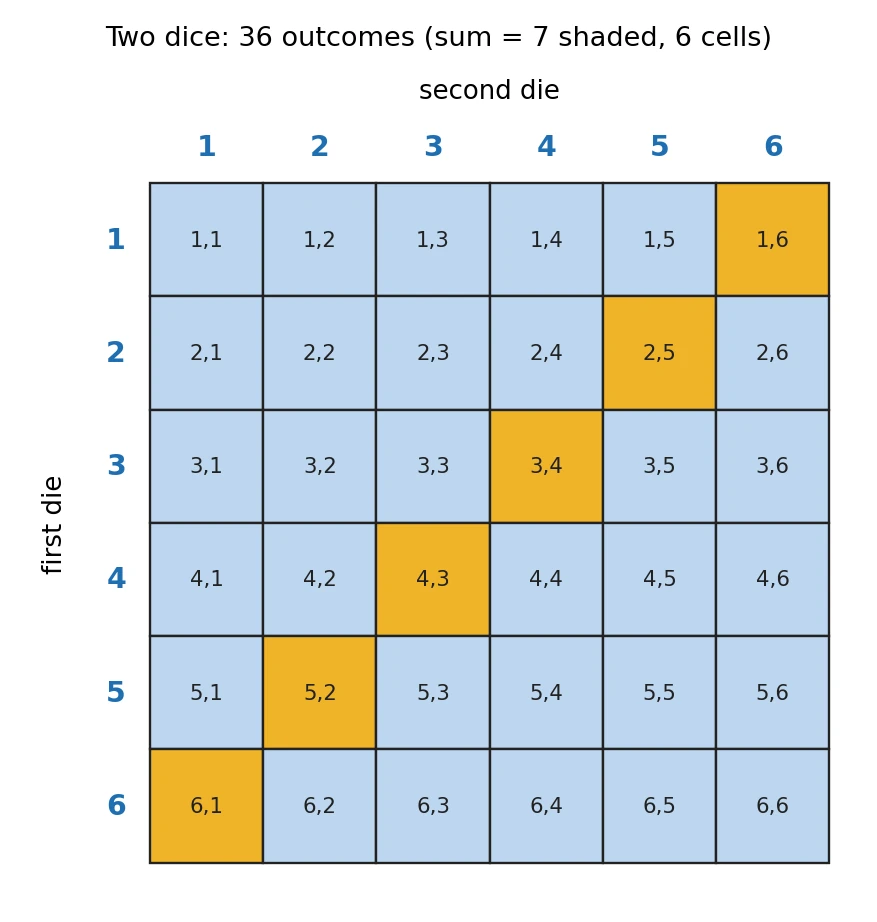
Reading the Two-Dice Grid
Think of the 36 outcomes as a 6×6 grid. Any event is just a set of cells; its probability is (cells in the event) ÷ 36. For example:
- P(both show 6)=361,
- P(sum≤4)=361+2+3=366=61,
- P(a total of 8)=365.
Key Point: Two dice ⇒ 36 in the denominator. Count the favourable cells from the sum table.
Solved Examples
Example 1: Two coins
Two coins are tossed together. Find the probability of getting (i) at least one head, (ii) exactly one tail.
Solution:
- Sample space {HH,HT,TH,TT}, total 4.
- (i) At least one head ={HH,HT,TH}: 43.
- (ii) Exactly one tail ={HT,TH}: 42=21.
Final Answer: (i) 43; (ii) 21.
Takeaway: List all 4 outcomes, then count.
Example 2: Sum of two dice
Two dice are thrown. Find the probability that the sum is (i) 7, (ii) 10, (iii) 8.
Solution:
- Total outcomes =36.
- (i) Sum 7: 6 ways ⇒366=61.
- (ii) Sum 10: {(4,6),(5,5),(6,4)}, 3 ways ⇒363=121.
- (iii) Sum 8: 5 ways ⇒365.
Final Answer: (i) 61; (ii) 121; (iii) 365.
Takeaway: Use the sum table for the number of ways.
Example 3: Doublets
Two dice are thrown. Find the probability of getting a doublet.
Solution:
- Doublets {(1,1),(2,2),(3,3),(4,4),(5,5),(6,6)}: 6 outcomes.
- P=366=61.
Final Answer: 61.
Takeaway: A doublet is "same number on both dice".
Example 4: Complement with dice
Two dice are thrown. Find the probability that the sum is not 7.
Solution:
- P(sum=7)=61.
- P(sum=7)=1−61=65.
Final Answer: 65.
Takeaway: Complement saves counting all the non-7 sums.
