
What Does Probability Measure?
Probability is a number that measures how likely an event is to happen. It runs from 0 (the event cannot happen) to 1 (the event is certain). A probability of means an even chance — as likely to happen as not.
In Class 9 you estimated probability by experiment (tossing a coin many times and counting). Here we compute the exact, theoretical probability by reasoning about the possible outcomes — no experiment needed.
Equally Likely Outcomes and the Formula
The key assumption is that the possible outcomes are equally likely — none is favoured over another. When you toss a fair coin, head and tail are equally likely; when you throw a fair die, the six faces are equally likely.
For an event , the theoretical probability is
How to use it: (1) list or count all equally likely outcomes (the sample space); (2) count how many are favourable to ; (3) divide.
Key Point: Every probability is (favourable)/(total). The whole chapter is careful counting.
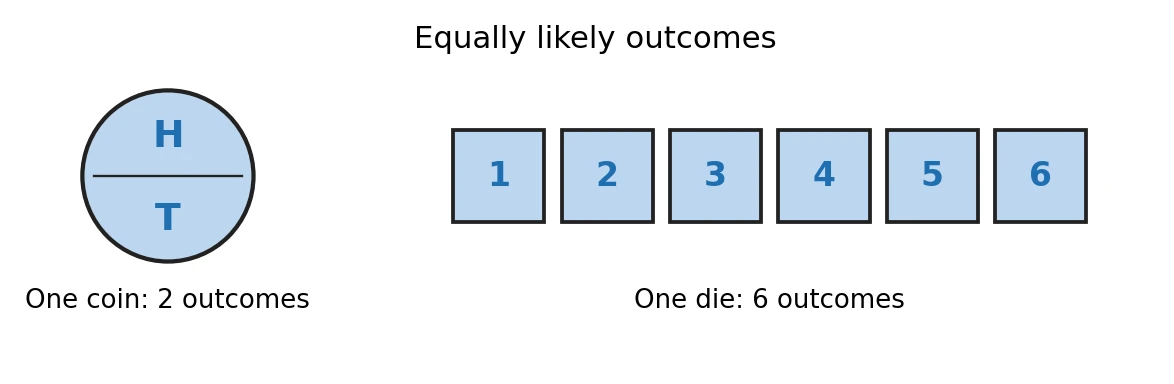
Elementary Events
An elementary event is an event with exactly one outcome — for example, "getting a head" when tossing one coin, or "getting a 3" when throwing a die.
A neat fact ties them together:
The sum of the probabilities of all the elementary events of an experiment is 1.
For a die, . For a coin, .
[Board Important] Because all outcomes together are certain, their probabilities must total 1 — a quick way to check your counting.
Solved Examples
Example 1: One coin
A fair coin is tossed once. Find the probability of getting a head.
Solution:
- Total equally likely outcomes: head, tail .
- Favourable to "head": .
- .
Final Answer: .
Takeaway: Favourable over total.
Example 2: One die
A fair die is thrown once. Find the probability of getting (i) a 4, (ii) an even number.
Solution:
- Total outcomes: .
- (i) Favourable to 4: just , so .
- (ii) Even numbers : favourable, so .
Final Answer: (i) ; (ii) .
Takeaway: Count the favourable outcomes carefully.
Example 3: A number greater than 4
A die is thrown. Find the probability of a number greater than 4.
Solution:
- Numbers greater than 4: , so favourable.
- .
Final Answer: .
Takeaway: "Greater than 4" does not include 4 itself.
Example 4: Elementary events sum to 1
A die is thrown. Verify that the probabilities of the six elementary events add to 1.
Solution:
- Each face has probability .
- Sum .
Final Answer: The total is 1.
Takeaway: All elementary events together are certain, so their probabilities sum to 1.