
Two Components, One Name
Biologists follow universally accepted principles when they name a known organism. The system is beautifully economical: each name has two components -
- The Generic name (the genus), and
- The specific epithet.
A naming system that provides a name with two components is called binomial nomenclature. It was given by Carolus Linnaeus and is practised by biologists all over the world. The two-word format was found convenient - short enough to use constantly, precise enough to be unambiguous.
[NEET Important] The second word is the specific epithet, not the "species name". NEET has repeatedly used that distinction as a distractor. The species is the whole two-word name; the epithet is only the second word.
The Worked Example - Mangifera indica
Take the mango. Its scientific name is written Mangifera indica.
| Part | What it is |
|---|---|
| Mangifera | the genus (generic name) |
| indica | the specific epithet |
So Mangifera indica is a binomial name: a genus plus a particular species, or specific epithet.
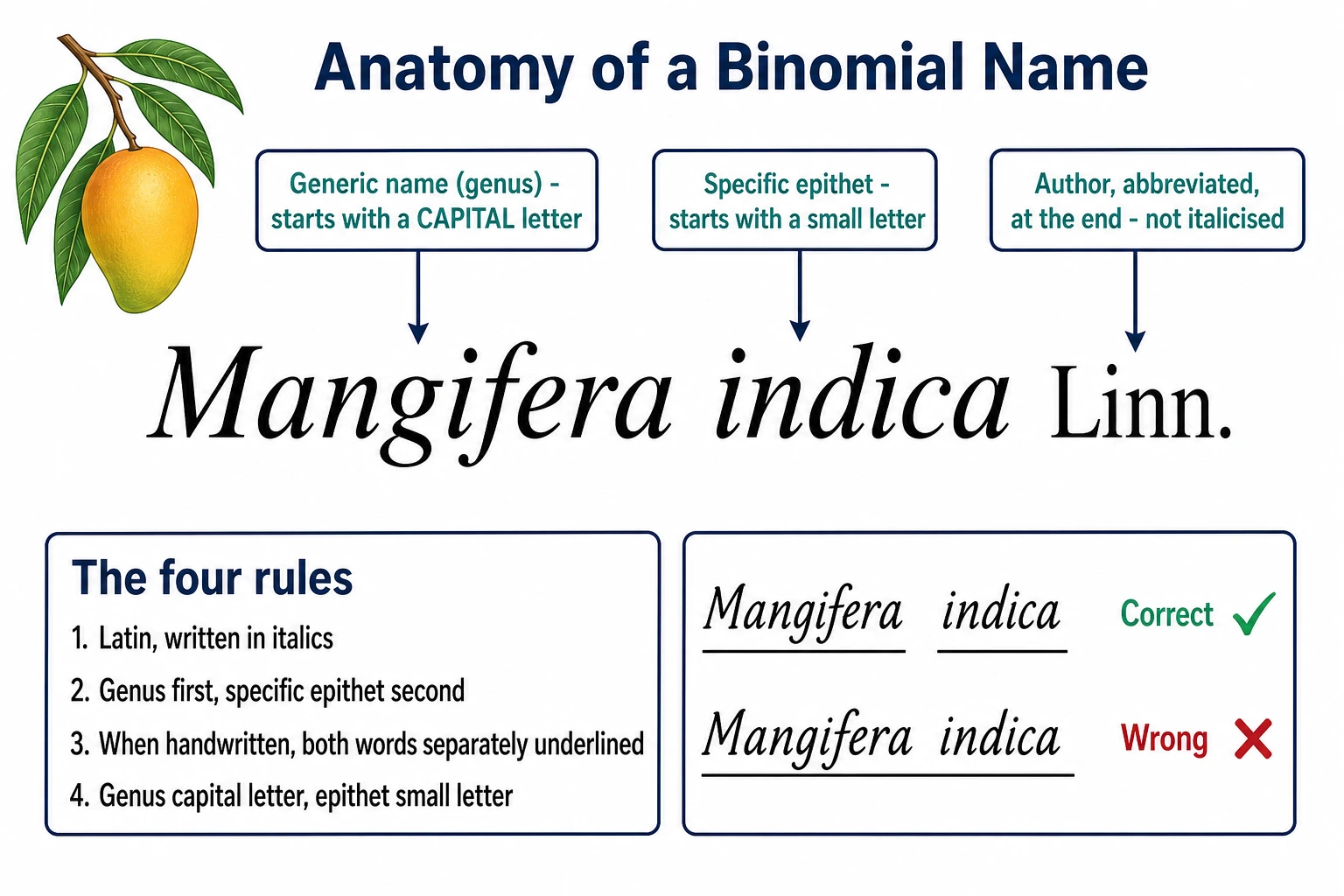
The Four Universal Rules of Nomenclature
These four are stated as a numbered list in the chapter, and every one of them has been turned into a question at some point. Learn them in order.
Rule 1 - language and script. Biological names are generally in Latin and written in italics. They are Latinised or derived from Latin irrespective of their origin.
Rule 2 - word order. The first word in a biological name represents the genus; the second component denotes the specific epithet.
Rule 3 - handwriting convention. Both words, when handwritten, are separately underlined, or printed in italics, to indicate their Latin origin.
Rule 4 - capitalisation. The first word denoting the genus starts with a capital letter, while the specific epithet starts with a small letter. Illustrated by Mangifera indica.
[NEET Important] Rule 3 says separately underlined. A single continuous line under both words is wrong - the underlines must be two, one per word. This precise wording is a classic single-mark trap.
The Author's Name
One more convention sits outside the numbered four. The name of the author appears after the specific epithet - that is, at the end of the biological name - and is written in an abbreviated form.
For example: Mangifera indica Linn.
That Linn. indicates that this species was first described by Linnaeus.
Points the exams pick on:
- The author's name goes at the end, never between the genus and the epithet.
- It is abbreviated (Linn. For Linnaeus).
- It is not italicised - only the genus and epithet carry the Latin italics.
- It records who first described the species, not who discovered the organism or who named the genus.
Reading a Name Correctly - A Checklist
When a question hands you a written name and asks whether it is correct, run this checklist in order. It catches every error type the exams use.
- Two words? A binomial has exactly two components (plus an optional author abbreviation).
- First word capitalised? Genus takes a capital.
- Second word in lower case? The specific epithet must not be capitalised.
- Both italicised in print, or separately underlined in handwriting?
- Author abbreviation, if present, at the end and not italicised?
Run it on the classic exercise item:
- Mangifera Indica - fails step 3, since Indica is capitalised. Incorrect.
- Mangifera indica - passes all steps. Correct.
More Names From This Chapter
You will meet these binomials again in the taxonomic-hierarchy sections, so start storing them now with their parts separated.
| Common name | Binomial | Genus | Specific epithet |
|---|---|---|---|
| Mango | Mangifera indica | Mangifera | indica |
| Potato | Solanum tuberosum | Solanum | tuberosum |
| Lion | Panthera leo | Panthera | leo |
| Tiger | Panthera tigris | Panthera | tigris |
| Leopard | Panthera pardus | Panthera | pardus |
| Human being | Homo sapiens | Homo | sapiens |
| Housefly | Musca domestica | Musca | domestica |
| Wheat | Triticum aestivum | Triticum | aestivum |
Notice something useful in the Panthera row group: one genus can carry several specific epithets - leo, tigris, pardus - each naming a different organism that nevertheless shares morphological similarities. That is the idea section 4 formalises as genus.
Also note the shorthand convention you will see in the chapter itself: Once Panthera has been written out in full, later species may be abbreviated to P. pardus and P. tigris.
Quick Recap
- Each scientific name has two components: The generic name and the specific epithet. The system is binomial nomenclature, given by Carolus Linnaeus.
- Mangifera indica: Mangifera = genus, indica = specific epithet.
- Rule 1: names are generally in Latin, written in italics, Latinised irrespective of origin.
- Rule 2: first word = genus, second = specific epithet.
- Rule 3: when handwritten, both words are separately underlined.
- Rule 4: genus takes a capital letter, specific epithet a small letter.
- The author's name is written in abbreviated form at the end, e.g. Mangifera indica Linn., showing who first described the species.
- One genus may have more than one specific epithet - Panthera leo, P. tigris, P. pardus.
Solved Examples
Question 1
Q. Who gave the binomial system of nomenclature?
Answer. Carolus Linnaeus.
Question 2
Q. In Solanum tuberosum, name the genus and the specific epithet.
Answer. Genus = Solanum; specific epithet = tuberosum.
Question 3
Q. Why are biological names written in italics?
Answer. The italics flag their Latin origin. Names are generally in Latin, or Latinised irrespective of their origin, and the italics are what show that.
Question 4
Q. Identify the correctly written name: Mangifera Indica or Mangifera indica.
Answer. Mangifera indica. The specific epithet has to start with a small letter, so Indica breaks Rule 4.
Takeaway: This one is set at the end of the chapter - expect it almost verbatim.
Question 5
Q. What does Linn. signify in Mangifera indica Linn.?
Answer. That is the abbreviated name of the author, written at the end of the biological name. It tells you this species was first described by Linnaeus.
Question 6
Q. A student handwrites the mango's name and draws one continuous line under both words. Is this correct?
Answer. No. Rule 3 says the two words are separately underlined - one line under Mangifera, a second under indica. One continuous line is not the convention.
Question 7
Q. Rewrite panthera Leo linn correctly and list every error you fixed.
Answer. Correct form: Panthera leo Linn.
Errors fixed:
- panthera to Panthera - the genus must start with a capital letter (Rule 4).
- Leo to leo - the specific epithet must start with a small letter (Rule 4).
- Both words must be italicised in print, or separately underlined if handwritten (Rules 1 and 3).
- linn to Linn. - the author abbreviation is capitalised, followed by a full stop, placed at the end, and not italicised.
Takeaway: Four-error correction items like this are a standard written-answer question, and a standard NEET item too.
Question 8
Q. Panthera leo, Panthera tigris and Panthera pardus - what does the repetition of the first word tell you?
Answer. All three are different species belonging to the same genus, Panthera. One genus can carry one or more specific epithets, for different organisms that share morphological similarities.
Question 9
Q. Is the author's name italicised? Justify.
Answer. No. Italics are there to mark the Latin origin of the genus and the specific epithet. The author abbreviation is not part of the Latin binomial, it is just a credit tacked on at the end, so it stays in ordinary type.
Question 10
Q. Explain why the binomial system was described as "convenient" and what would be lost with a one-word system.
Answer. It is short enough to use all the time and still gives you two levels of information at once - the genus puts the organism among its close relatives, and the specific epithet separates it from them. With a one-word system every species would be named in isolation, so you would lose that instant signal of relatedness. You would not spot at a glance that lion, tiger and leopard go together, which Panthera leo, P. tigris and P. pardus make obvious.
Question 11
Q. "Biological names are Latinised irrespective of their origin." What does irrespective of their origin mean here? Give an example.
Answer. It means that even when the root word comes from somewhere other than Latin - a local language, a place name, a person's name - the name is still given a Latin form before it is used. Mangifera indica shows this well: indica comes from India, a place name, but it is Latinised so it behaves like a Latin word inside the binomial and follows all the Latin conventions of italics and case.
Question 12
Q. A journal prints a name as indica Mangifera Linn. State every rule violated.
Answer.
- Rule 2 - word order. The first word must be the genus, but here the specific epithet has been put first.
- Rule 4 - capitalisation. As printed, indica sits in the genus slot with a small letter where a capital is needed, and Mangifera sits in the epithet slot with a capital where a small letter is needed.
The name should read Mangifera indica Linn. Rule 1 (italics) and the author-placement convention were actually followed correctly here.
Question 13
Q. Two organisms are named Felis catus and Panthera tigris. Without any further information, what can you say about how closely related they are, and what can you not say?
Answer. What you can say: they belong to different genera (Felis and Panthera), so they are not as closely related as two species sharing a genus would be.
What you cannot say: the binomial on its own tells you nothing about the ranks above genus. You cannot tell from the name whether they share a family, order or class. (Both do fall in the family Felidae and the order Carnivora - but you get that from the classification, not from the name.)
Takeaway: A binomial encodes exactly two ranks. Every higher relationship must be looked up, not inferred from the name.