
How Wonderful Is the Living World
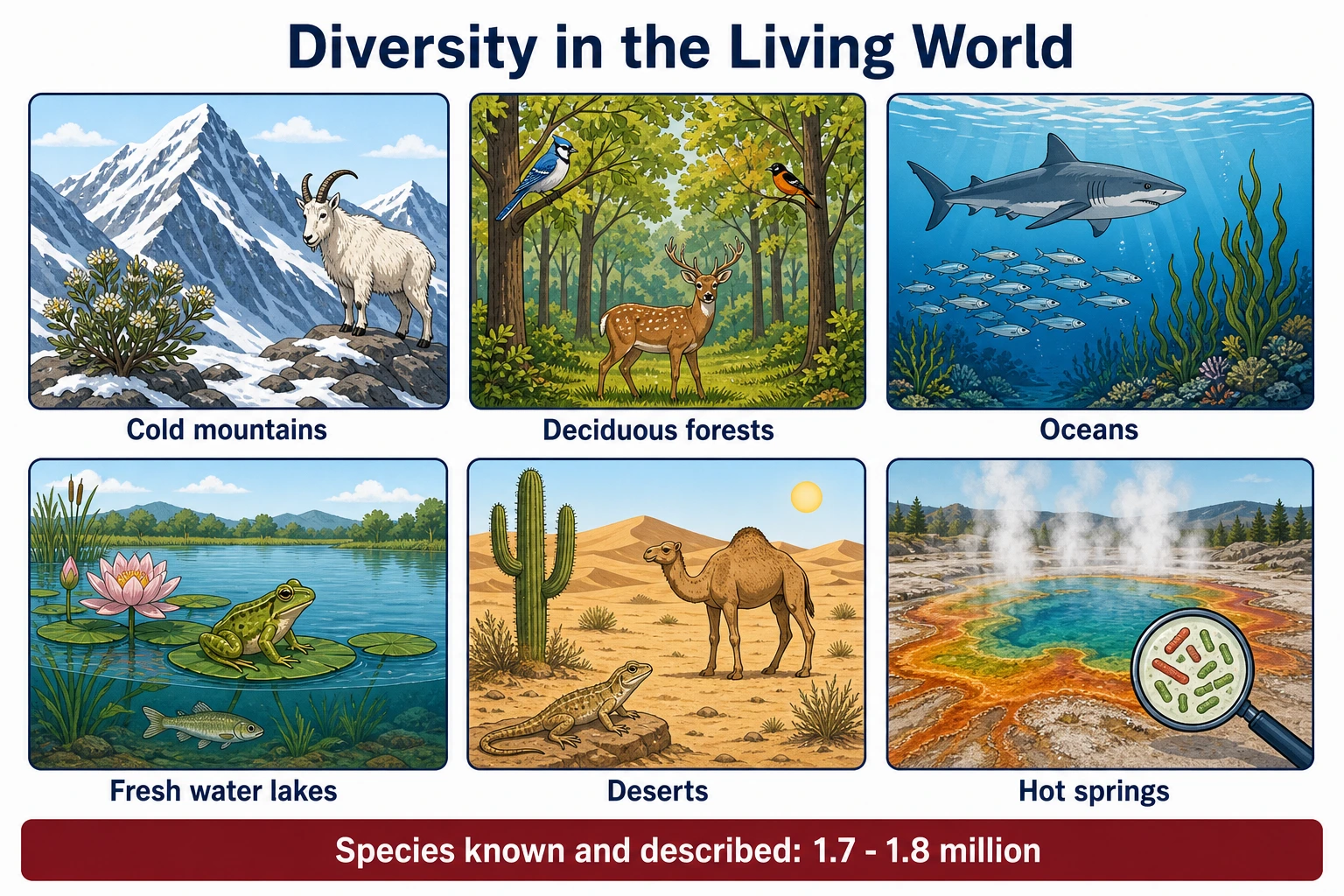
Start with the sheer range of it. Living organisms turn up in cold mountains, deciduous forests, oceans, fresh water lakes, deserts and hot springs. A galloping horse, migrating birds, a valley of flowers, an attacking shark - the variety evokes real wonder, and it also raises the question the whole chapter circles: what indeed is life?
This question hides two questions inside it:
- A technical one - what is living, as opposed to non-living?
- A philosophical one - what is the purpose of life?
As scientists we do not attempt the second. This chapter deals with the first, and with the machinery biologists built to handle the variety.
Diversity in the Living World
Look around you - potted plants, insects, birds, pets. There are also countless organisms you cannot see with the naked eye. Widen the area you observe and the range and variety go up. Walk into a dense forest and the number and kinds of organisms rise sharply.
Each different kind of plant, animal or organism you see represents a species.
[NEET Important] The number of species that are known and described ranges between 1.7 - 1.8 million. This is what is meant by biodiversity - the number and types of organisms present on earth.
Two cautions the exam builds questions on:
- The figure is for species known and described, not the total that exist. New organisms are continuously being identified, in new areas and even in old ones.
- So the number is a moving target - which is exactly why it is given as a range rather than a single value.
The Problem: Local Names Do Not Travel
There are millions of plants and animals in the world, and we know the ones in our own area by their local names. The trouble is that these local names vary from place to place, even within a single country.
Think about what that means in practice. A plant called one thing in Kerala may carry a completely different name in Punjab - and a third name across the border. Two biologists discussing the same organism would not know they were discussing the same organism.
So there is a clear need: standardise the naming of living organisms so that a particular organism is known by the same name all over the world.
That requirement is what generates the rest of this chapter.
Nomenclature and Identification - And Why the Order Matters
Two terms, and the relationship between them is a favourite exam hook.
- Nomenclature is the process of standardised naming - assigning a name that is the same everywhere in the world.
- Identification is knowing correctly what organism a name is attached to.
Here is the logical link, stated plainly: nomenclature is only possible when the organism is described correctly and we know to what organism the name is attached. In other words, identification comes first; naming follows. You cannot name what you have not correctly described.
And the description must be good enough that people in any part of the world arrive at the same name - and that the name has not already been used for another known organism.
The Two International Codes
Scientists established agreed procedures so that a scientific name assigned to a known organism is acceptable to biologists everywhere. These procedures live in two codes - and NEET tests the pairing directly.
| Code | Full form | Governs |
|---|---|---|
| ICBN | International Code for Botanical Nomenclature | Naming of plants |
| ICZN | International Code of Zoological Nomenclature | Naming of animals |
[NEET Important] Remember it by the middle letter: B for Botanical (plants), Z for Zoological (animals). Swapping the two is the single most common careless error on this fact.
What the codes guarantee is worth stating explicitly, because 1-mark questions ask for it:
- Each organism has only one name.
- A correct description leads everyone, anywhere, to the same name.
- That name has not been used for any other known organism.
Quick Recap
- Living organisms occupy an extraordinary range of habitats - cold mountains, deciduous forests, oceans, fresh water lakes, deserts, hot springs.
- The question what is living? has a technical part (living versus non-living) and a philosophical part (the purpose of life); science addresses only the first.
- Each different kind of organism represents a species.
- Known and described species: 1.7 - 1.8 million. This is biodiversity - the number and types of organisms present on earth. New organisms are still being identified continuously.
- Local names vary from place to place, even within a country - hence the need to standardise naming.
- Identification (knowing what organism the name belongs to) must come before nomenclature (standardised naming).
- ICBN governs plant names; ICZN governs animal names.
- Scientific names ensure each organism has exactly one name, arrived at identically anywhere in the world, and not already used for another organism.
Solved Examples
Question 1
Q. How many species are currently known and described, according to the chapter?
Answer. Between 1.7 and 1.8 million.
Takeaway: Note the wording - known and described, not existing. A question that says "total number of species on earth is 1.7-1.8 million" is false.
Question 2
Q. Define biodiversity as used in this chapter.
Answer. Biodiversity just means the number and types of organisms present on earth.
Takeaway: In Class 11 Chapter 1 the definition is deliberately simple. The richer three-level definition (genetic, species, ecological) belongs to Class 12.
Question 3
Q. Which code governs the naming of animals?
Answer. The International Code of Zoological Nomenclature (ICZN).
Takeaway: Z for Zoological, and zoology is animals.
Question 4
Q. Expand ICBN and state what it applies to.
Answer. ICBN is the International Code for Botanical Nomenclature, and it covers the scientific naming of plants.
Question 5
Q. Why can two biologists in different states of India end up confused when they use local names?
Answer. Because local names vary from place to place, even within a country. The same organism picks up different local names in different regions, and the same local name gets stuck on different organisms. So neither biologist can be sure they are talking about the same thing - that is exactly why nomenclature had to be standardised.
Question 6
Q. A student says: "First we name an organism, then we describe it." Correct the statement and justify.
Answer. It is the wrong way round. You cannot name something you have not pinned down yet, because nomenclature is only possible when the organism is described correctly and we know to what organism the name is attached - and that knowing is identification. So the correct order is: description and identification first, then nomenclature.
Takeaway: Sequence questions ("which comes first?") are cheap marks if you have this straight.
Question 7
Q. State the three guarantees a scientific name provides.
Answer.
- Each organism has only one name.
- Anyone in any part of the world, working from a correct description, ends up at that same name.
- The name has not been used for any other known organism.
Question 8
Q. Why is the number of species given as a range rather than a fixed figure?
Answer. Because the count is not finished. As we explore new areas, and even old ones, new organisms are continuously being identified, so the number of described species keeps climbing. Giving a range is a way of saying the figure is still provisional.
Question 9
Q. Distinguish between identification and nomenclature in one line each.
Answer.
- Identification: working out correctly which organism a given name is attached to, using a correct description.
- Nomenclature: giving that organism a standardised name, so it is called the same thing everywhere in the world.
Question 10
Q. A newly discovered flowering plant from the Western Ghats is to be named. List, in order, what must happen and under which code.
Answer.
- The plant is described correctly - its external and internal features recorded.
- It is identified as distinct from all already-described species.
- You check that the proposed name has not been used for any other known organism.
- The name is given under the ICBN, because this is a plant.
- The name is framed so that any biologist anywhere, working from the description, lands on the same name.
Takeaway: This chains the whole section together - it is the shape a full written answer to "why do we need standardised naming" wants.
Question 11
Q. "Each different kind of plant, animal or organism represents a species." Is this a rigorous definition of species? Comment.
Answer. No - it is an operational, introductory statement, not a rigorous definition. It is good enough for counting biodiversity in this section. The strict taxonomic version comes later in the chapter: a species is a group of individual organisms with fundamental similarities, told apart from closely related species by distinct morphological differences. Also, the word 'species' does not mean quite the same thing for higher plants and animals as it does for bacteria.
Question 12
Q. Two hypothetical taxonomists independently describe the same beetle and propose two different names. Which principle of nomenclature has been violated, and what is the practical consequence?
Answer. They have broken the principle that each organism has only one name. In practice the same beetle would then sit in the literature under two names, so its records, distribution data and conservation assessments get split across two entries - which defeats the whole point of a universal naming system. This is exactly what the codes stop: a proposed name has to be checked against names already used for known organisms.