
Why We Classify At All
It is nearly impossible to study all the living organisms one by one - 1.7 to 1.8 million described species, and rising. So we need a device that makes the job possible.
That device is classification.
Classification is the process by which anything is grouped into convenient categories based on some easily observable characters.
Read that definition slowly, because two phrases in it get tested:
- convenient categories - the groups exist to make study manageable;
- easily observable characters - the basis is features you can actually see and compare.
Taxa - And the Fact That They Sit at Different Levels
We already do this instinctively. Say plants, animals, dogs, cats or insects, and a set of characters comes to mind at once. Think of a dog and you see dogs, not cats. Say Alsatians and you know exactly what is meant. Say mammals and you think of animals with external ears and body hair. Say Wheat and you picture wheat plants, not rice.
The scientific term for these convenient categories is taxa (singular: taxon).
Now the point you must recognise:
Taxa can indicate categories at very different levels.
'Plants' is a taxon. 'Wheat' is a taxon. 'Animals', 'mammals' and 'dogs' are all taxa - yet a dog is a mammal, and mammals are animals. So these three represent taxa at different levels.
[NEET Important] The commonest wrong answer here is that a taxon means one particular rank. It does not. A taxon is a unit of classification at any rank, from species right up to kingdom.
Taxonomy
Based on characteristics, all living organisms can be classified into different taxa. This process of classification is taxonomy.
What does modern taxonomy actually use as its evidence? The list is short, and a question asking "which of these is NOT a basis of modern taxonomic studies" is built straight from this list:
- External structure
- Internal structure
- Structure of cell
- Development process
- Ecological information of organisms
These are described as essential, and they form the basis of modern taxonomic studies.
The four processes basic to taxonomy
The whole discussion then compresses into one sentence worth memorising verbatim:
Characterisation, identification, classification and nomenclature are the processes that are basic to taxonomy.
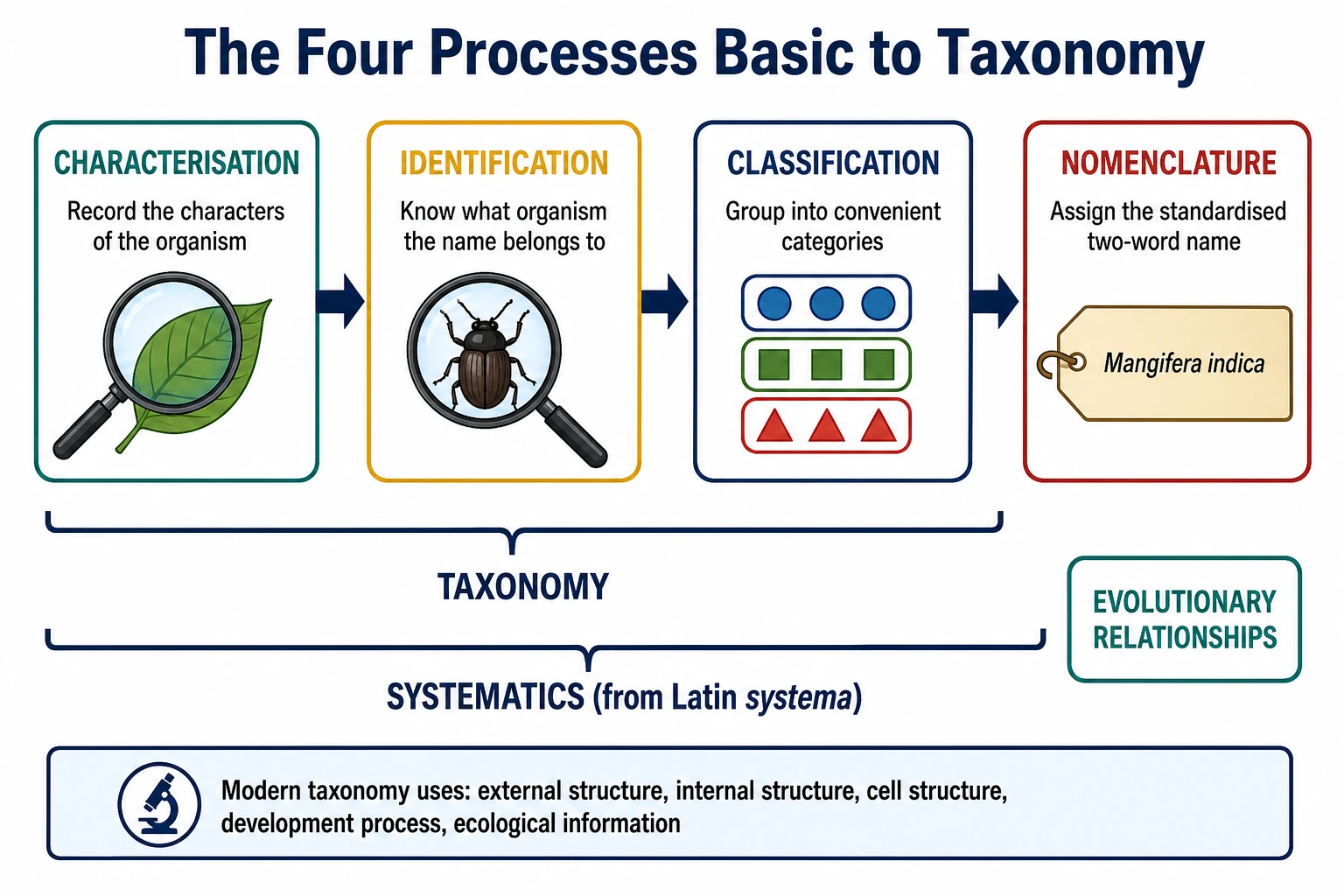
Taxonomy Is Not New
Human beings have always been interested in knowing more about the various kinds of organisms - particularly with reference to their own use.
In early days people needed sources for their basic needs of food, clothing and shelter. So the earliest classifications were based on the 'uses' of various organisms.
[NEET Important] "The earliest classifications were based on the uses of organisms" is a direct one-mark recall item. Not on evolutionary relationships, not on cell structure - on uses.
Systematics
People were interested not only in the kinds of organisms and their diversities, but also in the relationships among them. That branch of study is systematics.
The etymology is examinable:
- The word systematics is derived from the Latin word 'systema', which means systematic arrangement of organisms.
- Linnaeus used Systema Naturae as the title of his publication.
And then the two facts that separate systematics from plain taxonomy:
- The scope of systematics was later enlarged to include identification, nomenclature and classification.
- Systematics takes into account evolutionary relationships between organisms.
[NEET Important] Point 2 is the discriminator. If a question contrasts taxonomy with systematics, the expected answer is that systematics additionally accounts for evolutionary relationships.
The Four Terms Side by Side
This table is the whole section in one place. If you can reproduce it, this part of the chapter is done.
| Term | Definition | Key detail |
|---|---|---|
| Identification | Knowing correctly to what organism a name is attached | Must precede nomenclature |
| Nomenclature | Assigning a standardised name valid worldwide | Governed by ICBN (plants) and ICZN (animals) |
| Classification | Grouping into convenient categories based on easily observable characters | Produces taxa, which exist at different levels |
| Taxonomy | The process of classification of organisms into taxa | Rests on external and internal structure, cell structure, development process and ecological information |
| Systematics | Study of the kinds and diversity of organisms and the relationships among them | From Latin systema; scope enlarged to include identification, nomenclature and classification; accounts for evolutionary relationships |
The nesting to remember: characterisation, identification, classification and nomenclature are the four processes basic to taxonomy; systematics is the widest of these terms, having absorbed identification, nomenclature and classification and added evolutionary relationships on top.
Quick Recap
- It is nearly impossible to study every organism individually, so we classify.
- Classification = grouping into convenient categories based on easily observable characters.
- The scientific term for these categories is taxa (sing. taxon). Taxa exist at very different levels - 'plants', 'animals', 'mammals', 'dogs' and 'wheat' are all taxa.
- Taxonomy = the process of classification into taxa. Modern taxonomy uses external structure, internal structure, cell structure, development process and ecological information.
- Characterisation, identification, classification and nomenclature are the four processes basic to taxonomy.
- The earliest classifications were based on the 'uses' of organisms, driven by needs of food, clothing and shelter.
- Systematics comes from the Latin systema = systematic arrangement of organisms; Linnaeus titled his publication Systema Naturae.
- The scope of systematics was later enlarged to include identification, nomenclature and classification, and it takes evolutionary relationships into account.
Solved Examples
Question 1
Q. Define classification.
Answer. Classification is sorting things into convenient categories on the basis of some easily observable characters.
Question 2
Q. What is the scientific term for the convenient categories used to study organisms?
Answer. Taxa (singular: Taxon).
Question 3
Q. From which word is 'systematics' derived, and what does it mean?
Answer. From the Latin word systema, meaning systematic arrangement of organisms.
Question 4
Q. What was the title of Linnaeus's publication?
Answer. Systema Naturae.
Question 5
Q. Name the four processes basic to taxonomy.
Answer. Characterisation, identification, classification and nomenclature.
Takeaway: Keep them in this order - that is the order they are stated in, and order-based questions do appear.
Question 6
Q. Are 'dogs', 'mammals' and 'animals' three taxa or one? Explain.
Answer. Three taxa, but sitting at three different levels. A dog is a mammal and mammals are animals, so they nest inside one another. That is the chapter's point - taxa can indicate categories at very different levels.
Question 7
Q. On what basis were the earliest classifications made? Why?
Answer. On the 'uses' of various organisms. Early human beings were hunting for sources of food, clothing and shelter, so their interest in organisms was a practical one, and the groups they made showed that.
Question 8
Q. List the kinds of information that form the basis of modern taxonomic studies.
Answer. External structure, internal structure, structure of the cell, development process and ecological information of organisms.
Question 9
Q. How is systematics broader than taxonomy?
Answer. Taxonomy is the job of sorting organisms into taxa. Systematics started out as the study of the relationships among organisms, and its scope was later enlarged to include identification, nomenclature and classification. On top of that, systematics takes into account evolutionary relationships between organisms, which plain classification does not have to do.
Question 10
Q. A student writes: "A taxon is a category, and a category is a rank, so 'taxon' must mean one fixed rank such as genus." Where is the reasoning wrong?
Answer. The first two steps are fine - a taxon is a unit of classification, and each rank is a category. The conclusion is where it breaks, because taxa can indicate categories at very different levels, and the examples given are 'plants', 'wheat', 'animals', 'mammals' and 'dogs'. So 'taxon' tells you the kind of thing (a unit of classification), not any one rank. Kingdom Animalia is a taxon, and so is Homo sapiens.
Question 11
Q. Why is the stress on "easily observable characters" in the definition of classification?
Answer. Because classification has to be workable. The whole point is to make millions of organisms possible to study, and a grouping character is only useful if you can actually check it on the specimen in front of you. Easily observed characters can be compared quickly, and in the same way, by different workers - that is what puts the same organism in the same group anywhere in the world. Deeper evidence - cell structure, development, ecology - then fine-tunes that placement in modern taxonomy.
Question 12
Q. Arrange these in order from narrowest to broadest in scope, and justify: Nomenclature, taxonomy, systematics.
Answer. Nomenclature to taxonomy to systematics.
- Nomenclature is one single process - giving out standardised names.
- Taxonomy is wider, because nomenclature is only one of the four processes basic to it, along with characterisation, identification and classification.
- Systematics is the widest of the three - its scope was enlarged to include identification, nomenclature and classification, and it also takes evolutionary relationships between organisms into account.
Takeaway: Scope-ordering questions on these three terms are a reliable 2-mark item.
Question 13
Q. Two taxonomists group a set of flowering plants differently - one by flower colour, the other by floral structure and cell type. Both are 'classifications'. Which is closer to modern taxonomy, and why?
Answer. The second one. Both fit the bare definition of classification, since both use observable characters to make convenient categories. But modern taxonomic studies rest on external and internal structure, along with the structure of the cell, development process and ecological information. Floral structure and cell type come from that evidence base. Flower colour on its own is one surface character, it can vary within a species, and it would end up lumping unrelated plants together.