
A Change of Method at the Higher Ranks
Species, genus and family were built on a number of similar characters. From order upwards there is a shift:
Generally, order and other higher taxonomic categories are identified based on the aggregates of characters.
In other words, the higher you go, the more you are working from overall bundles of features rather than a tidy list of shared traits. Keep this line - it explains why relationships get harder to pin down as you climb, which is where the section ends.
Order
Order, being a higher category, is the assemblage of families which exhibit a few similar characters. The similar characters are less in number as compared to different genera included in a family.
The two examples, one from each kingdom:
Plants - the families Convolvulaceae and Solanaceae are included in the order Polymoniales, mainly based on the floral characters.
Animals - the order Carnivora includes the families Felidae and Canidae.
[NEET Important] Two details get tested here and both are easy to lose. First, Polymoniales is grouped mainly on floral characters - not vegetative ones. Second, Carnivora is where the cat family and the dog family finally meet: They were separated at family level, and they reunite one rank up.
Class
This category includes related orders.
The chapter's example: The order Primata, comprising monkey, gorilla and gibbon, is placed in the class Mammalia along with the order Carnivora, which includes animals like tiger, cat and dog. And it adds - class Mammalia has other orders also.
So the chain so far, following the cat:
Species (Felis catus-type) to Genus Felis to Family Felidae to Order Carnivora to Class Mammalia
And the monkey joins that chain only at the class, arriving through a different order, Primata.
Phylum - And Division for Plants
Classes comprising animals like fishes, amphibians, reptiles, birds along with mammals constitute the next higher category called Phylum.
What unites them? The common features of the presence of a notochord and a dorsal hollow neural system - and on that basis all of them are included in the phylum Chordata.
And the plant equivalent, which is a standard one-mark item:
In case of plants, classes with a few similar characters are assigned to a higher category called Division.
| Kingdom | Rank above class |
|---|---|
| Animalia | Phylum |
| Plantae | Division |
[NEET Important] "Notochord and dorsal hollow neural system" is the exact character pair given for Chordata here. Answers that offer only one of the two are incomplete.
Kingdom
All animals belonging to various phyla are assigned to the highest category called Kingdom Animalia in the classification system of animals. The Kingdom Plantae, on the other hand, is distinct, and comprises all plants from various divisions.
Henceforth these two groups are referred to simply as the animal and plant kingdoms.
Note also that beyond the broad categories from species to kingdom, taxonomists have developed sub-categories in this hierarchy to facilitate more sound and scientific placement of various taxa.
The Full Hierarchy - Both Directions
The taxonomic categories from species to kingdom are shown in ascending order starting with species in the chapter's Figure 1.1.
Ascending (species to kingdom):
Species - Genus - Family - Order - Class - Phylum / Division - Kingdom
Descending (kingdom to species):
Kingdom - Phylum / Division - Class - Order - Family - Genus - Species
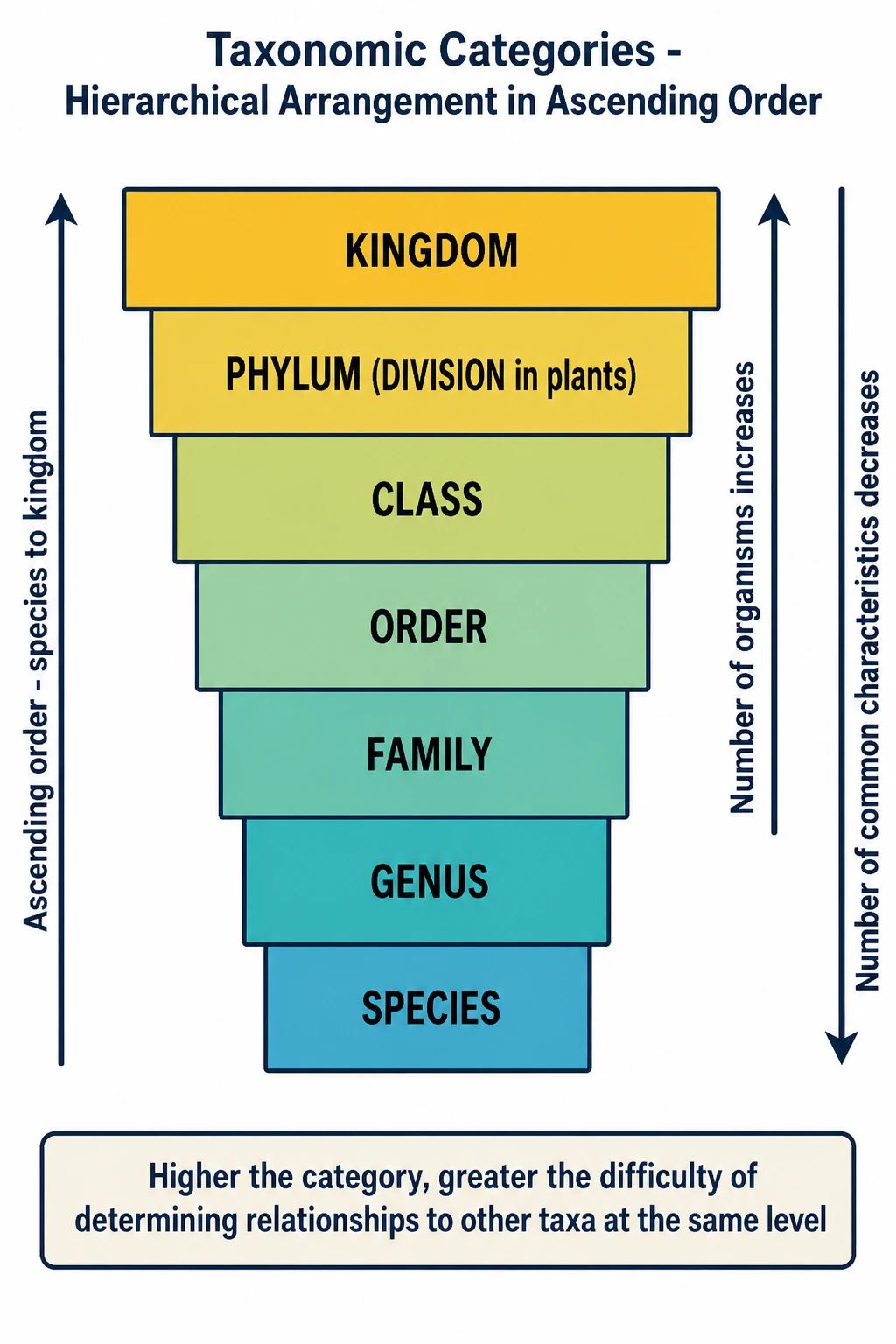
[NEET Important] Read the question wording before you answer. "Ascending order" starts at species; "descending order" starts at kingdom. Papers routinely offer both sequences among the options and rely on candidates grabbing the familiar one.
A mnemonic for the descending order: King Philip Came Over For Good Soup - kingdom, Phylum, Class, Order, Family, Genus, Species.
The Trend That Runs Through Everything
This is the single most examined idea in the chapter. You are asked to look at the hierarchy and recall the basis of the arrangement, then states it plainly:
As we go higher from species to kingdom, the number of common characteristics goes on decreasing.
Lower the taxa, more are the characteristics that the members within the taxon share.
Higher the category, greater is the difficulty of determining the relationship to other taxa at the same level. Hence, the problem of classification becomes more complex.
Set out as a table:
| Moving from species to kingdom | Effect |
|---|---|
| Number of organisms included | Increases |
| Number of common characteristics | Decreases |
| Difficulty of determining relationships with taxa at the same level | Increases |
| Complexity of the classification problem | Increases |
And read in reverse: the lower the taxon, the more characters its members share. Two organisms in one species share the most; two in one kingdom share the least.
Table 1.1 - Four Organisms Placed in Full
This table is the chapter's Table 1.1 and it is a guaranteed source of match-the-column questions. Learn all four rows.
| Common name | Biological name | Genus | Family | Order | Class | Phylum / Division |
|---|---|---|---|---|---|---|
| Man | Homo sapiens | Homo | Hominidae | Primata | Mammalia | Chordata |
| Housefly | Musca domestica | Musca | Muscidae | Diptera | Insecta | Arthropoda |
| Mango | Mangifera indica | Mangifera | Anacardiaceae | Sapindales | Dicotyledonae | Angiospermae |
| Wheat | Triticum aestivum | Triticum | Poaceae | Poales | Monocotyledonae | Angiospermae |
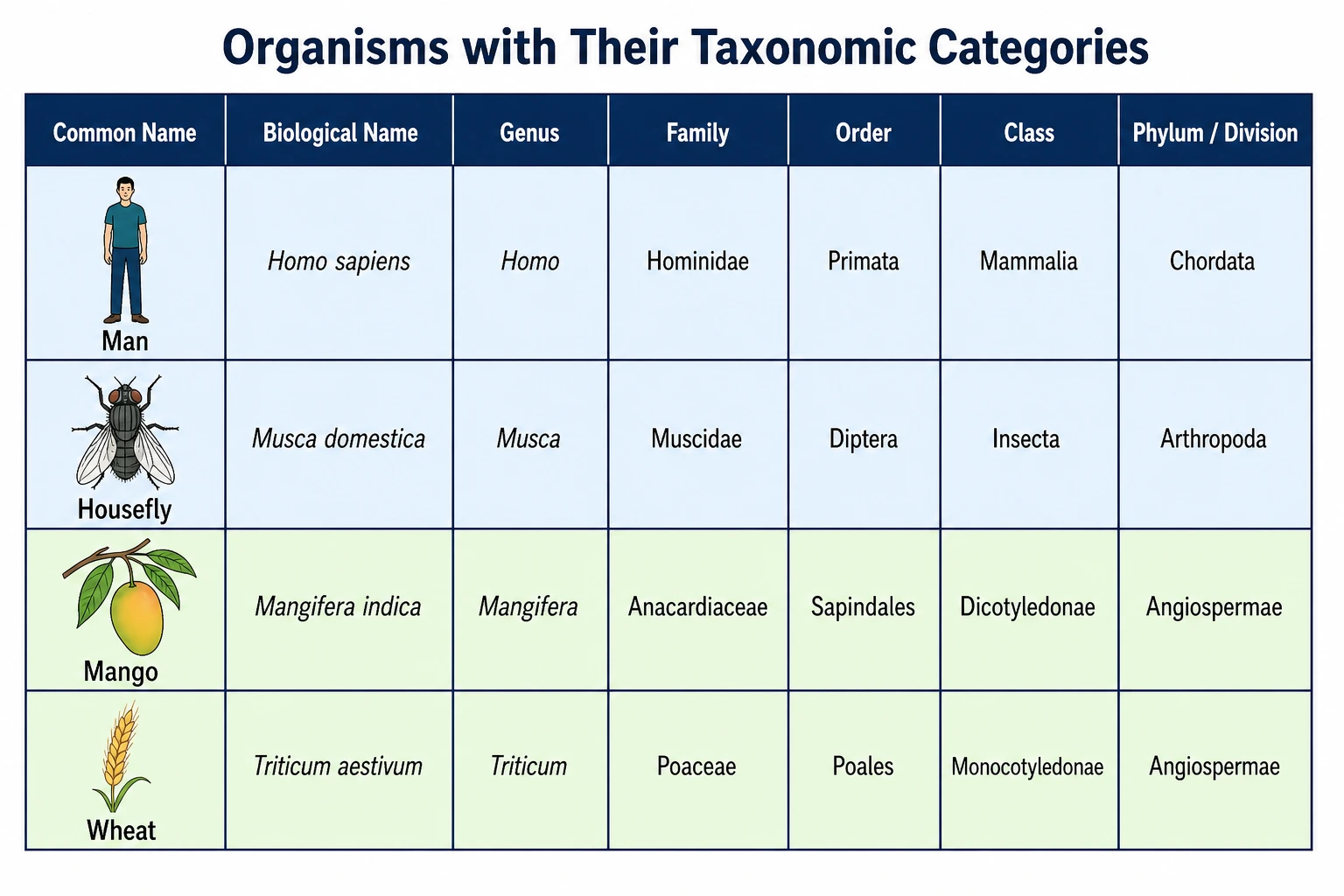
Things worth noticing, because questions are built on exactly these:
- Mango and wheat share a Division (Angiospermae) but differ at every rank below it - including class, where mango is a Dicotyledonae and wheat a Monocotyledonae.
- Man and housefly share nothing in this table - different phylum (Chordata vs Arthropoda), class, order, family and genus.
- The two plants use Division; the two animals use Phylum.
- Man's family is Hominidae, order Primata - the same order used to illustrate class Mammalia.
Quick Recap
- Order and higher categories are identified based on aggregates of characters.
- Order = assemblage of families exhibiting a few similar characters. Convolvulaceae + Solanaceae to Polymoniales (mainly floral characters); Felidae + Canidae to Carnivora.
- Class = related orders. Primata (monkey, gorilla, gibbon) + Carnivora (tiger, cat, dog) to Mammalia, which has other orders too.
- Phylum = related classes in animals. Fishes, amphibians, reptiles, birds and mammals to Chordata, on the common features of a notochord and a dorsal hollow neural system. In plants the equivalent rank is Division.
- Kingdom = the highest category. All animal phyla to Kingdom Animalia; all plant divisions to Kingdom Plantae.
- Ascending order: species, genus, family, order, class, Phylum/Division, kingdom.
- The trend: going from species to kingdom, common characteristics decrease, and the difficulty of determining relationships at the same level increases, so classification becomes more complex.
- Taxonomists have developed sub-categories within this hierarchy for more precise placement.
- Table 1.1: man (Hominidae, Primata, Mammalia, Chordata), housefly (Muscidae, Diptera, Insecta, Arthropoda), mango (Anacardiaceae, Sapindales, Dicotyledonae, Angiospermae), wheat (Poaceae, Poales, Monocotyledonae, Angiospermae).
Solved Examples
Question 1
Q. Which order includes the families Felidae and Canidae?
Answer. Carnivora.
Question 2
Q. Name the plant order that includes Convolvulaceae and Solanaceae, and the basis of the grouping.
Answer. Polymoniales, mainly on the basis of floral characters.
Question 3
Q. Which category in plants is equivalent to phylum in animals?
Answer. Division.
Question 4
Q. Give the two common features on which fishes, amphibians, reptiles, birds and mammals are placed in Chordata.
Answer. Presence of a notochord and a dorsal hollow neural system.
Question 5
Q. Write the taxonomic categories in ascending order.
Answer. Species, genus, family, order, class, phylum (or division), kingdom.
Question 6
Q. Monkey, gorilla and gibbon belong to which order, and to which class?
Answer. Order Primata; class Mammalia. Mammalia also contains the order Carnivora, and other orders besides.
Question 7
Q. State the family, order, class and phylum of the housefly.
Answer. Family Muscidae, order Diptera, class Insecta, phylum Arthropoda. Its biological name is Musca domestica and its genus Musca.
Question 8
Q. Mango and wheat - at which rank do they first agree, and what separates them just below it?
Answer. They first agree at the Division: Angiospermae. Just below that they split at class - mango goes into Dicotyledonae, wheat into Monocotyledonae - and they also differ at order (Sapindales vs Poales), family (Anacardiaceae vs Poaceae) and genus.
Question 9
Q. What happens to the number of common characteristics as we move from species to kingdom?
Answer. It goes on decreasing. The lower the taxon, the more characteristics its members share, and the higher you go, the fewer they have in common.
Question 10
Q. Give the complete classification of man from genus to phylum.
Answer. Genus Homo, family Hominidae, order Primata, class Mammalia, phylum Chordata. Biological name Homo sapiens.
Question 11
Q. Why are order and higher categories said to be identified from 'aggregates of characters'?
Answer. Because at these ranks there is no longer a tidy short list of traits that everyone shares. An order pulls together families that show only a few similar characters, fewer than the genera inside one family share, so you place a group by its overall bundle of features instead of a couple of decisive ones.
Question 12
Q. Trace the full path by which a tiger and a monkey come to share a taxon, naming the rank at which they meet.
Answer. The tiger (Panthera tigris) sits in genus Panthera, family Felidae, order Carnivora. The monkey sits in order Primata. So they differ at genus, family and order. They first meet at the class, Mammalia, which holds Primata alongside Carnivora - and other orders too.
Takeaway: "At which rank do X and Y first share a taxon?" is a standard NEET item. Work upward from species until the names match.
Question 13
Q. Why does the problem of classification become more complex at higher categories?
Answer. Because the higher you climb, the more the number of common characteristics decreases. With fewer shared characters to work from, it gets harder to determine the relationship of one taxon to other taxa at the same level - there is simply less evidence for judging whether two large groups belong together. That is why the problem of classification becomes more complex.
Question 14
Q. A question offers these four sequences. Identify the correct one and explain why the others fail. (a) Species - Order - Phylum - Kingdom (b) Genus - Species - Order - Kingdom (c) Species - Genus - Order - Phylum (d) Kingdom - Class - Genus - Species
Answer. (a) and (c) are both correctly ordered as ascending subsets of the hierarchy. Species to order to phylum to kingdom skips genus, family and class, but it never goes backwards, and species to genus to order to phylum is the same story. (b) fails because it puts genus before species, which is a reversal. (d) is a fine descending subset, so it is only wrong if the question asks for ascending order.
Takeaway: This is one of the chapter-end exercises. When a sequence question skips ranks, check only that the surviving ranks stay in order; do not reject a sequence merely because ranks are missing.
Question 15
Q. Two organisms share a phylum but not a class. A third shares a class with the first. Which pair shares more characters, and why?
Answer. The first and third. Class is a lower category than phylum, and the lower the taxon, the more characteristics its members share. The pair that agrees all the way down to class has passed through more shared levels than the pair that splits straight below phylum, so the class-mates must share more characters.
Question 16
Q. Cat and dog were separated at family level yet they are placed together two lines later. Explain, and name every rank they share.
Answer. They are split into Felidae and Canidae because a family groups related genera with a fairly close set of shared characters, and cat and dog differ enough to land in two such groups. But an order is an assemblage of families exhibiting only a few similar characters, which is a looser test, so at that rank the two families come back together in Carnivora. Above that they stay together: class Mammalia, phylum Chordata, kingdom Animalia. There is no real contradiction - it is just the shared-characters trend, separate below and together above.