
Classification Is a Hierarchy, Not One Step
Here is the framing sentence for the whole second half of the chapter:
Classification is not a single step process but involves a hierarchy of steps, in which each step represents a rank or category.
Unpack the vocabulary, because the exams use all four words:
- Since the category is a part of the overall taxonomic arrangement, it is called a taxonomic category.
- All categories together constitute the taxonomic hierarchy.
- Each category, referred to as a unit of classification, in fact represents a rank and is commonly termed a taxon (pl.: taxa).
The insect illustration
The idea is explained with insects. Insects are a group of organisms sharing common features like three pairs of jointed legs. That makes them recognisable concrete objects which can be classified - and so they were given a rank, or category.
And the sentence that gets quoted in question papers:
These taxonomic groups or categories are distinct biological entities and not merely morphological aggregates.
The Seven Common Categories
Taxonomical studies of all known organisms have led to the development of common categories:
Kingdom - Phylum (or Division, for plants) - Class - Order - Family - Genus - Species
Two things to fix immediately:
- All organisms, including those in the plant and animal kingdoms, have species as the lowest category.
- For plants, the rank equivalent to phylum is called Division. Phylum is used for animals.
How do you actually place an organism in these categories? The basic requirement is the knowledge of characters of an individual or group of organisms. That knowledge helps identify similarities and dissimilarities among individuals of the same kind of organism as well as of other kinds.
This section takes the three lowest ranks - species, genus and family. Section 5 takes the higher ones.
Species
Taxonomic studies consider a group of individual organisms with fundamental similarities as a species. One should be able to distinguish one species from another closely related species based on distinct morphological differences.
Work through the chapter's own examples. Take Mangifera indica, Solanum tuberosum (potato) and Panthera leo (lion).
- indica, tuberosum and leo are the specific epithets.
- Mangifera, Solanum and Panthera are genera - and a genus represents another higher level of taxon or category.
Each genus may have one or more than one specific epithet representing different organisms that nevertheless have morphological similarities:
- Panthera also has the specific epithet tigris.
- Solanum includes species like nigrum and melongena.
And for ourselves: human beings belong to the species sapiens, grouped in the genus Homo - so the scientific name is Homo sapiens.
[NEET Important] Two criteria define a species here and both must appear in a full-mark answer: fundamental similarities within the group, and distinct morphological differences from closely related species.
Genus
Genus comprises a group of related species which has more characters in common in comparison to species of other genera. We can say that genera are aggregates of closely related species.
The two standard examples:
In plants - potato and brinjal are two different species but both belong to the genus Solanum.
In animals - lion (Panthera leo), leopard (P. pardus) and tiger (P. tigris), with several common features, are all species of the genus Panthera. This genus differs from another genus Felis, which includes cats.
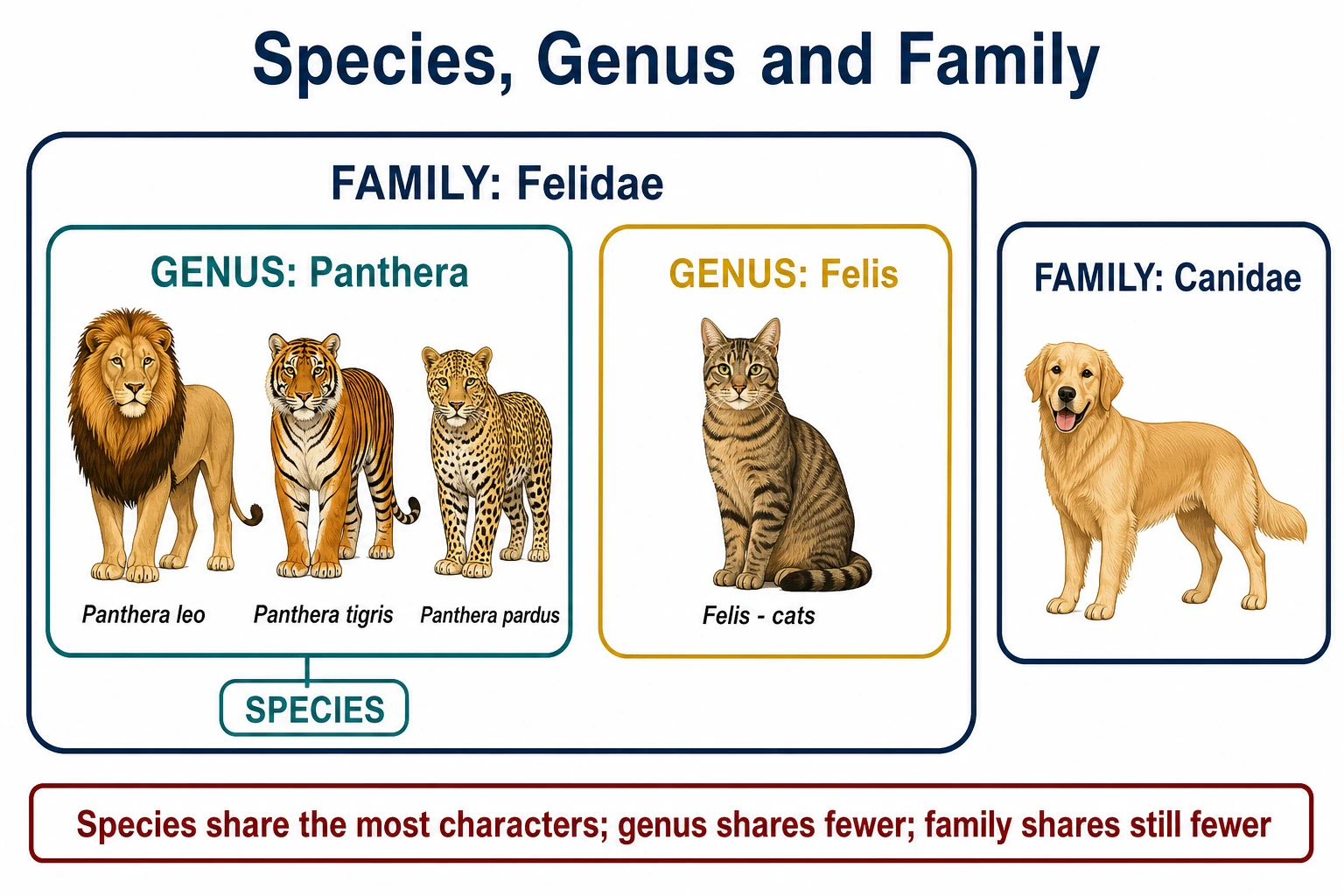
[NEET Important] The Panthera versus Felis contrast is the chapter's workhorse example. Panthera holds lion, tiger and leopard; Felis holds cats; and - as the next block shows - both sit inside the family Felidae. Questions are built on every step of that chain.
Family
The next category, Family, has a group of related genera with still less number of similarities as compared to genus and species.
A detail specific to plants, and a favourite of examiners:
Families are characterised on the basis of both vegetative and reproductive features of plant species.
The examples to memorise:
Plants - three different genera Solanum*, *Petunia* and *Datura are placed in the family Solanaceae.
Animals - the genus Panthera, comprising lion, tiger and leopard, is put along with the genus Felis (cats) in the family Felidae.
Cat versus dog - observe the features of a cat and a dog and you will find some similarities and some differences. They are separated into two different families - Felidae and Canidae respectively.
| Family | Genera in it | Group |
|---|---|---|
| Solanaceae | Solanum, Petunia, Datura | Plants |
| Felidae | Panthera, Felis | Animals (cats) |
| Canidae | dogs | Animals (dogs) |
The Pattern Behind All Three
Read the three definitions again and one trend jumps out - it is the same trend that runs through the rest of the chapter.
| Rank | Made of | Number of shared characters |
|---|---|---|
| Species | individual organisms with fundamental similarities | Most |
| Genus | related species | Fewer than within a species |
| Family | related genera | Still less than in genus and species |
As you move up, the group gets bigger and the members share fewer characters. Hold on to this - section 5 extends it all the way to kingdom, and it is the single most examined idea in the chapter.
Quick Recap
- Classification is not a single step process - it is a hierarchy of steps, each step a rank or category.
- A category that is part of the taxonomic arrangement is a taxonomic category; all categories together form the taxonomic hierarchy; each is a unit of classification and is termed a taxon.
- Taxonomic groups are distinct biological entities and not merely morphological aggregates.
- The common categories: kingdom, phylum or division, class, order, family, genus, species. Species is the lowest category for all organisms.
- Species = a group of individual organisms with fundamental similarities, separated from close relatives by distinct morphological differences. Humans: Genus Homo, species sapiens.
- Genus = a group of related species with more characters in common than species of other genera; genera are aggregates of closely related species. Solanum (potato, brinjal); Panthera (lion, leopard, tiger), distinct from Felis (cats).
- Family = a group of related genera with still fewer similarities. In plants, families are characterised on both vegetative and reproductive features. Solanum, Petunia, Datura to Solanaceae; Panthera and Felis to Felidae; cats and dogs to Felidae and Canidae.
Solved Examples
Question 1
Q. Which is the lowest taxonomic category for all organisms?
Answer. Species.
Question 2
Q. To which genus do potato and brinjal both belong?
Answer. Solanum.
Question 3
Q. Name the family that contains Solanum, Petunia and Datura.
Answer. Solanaceae.
Question 4
Q. Cats and dogs are placed in which two families?
Answer. Cats in Felidae, dogs in Canidae.
Question 5
Q. What common feature characterises insects?
Answer. Three pairs of jointed legs.
Question 6
Q. Define species, giving both criteria.
Answer. A species is a group of individual organisms with fundamental similarities. You should also be able to tell one species from a closely related species by distinct morphological differences.
Takeaway: A one-criterion answer will lose half the mark. Both halves are required.
Question 7
Q. Panthera leo, Panthera pardus and Panthera tigris - how many species and how many genera are represented?
Answer. Three species, one genus. Lion, leopard and tiger are three separate species, but they share several common features, so all three sit in the genus Panthera.
Question 8
Q. How does the genus Panthera differ from the genus Felis?
Answer. Panthera holds the lion, leopard and tiger, while Felis includes cats. They are two different genera, each one a bunch of its own closely related species, and the species inside one genus share more characters with each other than with species of the other genus. Even so, both genera go together in the family Felidae.
Question 9
Q. On what basis are plant families characterised?
Answer. On the basis of both vegetative and reproductive features of plant species.
Question 10
Q. Give the genus and species of human beings and write the scientific name.
Answer. Genus Homo, species sapiens; scientific name Homo sapiens.
Question 11
Q. Name two specific epithets belonging to the genus Solanum other than tuberosum.
Answer. nigrum and melongena.
Question 12
Q. Arrange species, family and genus in order of decreasing number of shared characters, and justify from the definitions.
Answer. Species to genus to family.
- Members of a species share fundamental similarities - the tightest grouping.
- A genus groups related species that have more characters in common in comparison to species of other genera, so the sharing is looser than inside one species.
- A family collects related genera with still less number of similarities as compared to genus and species, so it is the loosest of the three.
Takeaway: the chapter's own phrase "still less number of similarities" is the giveaway. Quote it.
Question 13
Q. Explain the statement: "Taxonomic categories are distinct biological entities and not merely morphological aggregates."
Answer. It means a taxon is not just a bag of organisms that happen to look alike. Take insects: they are grouped by shared features like three pairs of jointed legs, but the group is a recognisable concrete biological entity holding a real rank in the hierarchy, not a collection thrown together on looks. That is why modern taxonomy also uses internal structure, cell structure, development and ecology, and not external form by itself.
Question 14
Q. A student claims that because Panthera and Felis are different genera, a lion and a cat share no taxonomic category. Correct this.
Answer. That is wrong. Different genera can still be related genera, and related genera get grouped into a family. Panthera is placed along with Felis in the family Felidae. So lion and cat split at the genus level but share the family Felidae - and, as section 5 shows, they also share the order Carnivora and the class Mammalia.
Question 15
Q. Two plants are found to have similar vegetative features but very different floral structures. Would a taxonomist confidently place them in the same family? Explain.
Answer. No, not confidently. Families are characterised on the basis of both vegetative and reproductive features of plant species - you need the two together. Matching vegetative characters with a clear mismatch in the reproductive ones meets only half the criterion, so the family placement would need more evidence from internal structure, cell structure, development and ecology before it could be settled.