Addition, Subtraction and Their Laws
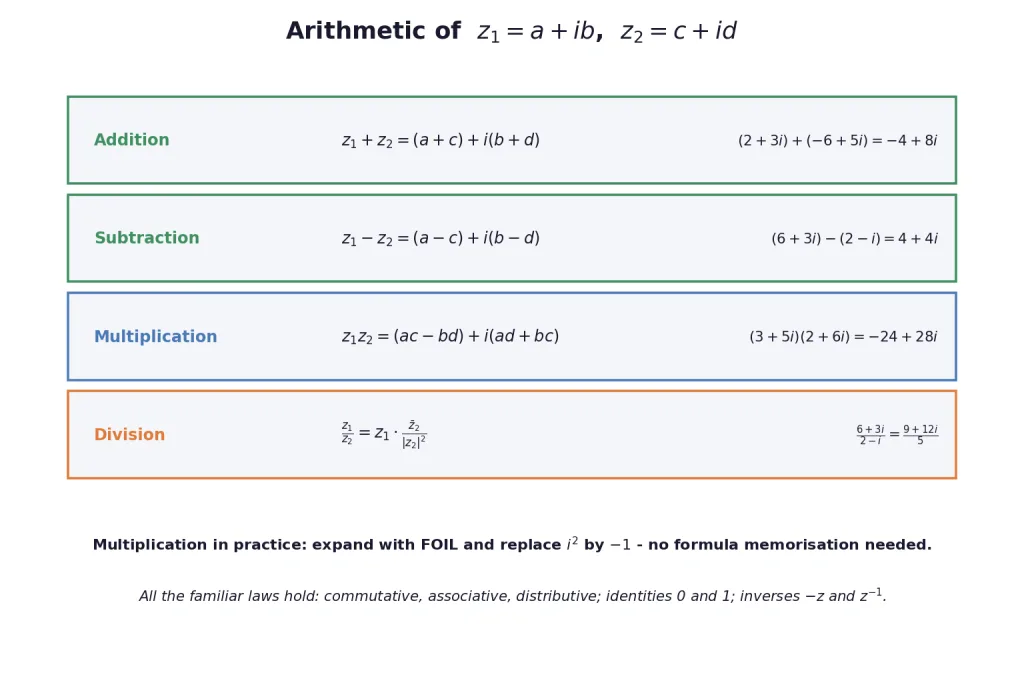
For z 1 = a + i b z_1 = a + ib z 1 = a + ib z 2 = c + i d z_2 = c + id z 2 = c + i d
z 1 + z 2 = ( a + c ) + i ( b + d ) z_1 + z_2 = (a + c) + i(b + d) z 1 + z 2 = ( a + c ) + i ( b + d )
Add real parts together, imaginary parts together. Example: ( 2 + i 3 ) + ( − 6 + i 5 ) = − 4 + i 8 (2 + i3) + (-6 + i5) = -4 + i8 ( 2 + i 3 ) + ( − 6 + i 5 ) = − 4 + i 8
Addition obeys all the familiar laws: closure (the sum is again complex), commutativity (z 1 + z 2 = z 2 + z 1 z_1 + z_2 = z_2 + z_1 z 1 + z 2 = z 2 + z 1 associativity , the additive identity 0 = 0 + i 0 0 = 0 + i0 0 = 0 + i 0 z + 0 = z z + 0 = z z + 0 = z additive inverse − z = − a + i ( − b ) -z = -a + i(-b) − z = − a + i ( − b ) z + ( − z ) = 0 z + (-z) = 0 z + ( − z ) = 0
Subtraction is addition of the inverse:
z 1 − z 2 = z 1 + ( − z 2 ) = ( a − c ) + i ( b − d ) z_1 - z_2 = z_1 + (-z_2) = (a - c) + i(b - d) z 1 − z 2 = z 1 + ( − z 2 ) = ( a − c ) + i ( b − d )
Example: ( 6 + 3 i ) − ( 2 − i ) = 4 + 4 i (6 + 3i) - (2 - i) = 4 + 4i ( 6 + 3 i ) − ( 2 − i ) = 4 + 4 i ( 2 − i ) − ( 6 + 3 i ) = − 4 − 4 i (2 - i) - (6 + 3i) = -4 - 4i ( 2 − i ) − ( 6 + 3 i ) = − 4 − 4 i
[Board Important] These property names (closure, commutative law, associative law, existence of identity/inverse) are quotable theory — one of them routinely appears as a 1-mark "state the law" question.
Multiplication and Division
Multiplication
z 1 z 2 = ( a c − b d ) + i ( a d + b c ) z_1 z_2 = (ac - bd) + i(ad + bc) z 1 z 2 = ( a c − b d ) + i ( a d + b c )
In practice, nobody memorises this — just expand with the distributive law (FOIL) and replace i 2 i^2 i 2 − 1 -1 − 1
( 3 + i 5 ) ( 2 + i 6 ) = 6 + 18 i + 10 i + 30 i 2 = 6 + 28 i − 30 = − 24 + 28 i (3 + i5)(2 + i6) = 6 + 18i + 10i + 30i^2 = 6 + 28i - 30 = -24 + 28i ( 3 + i 5 ) ( 2 + i 6 ) = 6 + 18 i + 10 i + 30 i 2 = 6 + 28 i − 30 = − 24 + 28 i
Multiplication is closed, commutative, associative, distributes over addition, has identity 1 = 1 + i 0 1 = 1 + i0 1 = 1 + i 0 multiplicative inverse :
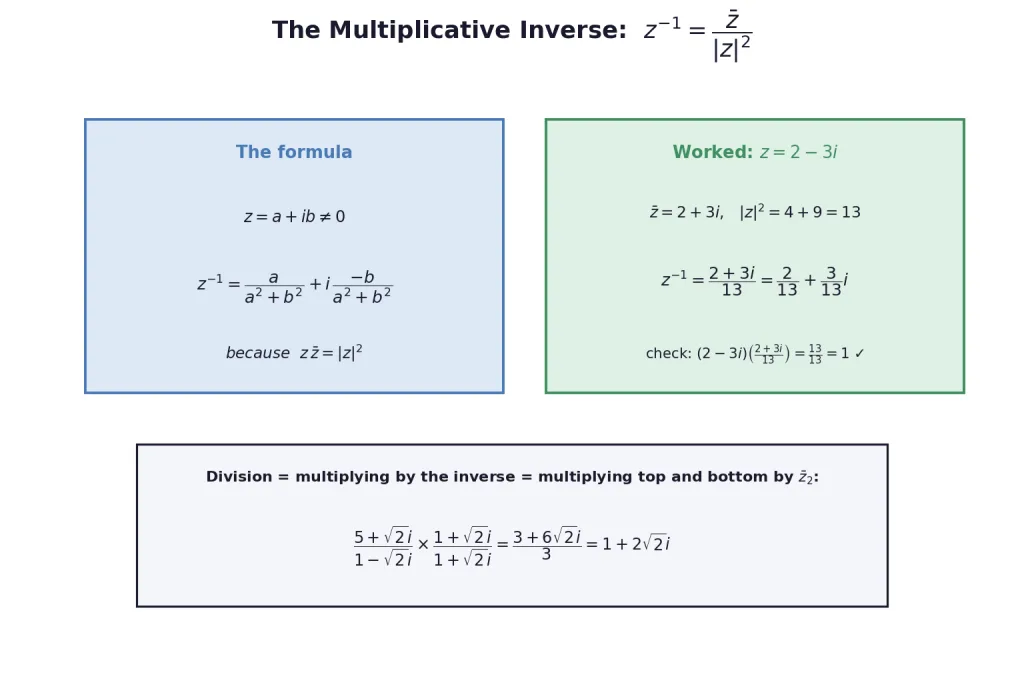
z − 1 = a a 2 + b 2 + i − b a 2 + b 2 z^{-1} = \frac{a}{a^2 + b^2} + i\,\frac{-b}{a^2 + b^2} z − 1 = a 2 + b 2 a + i a 2 + b 2 − b
(the next section will reveal this as z ˉ ∣ z ∣ 2 \frac{\bar{z}}{|z|^2} ∣ z ∣ 2 z ˉ
Division
z 1 z 2 = z 1 ⋅ 1 z 2 ( z 2 ≠ 0 ) \frac{z_1}{z_2} = z_1 \cdot \frac{1}{z_2} \qquad (z_2 \neq 0) z 2 z 1 = z 1 ⋅ z 2 1 ( z 2 = 0 )
Worked model: 6 + 3 i 2 − i = ( 6 + 3 i ) ⋅ 2 + i 5 = ( 12 − 3 ) + i ( 6 + 6 ) 5 = 9 + 12 i 5 \frac{6 + 3i}{2 - i} = (6 + 3i) \cdot \frac{2 + i}{5} = \frac{(12 - 3) + i(6 + 6)}{5} = \frac{9 + 12i}{5} 2 − i 6 + 3 i = ( 6 + 3 i ) ⋅ 5 2 + i = 5 ( 12 − 3 ) + i ( 6 + 6 ) = 5 9 + 12 i
[JEE Tip] Never divide by expanding blindly — multiply top and bottom by the conjugate of the denominator (Section 3's technique). It converts every division into one real division.
Identities — Real Algebra Survives
Because complex multiplication obeys the same laws as real multiplication, the classical identities carry over verbatim. The first follows from the distributive and commutative laws:
( z 1 + z 2 ) 2 = z 1 2 + 2 z 1 z 2 + z 2 2 (z_1 + z_2)^2 = z_1^2 + 2z_1z_2 + z_2^2 ( z 1 + z 2 ) 2 = z 1 2 + 2 z 1 z 2 + z 2 2
and lists its siblings:
( z 1 − z 2 ) 2 = z 1 2 − 2 z 1 z 2 + z 2 2 (z_1 - z_2)^2 = z_1^2 - 2z_1z_2 + z_2^2 ( z 1 − z 2 ) 2 = z 1 2 − 2 z 1 z 2 + z 2 2 ( z 1 + z 2 ) 3 = z 1 3 + 3 z 1 2 z 2 + 3 z 1 z 2 2 + z 2 3 (z_1 + z_2)^3 = z_1^3 + 3z_1^2z_2 + 3z_1z_2^2 + z_2^3 ( z 1 + z 2 ) 3 = z 1 3 + 3 z 1 2 z 2 + 3 z 1 z 2 2 + z 2 3 ( z 1 − z 2 ) 3 = z 1 3 − 3 z 1 2 z 2 + 3 z 1 z 2 2 − z 2 3 (z_1 - z_2)^3 = z_1^3 - 3z_1^2z_2 + 3z_1z_2^2 - z_2^3 ( z 1 − z 2 ) 3 = z 1 3 − 3 z 1 2 z 2 + 3 z 1 z 2 2 − z 2 3 z 1 2 − z 2 2 = ( z 1 + z 2 ) ( z 1 − z 2 ) z_1^2 - z_2^2 = (z_1 + z_2)(z_1 - z_2) z 1 2 − z 2 2 = ( z 1 + z 2 ) ( z 1 − z 2 )
In fact every polynomial identity true for all reals remains true for all complex numbers.
One new phenomenon with no real counterpart: sums of squares now FACTOR —
a 2 + b 2 = ( a + i b ) ( a − i b ) a^2 + b^2 = (a + ib)(a - ib) a 2 + b 2 = ( a + ib ) ( a − ib )
This is why x 2 + 1 = ( x + i ) ( x − i ) x^2 + 1 = (x + i)(x - i) x 2 + 1 = ( x + i ) ( x − i ) z z ˉ = ∣ z ∣ 2 z\bar{z} = |z|^2 z z ˉ = ∣ z ∣ 2
[JEE Tip] Binomial expansions of ( 1 + i ) n (1 + i)^n ( 1 + i ) n i i i ( 1 + i ) 2 = 2 i (1 + i)^2 = 2i ( 1 + i ) 2 = 2 i ( 1 + i ) 4 = − 4 (1 + i)^4 = -4 ( 1 + i ) 4 = − 4 ( 1 + i ) 8 = 16 (1 + i)^8 = 16 ( 1 + i ) 8 = 16 ( 1 ± i ) 2 = ± 2 i (1 \pm i)^2 = \pm 2i ( 1 ± i ) 2 = ± 2 i
Solved Examples
Example 1: Products with i
Express in the form a + i b a + ib a + ib ( − 5 i ) ( 1 8 i ) (-5i)\left(\frac{1}{8}i\right) ( − 5 i ) ( 8 1 i ) ( − i ) ( 2 i ) ( − 1 8 i ) 3 (-i)(2i)\left(-\frac{1}{8}i\right)^3 ( − i ) ( 2 i ) ( − 8 1 i ) 3
Solution:
Step 1 — (i) Multiply coefficients and powers of i separately. ( − 5 ) ( 1 8 ) = − 5 8 (-5)\left(\frac{1}{8}\right) = -\frac{5}{8} ( − 5 ) ( 8 1 ) = − 8 5 i ⋅ i = i 2 = − 1 i \cdot i = i^2 = -1 i ⋅ i = i 2 = − 1
Step 2 — Combine. − 5 8 ⋅ ( − 1 ) = 5 8 = 5 8 + i 0 -\frac{5}{8} \cdot (-1) = \frac{5}{8} = \frac{5}{8} + i0 − 8 5 ⋅ ( − 1 ) = 8 5 = 8 5 + i 0
Step 3 — (ii) Handle the first pair. ( − i ) ( 2 i ) = − 2 i 2 = 2 (-i)(2i) = -2i^2 = 2 ( − i ) ( 2 i ) = − 2 i 2 = 2
Step 4 — Cube the third factor. ( − 1 8 i ) 3 = − 1 512 i 3 = − 1 512 ( − i ) = 1 512 i \left(-\frac{1}{8}i\right)^3 = -\frac{1}{512}i^3 = -\frac{1}{512}(-i) = \frac{1}{512}i ( − 8 1 i ) 3 = − 512 1 i 3 = − 512 1 ( − i ) = 512 1 i
Step 5 — Multiply. 2 × 1 512 i = 1 256 i = 0 + 1 256 i 2 \times \frac{1}{512}i = \frac{1}{256}i = 0 + \frac{1}{256}i 2 × 512 1 i = 256 1 i = 0 + 256 1 i
Takeaway: Collect the numeric coefficients, then reduce the power of i separately.
Example 2: A cube
Express ( 5 − 3 i ) 3 (5 - 3i)^3 ( 5 − 3 i ) 3 a + i b a + ib a + ib
Solution:
Step 1 — Set up the binomial expansion. ( 5 − 3 i ) 3 = 5 3 − 3 ⋅ 5 2 ( 3 i ) + 3 ⋅ 5 ( 3 i ) 2 − ( 3 i ) 3 (5 - 3i)^3 = 5^3 - 3 \cdot 5^2(3i) + 3 \cdot 5(3i)^2 - (3i)^3 ( 5 − 3 i ) 3 = 5 3 − 3 ⋅ 5 2 ( 3 i ) + 3 ⋅ 5 ( 3 i ) 2 − ( 3 i ) 3
Step 2 — Evaluate the powers of 3i. ( 3 i ) 2 = 9 i 2 = − 9 (3i)^2 = 9i^2 = -9 ( 3 i ) 2 = 9 i 2 = − 9 ( 3 i ) 3 = 27 i 3 = − 27 i (3i)^3 = 27i^3 = -27i ( 3 i ) 3 = 27 i 3 = − 27 i
Step 3 — Substitute. 125 − 225 i + 15 ( − 9 ) − ( − 27 i ) = 125 − 225 i − 135 + 27 i 125 - 225i + 15(-9) - (-27i) = 125 - 225i - 135 + 27i 125 − 225 i + 15 ( − 9 ) − ( − 27 i ) = 125 − 225 i − 135 + 27 i
Step 4 — Collect. Real: 125 − 135 = − 10 125 - 135 = -10 125 − 135 = − 10 − 225 + 27 = − 198 -225 + 27 = -198 − 225 + 27 = − 198 − 10 − 198 i -10 - 198i − 10 − 198 i
Takeaway: ( 3 i ) 2 = − 9 (3i)^2 = -9 ( 3 i ) 2 = − 9 ( 3 i ) 3 = − 27 i (3i)^3 = -27i ( 3 i ) 3 = − 27 i
Example 3: Surds and i together
Express ( − 3 + − 2 ) ( 2 3 − i ) (-\sqrt{3} + \sqrt{-2})(2\sqrt{3} - i) ( − 3 + − 2 ) ( 2 3 − i ) a + i b a + ib a + ib
Solution:
Step 1 — Convert the negative radicand first. − 2 = 2 i \sqrt{-2} = \sqrt{2}i − 2 = 2 i − 3 + 2 i -\sqrt{3} + \sqrt{2}i − 3 + 2 i
Step 2 — Expand with FOIL. ( − 3 ) ( 2 3 ) + ( − 3 ) ( − i ) + ( 2 i ) ( 2 3 ) + ( 2 i ) ( − i ) = − 6 + 3 i + 2 6 i − 2 i 2 (-\sqrt{3})(2\sqrt{3}) + (-\sqrt{3})(-i) + (\sqrt{2}i)(2\sqrt{3}) + (\sqrt{2}i)(-i) = -6 + \sqrt{3}i + 2\sqrt{6}i - \sqrt{2}i^2 ( − 3 ) ( 2 3 ) + ( − 3 ) ( − i ) + ( 2 i ) ( 2 3 ) + ( 2 i ) ( − i ) = − 6 + 3 i + 2 6 i − 2 i 2
Step 3 — Replace i 2 i^2 i 2 − 2 i 2 = + 2 -\sqrt{2}i^2 = +\sqrt{2} − 2 i 2 = + 2 ( 2 − 6 ) + ( 3 + 2 6 ) i (\sqrt{2} - 6) + (\sqrt{3} + 2\sqrt{6})i ( 2 − 6 ) + ( 3 + 2 6 ) i
Takeaway: i-form first, FOIL second, collect real/imaginary last — the invariable order.
Example 4: Linear combinations
Express 3 ( 7 + i 7 ) + i ( 7 + i 7 ) 3(7 + i7) + i(7 + i7) 3 ( 7 + i 7 ) + i ( 7 + i 7 ) a + i b a + ib a + ib
Solution:
Step 1 — Expand both products. 21 + 21 i + 7 i + 7 i 2 21 + 21i + 7i + 7i^2 21 + 21 i + 7 i + 7 i 2
Step 2 — Replace i 2 i^2 i 2 21 + 28 i − 7 = 14 + 28 i 21 + 28i - 7 = 14 + 28i 21 + 28 i − 7 = 14 + 28 i
Step 3 — Cross-check by factoring. ( 3 + i ) ( 7 + 7 i ) = 7 ( 3 + i ) ( 1 + i ) = 7 ( 3 + 3 i + i − 1 ) = 7 ( 2 + 4 i ) = 14 + 28 i (3 + i)(7 + 7i) = 7(3 + i)(1 + i) = 7(3 + 3i + i - 1) = 7(2 + 4i) = 14 + 28i ( 3 + i ) ( 7 + 7 i ) = 7 ( 3 + i ) ( 1 + i ) = 7 ( 3 + 3 i + i − 1 ) = 7 ( 2 + 4 i ) = 14 + 28 i
Takeaway: Factoring the common bracket first is the slicker route — both give the same answer.
Example 5: Subtraction chain
Express ( 1 − i ) − ( − 1 + i 6 ) (1 - i) - (-1 + i6) ( 1 − i ) − ( − 1 + i 6 ) a + i b a + ib a + ib
Solution:
Step 1 — Distribute the minus over BOTH parts. ( 1 − i ) + 1 − 6 i (1 - i) + 1 - 6i ( 1 − i ) + 1 − 6 i
Step 2 — Collect. Real: 1 + 1 = 2 1 + 1 = 2 1 + 1 = 2 − 1 − 6 = − 7 -1 - 6 = -7 − 1 − 6 = − 7 2 − 7 i 2 - 7i 2 − 7 i
Takeaway: The minus flips BOTH parts of the second number.
Example 6: Fractional parts
Express ( 1 5 + i 2 5 ) − ( 4 + i 5 2 ) \left(\frac{1}{5} + i\frac{2}{5}\right) - \left(4 + i\frac{5}{2}\right) ( 5 1 + i 5 2 ) − ( 4 + i 2 5 ) a + i b a + ib a + ib
Solution:
Step 1 — Subtract the real parts. 1 5 − 4 = 1 − 20 5 = − 19 5 \frac{1}{5} - 4 = \frac{1 - 20}{5} = -\frac{19}{5} 5 1 − 4 = 5 1 − 20 = − 5 19
Step 2 — Subtract the imaginary parts. 2 5 − 5 2 = 4 − 25 10 = − 21 10 \frac{2}{5} - \frac{5}{2} = \frac{4 - 25}{10} = -\frac{21}{10} 5 2 − 2 5 = 10 4 − 25 = − 10 21
Step 3 — Assemble. − 19 5 − 21 10 i -\frac{19}{5} - \frac{21}{10}i − 5 19 − 10 21 i
Takeaway: Work each part as ordinary fraction arithmetic; the i never mixes in.
Example 7: The fourth power of (1 − i)
Express ( 1 − i ) 4 (1 - i)^4 ( 1 − i ) 4 a + i b a + ib a + ib
Solution:
Step 1 — Square once. ( 1 − i ) 2 = 1 − 2 i + i 2 = 1 − 2 i − 1 = − 2 i (1 - i)^2 = 1 - 2i + i^2 = 1 - 2i - 1 = -2i ( 1 − i ) 2 = 1 − 2 i + i 2 = 1 − 2 i − 1 = − 2 i
Step 2 — Square again. ( 1 − i ) 4 = ( − 2 i ) 2 = 4 i 2 = − 4 (1 - i)^4 = (-2i)^2 = 4i^2 = -4 ( 1 − i ) 4 = ( − 2 i ) 2 = 4 i 2 = − 4
Step 3 — Standard form. − 4 + 0 i -4 + 0i − 4 + 0 i
Takeaway: Square-then-square beats the full binomial — and ( 1 ± i ) 2 = ± 2 i (1 \pm i)^2 = \pm 2i ( 1 ± i ) 2 = ± 2 i
Example 8: A cube with fractions
Express ( 1 3 + 3 i ) 3 \left(\frac{1}{3} + 3i\right)^3 ( 3 1 + 3 i ) 3 a + i b a + ib a + ib
Solution:
Step 1 — Set up the binomial. ( 1 3 ) 3 + 3 ( 1 3 ) 2 ( 3 i ) + 3 ⋅ 1 3 ( 3 i ) 2 + ( 3 i ) 3 \left(\frac{1}{3}\right)^3 + 3\left(\frac{1}{3}\right)^2(3i) + 3 \cdot \frac{1}{3}(3i)^2 + (3i)^3 ( 3 1 ) 3 + 3 ( 3 1 ) 2 ( 3 i ) + 3 ⋅ 3 1 ( 3 i ) 2 + ( 3 i ) 3
Step 2 — Evaluate term by term. 1 27 + 3 ⋅ 1 9 ⋅ 3 i + ( 3 i ) 2 + ( 3 i ) 3 = 1 27 + i + ( − 9 ) + ( − 27 i ) \frac{1}{27} + 3 \cdot \frac{1}{9} \cdot 3i + (3i)^2 + (3i)^3 = \frac{1}{27} + i + (-9) + (-27i) 27 1 + 3 ⋅ 9 1 ⋅ 3 i + ( 3 i ) 2 + ( 3 i ) 3 = 27 1 + i + ( − 9 ) + ( − 27 i )
Step 3 — Collect. Real: 1 27 − 9 = 1 − 243 27 = − 242 27 \frac{1}{27} - 9 = \frac{1 - 243}{27} = -\frac{242}{27} 27 1 − 9 = 27 1 − 243 = − 27 242 1 − 27 = − 26 1 - 27 = -26 1 − 27 = − 26 − 242 27 − 26 i -\frac{242}{27} - 26i − 27 242 − 26 i
Takeaway: Fractions stay in the real part; keep them exact.
Example 9: Another cube
Express ( − 2 − 1 3 i ) 3 \left(-2 - \frac{1}{3}i\right)^3 ( − 2 − 3 1 i ) 3 a + i b a + ib a + ib
Solution:
Step 1 — Pull out the minus. ( − 2 − 1 3 i ) 3 = − ( 2 + 1 3 i ) 3 \left(-2 - \frac{1}{3}i\right)^3 = -\left(2 + \frac{1}{3}i\right)^3 ( − 2 − 3 1 i ) 3 = − ( 2 + 3 1 i ) 3 ( − 1 ) 3 = − 1 (-1)^3 = -1 ( − 1 ) 3 = − 1
Step 2 — Binomial on the bracket. 8 + 3 ( 4 ) i 3 + 3 ( 2 ) i 2 9 + i 3 27 = 8 + 4 i − 2 3 − i 27 8 + 3(4)\frac{i}{3} + 3(2)\frac{i^2}{9} + \frac{i^3}{27} = 8 + 4i - \frac{2}{3} - \frac{i}{27} 8 + 3 ( 4 ) 3 i + 3 ( 2 ) 9 i 2 + 27 i 3 = 8 + 4 i − 3 2 − 27 i
Step 3 — Collect the bracket. Real: 8 − 2 3 = 22 3 8 - \frac{2}{3} = \frac{22}{3} 8 − 3 2 = 3 22 4 − 1 27 = 108 − 1 27 = 107 27 4 - \frac{1}{27} = \frac{108 - 1}{27} = \frac{107}{27} 4 − 27 1 = 27 108 − 1 = 27 107 = 22 3 + 107 27 i = \frac{22}{3} + \frac{107}{27}i = 3 22 + 27 107 i
Step 4 — Negate. Answer = − 22 3 − 107 27 i = -\frac{22}{3} - \frac{107}{27}i = − 3 22 − 27 107 i
Takeaway: Pulling out ( − 1 ) 3 = − 1 (-1)^3 = -1 ( − 1 ) 3 = − 1
Example 10: Verifying an identity numerically
Verify z 1 2 − z 2 2 = ( z 1 + z 2 ) ( z 1 − z 2 ) z_1^2 - z_2^2 = (z_1 + z_2)(z_1 - z_2) z 1 2 − z 2 2 = ( z 1 + z 2 ) ( z 1 − z 2 ) z 1 = 2 + i z_1 = 2 + i z 1 = 2 + i z 2 = 1 − i z_2 = 1 - i z 2 = 1 − i
Solution:
Step 1 — Compute the left side. z 1 2 = ( 2 + i ) 2 = 4 + 4 i + i 2 = 3 + 4 i z_1^2 = (2 + i)^2 = 4 + 4i + i^2 = 3 + 4i z 1 2 = ( 2 + i ) 2 = 4 + 4 i + i 2 = 3 + 4 i z 2 2 = ( 1 − i ) 2 = − 2 i z_2^2 = (1 - i)^2 = -2i z 2 2 = ( 1 − i ) 2 = − 2 i = ( 3 + 4 i ) − ( − 2 i ) = 3 + 6 i = (3 + 4i) - (-2i) = 3 + 6i = ( 3 + 4 i ) − ( − 2 i ) = 3 + 6 i
Step 2 — Compute the right side. z 1 + z 2 = 3 + 0 i = 3 z_1 + z_2 = 3 + 0i = 3 z 1 + z 2 = 3 + 0 i = 3 z 1 − z 2 = 1 + 2 i z_1 - z_2 = 1 + 2i z 1 − z 2 = 1 + 2 i = 3 ( 1 + 2 i ) = 3 + 6 i = 3(1 + 2i) = 3 + 6i = 3 ( 1 + 2 i ) = 3 + 6 i
Step 3 — Compare. LHS = RHS ✓.
Takeaway: Identities proved abstractly can always be spot-checked with small numbers — a habit that catches expansion errors.
Example 11: Division worked in full
Express 6 + 3 i 2 − i \frac{6 + 3i}{2 - i} 2 − i 6 + 3 i a + i b a + ib a + ib
Solution:
Step 1 — Multiply top and bottom by the conjugate of the denominator. ( 6 + 3 i ) ( 2 + i ) ( 2 − i ) ( 2 + i ) \frac{(6 + 3i)(2 + i)}{(2 - i)(2 + i)} ( 2 − i ) ( 2 + i ) ( 6 + 3 i ) ( 2 + i )
Step 2 — Expand the denominator. ( 2 − i ) ( 2 + i ) = 4 − i 2 = 4 + 1 = 5 (2 - i)(2 + i) = 4 - i^2 = 4 + 1 = 5 ( 2 − i ) ( 2 + i ) = 4 − i 2 = 4 + 1 = 5
Step 3 — Expand the numerator. 12 + 6 i + 6 i + 3 i 2 = 12 + 12 i − 3 = 9 + 12 i 12 + 6i + 6i + 3i^2 = 12 + 12i - 3 = 9 + 12i 12 + 6 i + 6 i + 3 i 2 = 12 + 12 i − 3 = 9 + 12 i
Step 4 — Divide. 9 + 12 i 5 = 9 5 + 12 5 i \frac{9 + 12i}{5} = \frac{9}{5} + \frac{12}{5}i 5 9 + 12 i = 5 9 + 5 12 i
Takeaway: The denominator became 2 2 + 1 2 = 5 2^2 + 1^2 = 5 2 2 + 1 2 = 5
Example 12: Nested arithmetic
Express [ ( 1 3 + i 7 3 ) + ( 4 + i 1 3 ) ] − ( − 4 3 + i ) \left[\left(\frac{1}{3} + i\frac{7}{3}\right) + \left(4 + i\frac{1}{3}\right)\right] - \left(-\frac{4}{3} + i\right) [ ( 3 1 + i 3 7 ) + ( 4 + i 3 1 ) ] − ( − 3 4 + i ) a + i b a + ib a + ib
Solution:
Step 1 — Do the inner sum first. ( 1 3 + 4 ) + i ( 7 3 + 1 3 ) = 13 3 + 8 3 i \left(\frac{1}{3} + 4\right) + i\left(\frac{7}{3} + \frac{1}{3}\right) = \frac{13}{3} + \frac{8}{3}i ( 3 1 + 4 ) + i ( 3 7 + 3 1 ) = 3 13 + 3 8 i
Step 2 — Subtract, flipping both parts. ( 13 3 + 4 3 ) + i ( 8 3 − 1 ) \left(\frac{13}{3} + \frac{4}{3}\right) + i\left(\frac{8}{3} - 1\right) ( 3 13 + 3 4 ) + i ( 3 8 − 1 )
Step 3 — Collect. 17 3 + 5 3 i \frac{17}{3} + \frac{5}{3}i 3 17 + 3 5 i
Takeaway: Brackets first, one operation at a time; the parts never interact.
Example 13: Powers via (1 + i)² = 2i
Evaluate ( 1 + i 1 − i ) 3 \left(\frac{1 + i}{1 - i}\right)^{3} ( 1 − i 1 + i ) 3 ( 1 + i ) 6 (1 + i)^6 ( 1 + i ) 6
Solution:
Step 1 — Simplify the base. 1 + i 1 − i × 1 + i 1 + i = ( 1 + i ) 2 1 + 1 = 2 i 2 = i \frac{1 + i}{1 - i} \times \frac{1 + i}{1 + i} = \frac{(1 + i)^2}{1 + 1} = \frac{2i}{2} = i 1 − i 1 + i × 1 + i 1 + i = 1 + 1 ( 1 + i ) 2 = 2 2 i = i
Step 2 — Cube. i 3 = − i i^3 = -i i 3 = − i
Step 3 — Second part: nest the square. ( 1 + i ) 6 = [ ( 1 + i ) 2 ] 3 = ( 2 i ) 3 = 8 i 3 = − 8 i (1 + i)^6 = \left[(1 + i)^2\right]^3 = (2i)^3 = 8i^3 = -8i ( 1 + i ) 6 = [ ( 1 + i ) 2 ] 3 = ( 2 i ) 3 = 8 i 3 = − 8 i
Takeaway: 1 + i 1 − i = i \frac{1+i}{1-i} = i 1 − i 1 + i = i 1 − i 1 + i = − i \frac{1-i}{1+i} = -i 1 + i 1 − i = − i
Example 14: Real and imaginary parts of a product
For any two complex numbers, prove that Re(z 1 z 2 z_1 z_2 z 1 z 2 z 1 z_1 z 1 z 2 z_2 z 2 − - − z 1 z_1 z 1 z 2 z_2 z 2
Solution:
Step 1 — Name the parts. z 1 = a + i b z_1 = a + ib z 1 = a + ib z 2 = c + i d z_2 = c + id z 2 = c + i d z 1 z_1 z 1 z 1 z_1 z 1 z 2 z_2 z 2 z 2 z_2 z 2
Step 2 — Multiply. z 1 z 2 = ( a c − b d ) + i ( a d + b c ) z_1 z_2 = (ac - bd) + i(ad + bc) z 1 z 2 = ( a c − b d ) + i ( a d + b c )
Step 3 — Read off the real part. Re(z 1 z 2 z_1z_2 z 1 z 2 a c − b d ac - bd a c − b d z 1 z_1 z 1 z 2 z_2 z 2 − - − z 1 z_1 z 1 z 2 z_2 z 2
Takeaway: The product formula IS the proof; write it and point.