
Why Invent New Numbers?
The equation demands a number whose square is . No real number qualifies — squares of reals are never negative. Faced with this, mathematics does what it has always done: build a bigger number system. Naturals grew into integers (to solve ), integers into rationals (to solve ), rationals into reals (to solve ) — and now reals grow into complex numbers, where finally has roots.
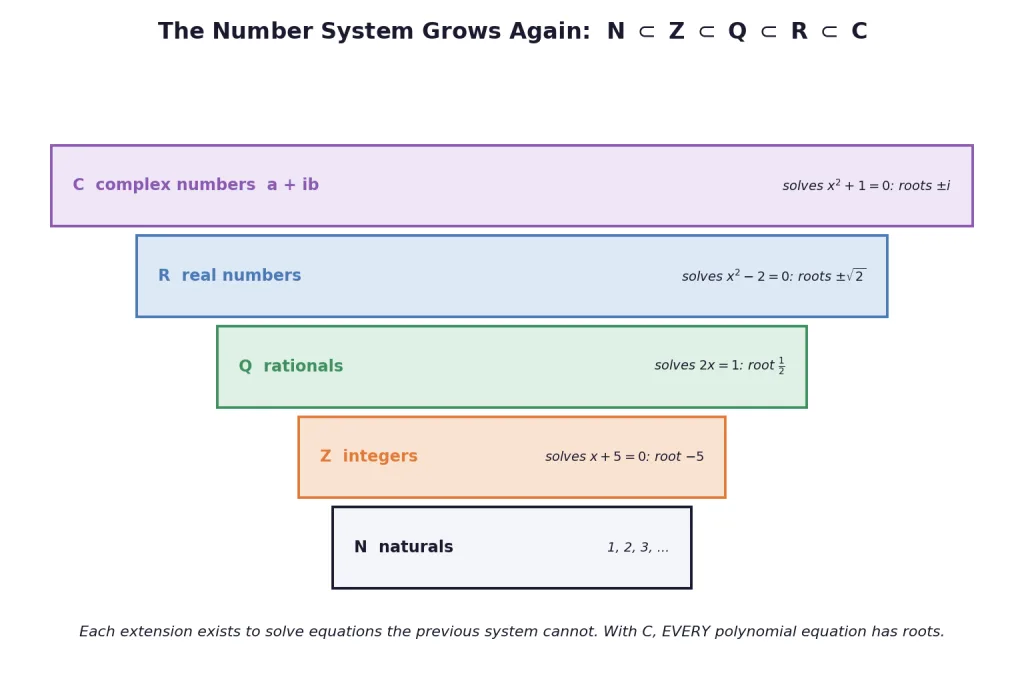
Key Point (Definition): Denote by the symbol i, so that . A number of the form , where a and b are real, is a complex number. For : a is the real part (Re z) and b is the imaginary part (Im z).
Examples: , , . For : Re z = 2 and Im z = 5. Every real number is a complex number with imaginary part 0 (e.g. ), and numbers like are called purely imaginary.
Equality of complex numbers
exactly when AND — real parts match and imaginary parts match. One complex equation therefore packs TWO real equations, a fact used constantly to solve for unknowns.
[Board Important] In this chapter the roadmap is: definition and powers of i (this section) → arithmetic (Section 2) → modulus and conjugate (Section 3) → the Argand plane (Section 4). JEE extras (polar form, quadratic equations, cube roots of unity) live in the JEE Corner.
The Powers of i — a Four-Cycle
Multiplying by i over and over produces a repeating wheel:
and then it repeats: , , and so on. Negative powers run the wheel backwards: , , , .
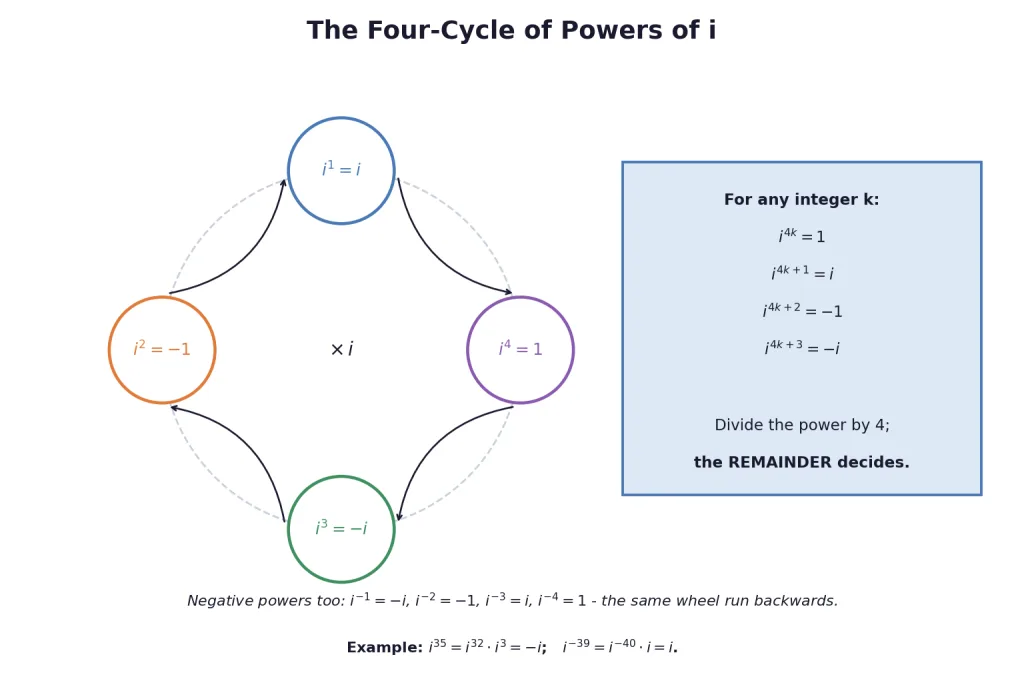
Key Point: For any integer k: , , , . To evaluate any power of i, divide the exponent by 4 — the remainder decides everything.
Worked instances: ; ; .
[JEE Tip] For big negative exponents, add a convenient multiple of 4 instead of dividing: . Multiplying by is always free.
Square Roots of Negative Real Numbers
Since and , the square roots of are and . By convention, the symbol means i only. More generally, for a positive real a:
So and (while the equation has BOTH solutions ).
The trap
The familiar rule holds when at least one of a, b is non-negative — but FAILS when both are negative. The famous contradiction if we ignore this:
The step marked ? is illegal. Correct procedure: convert each root to form FIRST, then multiply: .
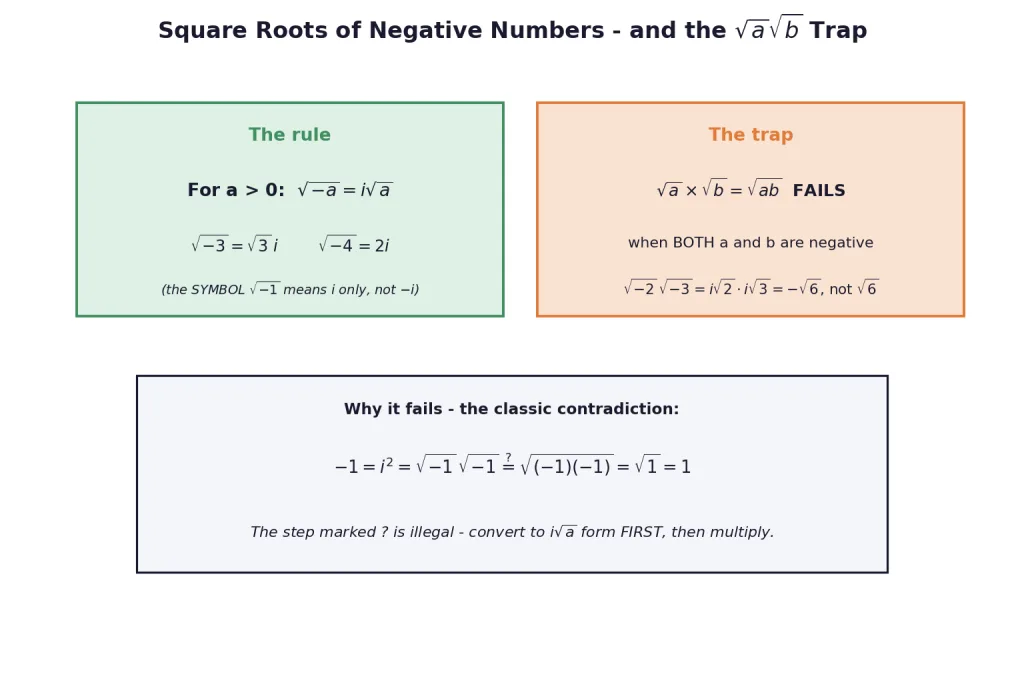
[JEE Tip] This trap is a direct MCQ generator: " = ?" Answer: , NOT +12. Convert to i-form before every multiplication involving two negative radicands.
Solved Examples
Example 1: Equality of complex numbers
If , where x and y are real numbers, find x and y.
Solution:
Step 1 — Equate the real parts. , so .
Step 2 — Equate the imaginary parts. .
Step 3 — Substitute x and solve for y. .
Step 4 — Check. ✓ and ✓.
Final Answer: , .
Takeaway: One complex equation = two real equations. Split and solve simultaneously.
Example 2: Identifying parts
Write the real and imaginary parts of: (i) (ii) (iii) (iv) .
Solution:
Step 1 — (i) Read off directly. Re z = , Im z = 2.
Step 2 — (ii) Write in standard form. : Re z = 0, Im z = — purely imaginary.
Step 3 — (iii) Standard form again. : Re z = 5, Im z = 0 — a real number.
Step 4 — (iv) Split the fraction. : Re z = , Im z = .
Takeaway: Im z is the COEFFICIENT of i — a real number, never including the i itself.
Example 3: Powers of i, the remainder method
Evaluate: (i) (ii) (iii) (iv) .
Solution:
Step 1 — (i) Divide the exponent by 4. , remainder 3: .
Step 2 — (ii) Same method. , remainder 2: .
Step 3 — (iii) Negative exponent: add a multiple of 4. (multiplying by is free).
Step 4 — (iv) One more remainder. : .
Takeaway: Remainder 0, 1, 2, 3 ↔ value 1, i, , . Nothing else to memorise.
Example 4: A sum of powers
Express in the form .
Solution:
Step 1 — Reduce each power by its remainder. gives ; and gives .
Step 2 — Add. .
Step 3 — Standard form. .
Takeaway: Powers whose remainders are 1 and 3 cancel in pairs.
Example 5: i to a negative power
Express in the form .
Solution:
Step 1 — Multiply by a free factor of 1. , so .
Step 2 — Standard form. .
Takeaway: The add-a-multiple-of-4 move beats computing reciprocals every time.
Example 6: Products with roots of negatives
Evaluate: (i) (ii) (iii) .
Solution:
Step 1 — (i) Convert each radical to i-form, then add. and : .
Step 2 — (ii) Convert BEFORE multiplying. — not +6; the rule fails for two negative radicands.
Step 3 — (iii) Square the i-form. .
Takeaway: Every negative radicand becomes before any other algebra happens.
Example 7: The i-cycle in an expression
Evaluate .
Solution:
Step 1 — Reduce the first term. : .
Step 2 — Reduce the second term. .
Step 3 — Set up the cube. The bracket is , so the cube is .
Step 4 — Expand with the binomial identity. .
Step 5 — Attach the minus. .
Final Answer: .
Takeaway: Reduce every power first, then expand the small cube with the binomial identity.
Example 8: Solving with equality
Find real x, y if .
Solution:
Step 1 — Split into two real equations. and .
Step 2 — Add the equations. , so .
Step 3 — Back-substitute. .
Step 4 — Check. ✓.
Takeaway: Complex equality hands you a friendly linear system.
Example 9: An equation forcing complex roots
Solve over the complex numbers.
Solution:
Step 1 — Isolate the square. .
Step 2 — Take both square roots. .
Step 3 — Check one root. ✓.
Takeaway: Equations dead in come alive in — and roots arrive in pairs.
Example 10: Sum of four consecutive powers
Show that for every integer n.
Solution:
Step 1 — Factor out the smallest power. .
Step 2 — Evaluate the bracket. .
Step 3 — Conclude. Anything times 0 is 0, for every n. ∎
Takeaway: Any four consecutive powers of i cancel — the tool for monster sums like (group in fours; the leftover terms decide).
Example 11: A long power sum
Evaluate .
Solution:
Step 1 — Group in blocks of four. Terms through form 25 complete blocks of four consecutive powers — each block sums to 0.
Step 2 — Handle the leftovers. Only and remain: gives ; gives .
Step 3 — Add. .
Final Answer: .
Takeaway: Long geometric strings of i collapse to at most three leftover terms.
Example 12: Purely real or purely imaginary?
For what real values of x is (i) purely imaginary? (ii) real?
Solution:
Step 1 — (i) Write both conditions. Purely imaginary needs Re z = 0 AND Im z 0.
Step 2 — Solve the real-part condition. gives .
Step 3 — Test each against the imaginary-part condition. At x = 2: Im z = 0 — rejected (z = 0 is not purely imaginary). At x = : Im z = ✓. So x = .
Step 4 — (ii) Real needs Im z = 0. : x = 2 (then z = 0, which counts as real).
Takeaway: "Purely imaginary" has TWO conditions — zero real part AND non-zero imaginary part. Check both.